


Opening View
Nigeria’s post-MPC market is no longer simply a story about falling interest rates. The more important development is how aggressively the Central Bank of Nigeria is controlling the quantity of money available.
The CBN allotted approximately ₦17.51 trillion of Open Market Operation bills in September while repaying ₦10.89 trillion of maturities. That produced an estimated net liquidity withdrawal of ₦6.62 trillion. At the final September auction, the Bank allotted ₦4.69 trillion against an initial ₦2.50 trillion offer, even as stop rates declined across the available tenors.
This is the tension investors must understand this week: the price of short-term money is falling, but the supply of investable cash is still being actively constrained. The CBN is easing through its policy-rate signal while tightening through the size of its balance-sheet operations.
That matters beyond banks. With individuals, companies and non-bank institutions now eligible to access OMO securities through deposit money banks, central-bank paper competes more directly with deposits, money-market funds, corporate treasury balances and equities.
Globally, weak US hiring has reduced the probability of another immediate Federal Reserve increase. Yet the US 10-year yield finished Friday above 5.2%, showing that slower growth has not eliminated inflation, oil or fiscal-risk premiums.
The Big Picture:
The Nigerian market is developing two distinct interest-rate signals.
The first is the 23% Monetary Policy Rate, which the CBN lowered by 350 basis points in September. The second is the actual combination of OMO stop rates, auction volumes and overnight funding conditions.
At the September 29 OMO auction, investors submitted approximately ₦6.40 trillion of bids and received ₦4.69 trillion of allotments. Stop rates declined to 17.24% on the 147-day bill, 16.94% on the 182-day bill and 16.23% on the new 266-day instrument.
Falling rates suggest investors expect further yield compression. The exceptionally large allotment, however, shows that the CBN remains willing to withdraw substantially more liquidity than its initial auction announcement indicated.
That combination is not conventional easing. It is easing in price but tightening in quantity.
For asset allocators, the result is a higher bar for risk-taking. Equities must compete with accessible, short-dated central-bank paper. Banks may face greater pressure to price large deposits competitively. Companies must decide whether surplus cash should fund inventories and expansion or earn double-digit returns in liquid securities.
Nigeria Market Intelligence
OMO demand is becoming the clearest measure of investor positioning
What happened: September’s final auction drew ₦6.40 trillion of subscriptions, with demand concentrated in longer-dated paper. The CBN allotted nearly ₦4.69 trillion, substantially above the ₦2.50 trillion initially offered.
Why it matters: Investors are trying to lock in yields before further compression. At the same time, the CBN is extending maturities and pushing more repayments into 2027, reducing the volume of cash likely to return quickly to the system.
What to watch: Any new OMO auction announcement, its final allotment relative to the initial offer, and whether secondary-market yields continue falling after such a large September withdrawal.
The NGX is demanding greater valuation discipline
What happened: The NGX All-Share Index declined 0.52% last week to 250,808.27 points. Market capitalisation closed at approximately ₦162.84 trillion, while weekly equity turnover fell to ₦155.02 billion from ₦240.82 billion.
Why it matters: The market remains up 61.17% year to date, but weaker turnover and a weekly decline near elevated index levels suggest that investors are becoming more selective. Accessible OMO paper strengthens the alternative available to investors unwilling to accept equity volatility.
What to watch: Market breadth, turnover in FTSE-eligible shares and whether upcoming corporate disclosures validate current valuations. Cash-flow conversion and dividend capacity should matter more than headline revenue growth.
Naira stability remains an important policy advantage
What happened: The official NFEM rate closed last week around ₦1,330.10 per US dollar, while the reported parallel-market rate strengthened to approximately ₦1,360. The premium narrowed to about 2.32%.
Why it matters: A small market premium reduces immediate incentives for speculative FX demand and gives the CBN more room to manage domestic liquidity. Stronger reserves also provide an external buffer, although that buffer should not be treated as unlimited.
What to watch: NFEM turnover, rather than the closing rate alone. Stable prices supported by weak trading volumes would provide less comfort than stability accompanied by consistently available dollar liquidity.
Corporate cash now faces a more difficult allocation decision
Broader access to OMO securities means corporate treasurers can compare working-capital investment directly against short-dated central-bank yields. That could slow discretionary expansion among companies without compelling returns on capital.
For banks, the effect is more nuanced. Strong OMO demand can support trading and investment income, but attractive securities may also force banks to defend large deposits more aggressively. The best-positioned lenders will be those capable of growing productive credit without sacrificing funding discipline.
Global Market Intelligence:
Weak US hiring has not produced a decisive bond rally
US nonfarm payrolls increased by only 29,000 in September, while the unemployment rate held at 4.2%. July and August payroll growth was revised lower by a combined 60,000.
US equities responded positively on Friday, with the S&P 500 gaining 0.7% and the Nasdaq rising 1.2%. However, the 10-year Treasury yield finished around 5.28% after initially falling following the report.
The message is important for Nigeria: weaker US employment may reduce the risk of another immediate Fed increase, but frontier-market capital will not become materially cheaper while long-term Treasury yields remain above 5%.
Fed minutes must explain the gap between jobs and yields
The minutes of the Federal Reserve’s September meeting are due Wednesday. Investors will look for evidence of how concerned policymakers were about persistent inflation when they raised rates, and what would justify another increase.
The key risk is that the minutes reveal greater sensitivity to services inflation and oil prices than markets currently assume. That would keep the dollar and global yields firm even as US employment slows.
Oil supply policy remains supportive of prices
Seven OPEC+ producers agreed on Sunday to keep November production targets unchanged. Brent remains above US$100 amid supply disruptions and geopolitical risk.
For Nigeria, elevated Brent supports export receipts, fiscal expectations and the external-reserve outlook. But expensive energy also raises global inflation and transport costs, increasing the risk that major central banks keep policy restrictive.
The result is a two-sided Nigerian exposure: better dollar earnings, but a higher global discount rate and renewed domestic cost pressure.
Asset Class Implications:
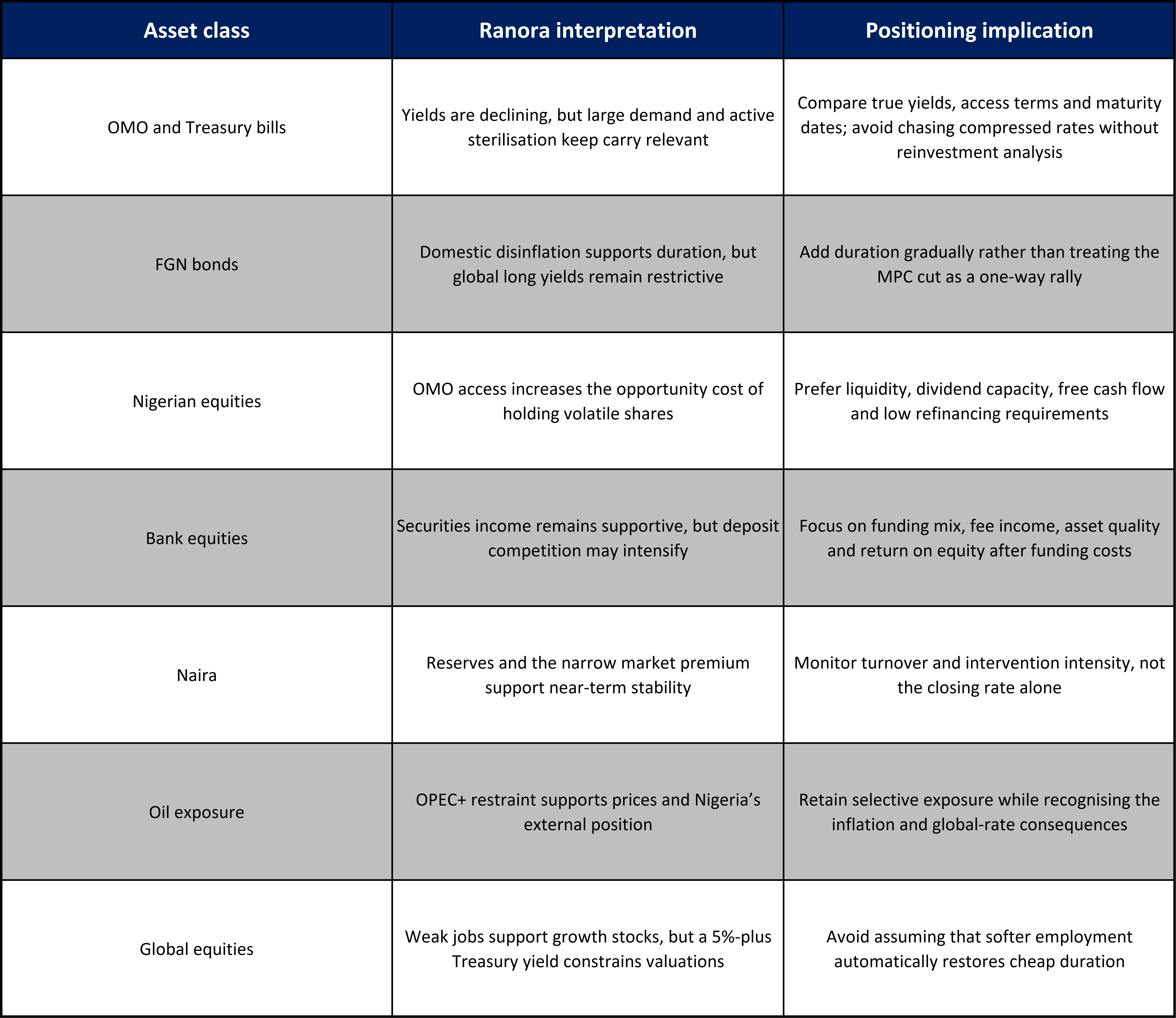
Ranora View:
September’s OMO data show that the CBN has changed the mechanics of Nigeria’s rate-cut trade.
The policy rate may be lower, but liquidity is not being left to expand freely. Instead, the CBN is allowing short-term yields to compress while using larger OMO allotments to control the volume and maturity of cash in the system. Broader access also makes OMO paper a direct competitor for deposits, fund assets, corporate cash and equities.
This supports a barbell approach. Short-dated naira carry can remain the portfolio anchor, while selective duration offers upside if inflation continues to moderate. Equity exposure should concentrate on companies with strong free cash flow, manageable refinancing needs and earnings yields capable of compensating investors for moving out of liquid central-bank paper.
Globally, weak US hiring is helpful but insufficient. Until long-term Treasury yields fall sustainably, Nigerian assets must continue to offer a convincing combination of carry, earnings growth and FX stability to attract incremental capital.
What to Watch Next:
US services data, Monday: September’s ISM Services report will show whether weaker hiring reflects softer demand or continued reluctance to recruit amid high input costs.
FOMC minutes, Wednesday: Watch for the threshold for another rate increase and the Fed’s treatment of oil-driven inflation.
CBN liquidity operations: The size of any fresh OMO allotment will matter more than the initial offer.
NGX breadth and turnover: A credible rebound should extend beyond a small group of liquid or speculative names.
US consumer sentiment, Friday: Inflation expectations will be particularly important with oil above US$100.
NFEM turnover: Persistent naira stability needs to be supported by sufficient dollar liquidity.
Question of the day:
If OMO securities remain accessible at attractive yields, what return should Nigerian equities now offer to justify taking additional earnings and market risk?
Stay smart. Stay informed. Subscribe to Ranora Market Outlook for free and support independent market analysis.