


Opening View
Opening View:
Nigeria’s equity market enters the week with momentum, but the more important story is the coming competition for capital. The NGX All-Share Index gained 2.36% last week, while turnover rose to ₦210.33 billion. At the same time, ten Nigerian companies were provisionally identified as newly eligible large-cap constituents in FTSE Russell’s Frontier Index Series, ahead of Nigeria’s reclassification on 21 September.
That should direct attention toward liquid names such as GTCO, Zenith Bank, MTN Nigeria, Dangote Cement and Aradel Holdings. But the market is also preparing for the Dangote Refinery IPO: 4.1 billion shares at ₦525 each, implying potential proceeds of approximately ₦2.15 trillion.
The contrast matters. The proposed offer is roughly ten times the value traded across the entire NGX last week. This is not a direct like-for-like comparison, but it illustrates the scale of the absorption challenge. Unless the IPO attracts substantial new foreign and domestic capital, investors may need to sell existing equities, redeem money-market positions or postpone other allocations to participate.
The headline index could therefore rise while liquidity and performance become increasingly concentrated. This week is less about chasing the market and more about identifying where capital is coming from, where it is going and which assets may be sold to fund the shift.
The Big Picture:
Nigeria is approaching two important capital-market events. FTSE’s constituent process is directing benchmark-sensitive demand toward a relatively small group of liquid companies, while the Dangote Refinery IPO could create a new equity asset valued far above the size of most existing NGX companies.
These developments should deepen the market over time. In the near term, however, they could divide it into three groups: FTSE-eligible stocks receiving index-related attention, existing companies used as sources of liquidity, and the new refinery offering competing for large institutional allocations.
The sharper interpretation is that Nigeria does not yet have one broad equity rally. It has several overlapping capital-allocation trades. Index inclusion, IPO participation and a one-year Treasury bill yielding 16.84% are all competing for the same marginal naira. Investors should expect dispersion rather than assume every listed company will benefit from Nigeria’s improved international visibility.
Nigeria Market Intelligence
The Dangote Refinery IPO becomes a market-liquidity event
What happened: Nigeria’s Securities and Exchange Commission approved the proposed sale of 4.1 billion Dangote Refinery shares at ₦525 each. Full subscription would raise about ₦2.15 trillion. The order book is expected to open on 14 September, although the final offer timetable should be confirmed in the published offer documents.
Why it matters: The proposed raise equals approximately 1.35% of last week’s total NGX market capitalisation, but more than ten times the week’s equity turnover by value. Large domestic institutions may have to rebalance portfolios to participate.
What to watch: The final prospectus, valuation assumptions, free float, allocation rules, dividend policy, use of proceeds and evidence of cornerstone foreign demand.
FTSE demand may narrow market leadership
What happened: FTSE’s September review identified ten newly eligible Nigerian large-cap stocks: Aradel Holdings, Dangote Cement, FirstHoldCo, GTCO, MTN Nigeria, Nestlé Nigeria, Nigerian Breweries, Presco, Stanbic IBTC Holdings and Zenith Bank. As of Monday morning, the changes were due to be finalised after the 7 September review deadline.
Why it matters: Benchmark-linked investors will focus on eligible securities, their weights, free float and tradability. That creates a liquidity premium for selected names rather than an automatic rerating of the whole market.
What to watch: Final constituent confirmation, index weights, trading volumes and whether price gains broaden beyond eligible companies.
Domestic liquidity is ample, but it is not cheap
What happened: System liquidity increased to ₦4.66 trillion last week. Nevertheless, overnight and open-repo rates ended at 22.13% and 22.00%. The 2 September Treasury-bill auction attracted ₦3.35 trillion of subscriptions, with ₦3.24 trillion directed toward the 364-day bill. Its stop rate declined by 31 basis points to 16.84%.
Why it matters: There is cash in the financial system, but investors continue to demand substantial compensation for deploying it. The concentration of bids at one year also shows that institutions expect some rate moderation without wanting excessive duration.
What to watch next: Whether IPO preparations trigger money-market redemptions, whether the CBN sterilises excess liquidity, and whether secondary-market bill yields decline further.
Naira stability remains part of the investability test
What happened: The official NFEM rate ended last week at approximately ₦1,321.22 per dollar, an appreciation over the week.
Why it matters: Foreign participation in both FTSE-linked stocks and the refinery IPO depends on more than expected returns. Investors must also be confident that FX can be obtained and proceeds repatriated without material delay.
What to watch: NFEM turnover, the gap with the parallel market and whether larger equity-related inflows produce durable FX liquidity rather than a temporary improvement.
Global Market Intelligence:
US inflation has become the week’s main global risk event
What happened: US payrolls increased by 162,000 in August, while unemployment remained at 4.1%. The stronger-than-expected report pushed the two-year Treasury yield to 4.37% and the ten-year yield to 4.78%.
Why it matters: A resilient labour market gives the Federal Reserve more room to respond to inflation. Higher US yields raise the return hurdle for frontier assets and could limit the foreign demand Nigeria expects from FTSE reclassification.
What to watch: US producer inflation on Thursday and consumer inflation on Friday. A hot CPI report would increase the risk of further tightening and strengthen competition from dollar assets.
The ECB decision will test the global tightening narrative
What happened: The European Central Bank will announce its monetary-policy decision on Thursday, alongside updated macroeconomic projections.
Why it matters: A more restrictive European outlook would reinforce the rise in global yields and reduce the relative appeal of emerging and frontier-market debt. It could also strengthen the euro against the dollar, affecting broader currency positioning.
What to watch: The ECB’s inflation projections, guidance on further tightening and the bond-market response.
Oil is helping Nigeria’s external account while raising its inflation risks
What happened: Brent crude settled at $96.28 a barrel on Friday, gaining 7.6% over the week as renewed US-Iran hostilities and impaired Middle East supply routes restored a geopolitical premium.
Why it matters: Higher oil prices can support Nigerian export receipts and fiscal revenue. But sustained prices near current levels could also raise transport and production costs, complicate global inflation and keep international interest rates elevated.
What to watch: Developments around the Strait of Hormuz and the US Energy Information Administration’s updated outlook on Wednesday.
Asset Class Implications:
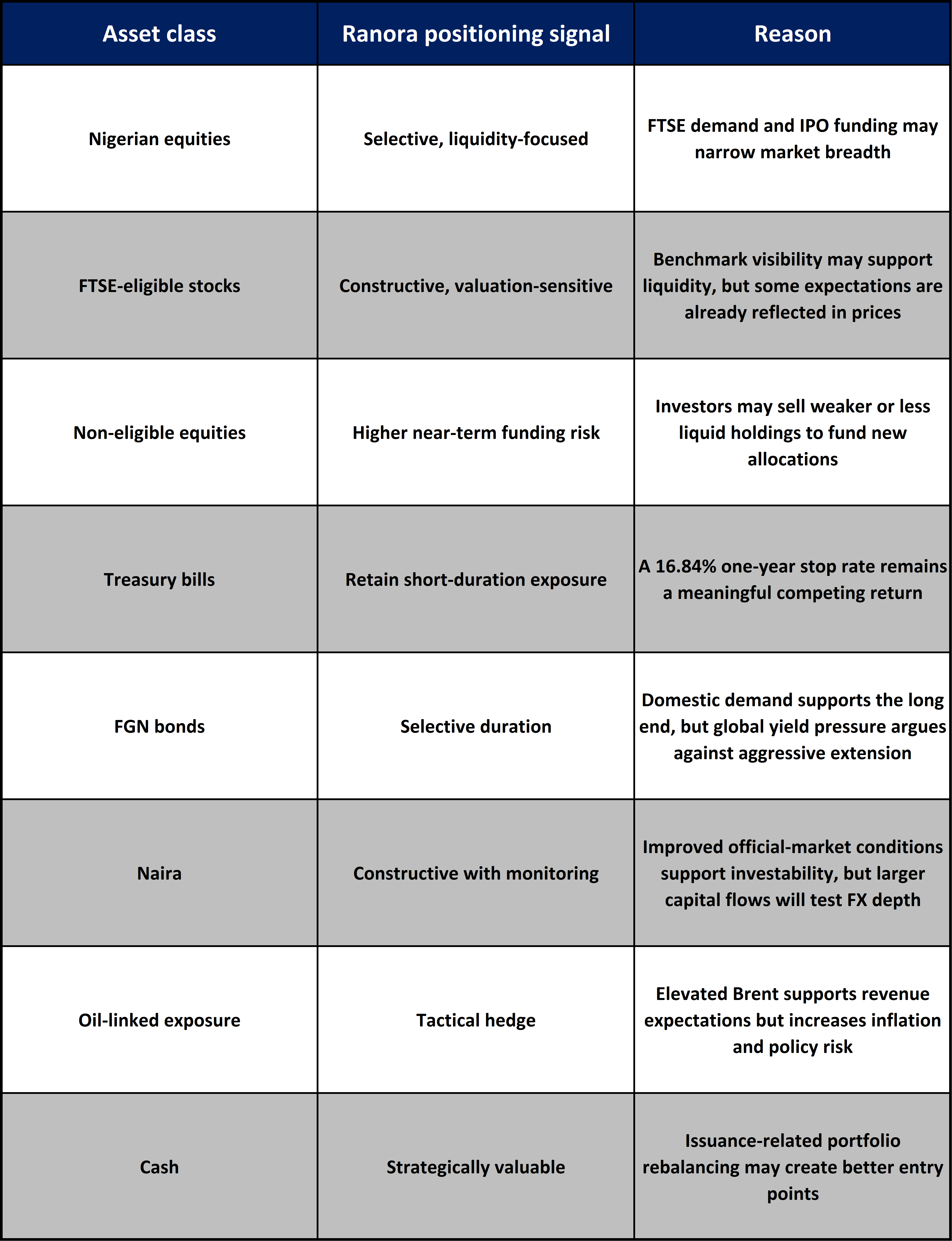
Ranora View:
The Dangote Refinery IPO should not be treated only as a new listing. It is a test of whether Nigeria can expand its investable equity universe without draining liquidity from existing securities.
Our preferred stance is to preserve optionality. FTSE-eligible companies with strong earnings, meaningful free float and reliable liquidity should command attention, but index inclusion alone is not sufficient justification for buying at any valuation. Short-duration fixed income remains useful as a portfolio anchor, while cash should be available for price dislocations created by IPO funding.
The bullish outcome would be substantial new foreign and domestic capital entering both the IPO and existing equities. The weaker outcome would be a successful offer funded mainly by selling other NGX positions. Market breadth, turnover and FX activity will show which scenario is developing before the headline index does.
What to Watch Next:
FTSE’s final Nigerian constituents and their published index weights.
Dangote Refinery’s final prospectus, offer timetable and institutional commitments.
Trading breadth and volumes outside the FTSE-eligible group.
The EIA oil outlook on Wednesday and the ECB decision on Thursday.
US CPI on Friday and its effect on Treasury yields, the dollar and frontier-market appetite.
Question of the day:
Will the Dangote Refinery IPO bring meaningful new capital into Nigeria’s market, or will investors have to sell existing equities and fixed-income positions to fund it?
Stay smart. Stay informed. Subscribe to Ranora Market Outlook for free and support independent market analysis.