


Opening View
Monday opens with a warning for Nigerian margin forecasts: low inflation in a supplier economy does not necessarily mean a cheaper next shipment.
China’s October consumer inflation slowed to 0.7% year on year from 0.9%, while factory-gate inflation accelerated to 5.7% from 5.0%. For Nigerian businesses buying Chinese inputs, equipment or finished goods, that divergence matters more than the comforting consumer-price headline.
The transmission is practical. If a supplier raises its invoice price, an importer needs more cash to replenish the same quantity of stock, even with an unchanged exchange rate. Financing that inventory can absorb part of the margin improvement shareholders expect. A better sales outlook does not automatically solve the cash requirement.
But a blanket imported-cost shock would be the wrong conclusion too. China’s monthly factory-price increase slowed, and energy-related industries accounted for most of it. Product mix, supplier competition and contract terms will determine what reaches Nigerian buyers.
This week, the useful question is whether expected earnings improvement survives the cost of replacing inventory and financing it. Nigeria’s recent equity decline, unchanged Treasury-bill auction rates and the coming US inflation releases make that a more demanding test than simply finding stronger revenue growth.
The Big Picture:
The distinction is between the cost already recorded and the cost of doing business again. A company can earn a healthy margin on existing inventory yet need substantially more funding for its next order. Conversely, a supplier facing weak demand may absorb higher costs rather than pass them on. Neither outcome can be read directly from an aggregate inflation index.
The Nigerian connection is substantial: reported trade figures put China at roughly 39% of Nigeria’s goods import value in the first half of 2026. That is historical exposure, not a measure of today’s supplier prices.
For investors, the analytical bridge runs from product-level purchase prices to landed costs, inventory funding and sustainable earnings. For businesses, procurement budgets and expansion plans need the same bridge. Exchange-rate movements, freight, duties and payment terms can reinforce or offset the supplier-price effect.
Nigeria Market Intelligence
Equities enter the week with a higher burden of proof
The NGX All-Share Index ended 6 November at 248,877.22 points, down 2.13% over the week. Industrial Goods fell 4.35% and Banking lost 2.45%. This is evidence of repricing, not proof that earnings have deteriorated or that shares are now cheap. The next useful signals are broader market participation and company disclosures that explain margins after replacement costs and financing expenses.
Sovereign rates do not describe every company's funding cost
The 4 November Treasury-bill auction left the 91-day, 182-day and 364-day stop discount rates unchanged at 15.40%, 15.79% and 15.80%. These are auction discount rates, not annualised investment yields. FMDQ's overnight money-market reference was 20.20% on 6 November. Neither measure is a corporate loan quote. Businesses carrying larger inventory balances still need to establish their own borrowing cost, collateral requirements and available credit before assuming funding relief
The external borrowing request is an execution question
On 4 November, the president requested approval for about US$7.7 billion in external borrowing, replacing an earlier proposal. Reported funding options include Eurobonds, with final market terms dependent on pricing. A request is not evidence of dollars received or contractors paid. Financing could support budget execution, but its cost, timing and use will determine the benefit. Watch for financing terms and actual disbursement rather than infer fiscal consolidation from differently scoped borrowing headlines.
Global Market Intelligence:
China's detail argues against a uniform cost forecast
October producer prices for consumer goods fell 0.1% year on year even as the overall factory-gate index rose. The official breakdown also attributes more than four-fifths of the monthly aggregate increase to six energy-related industries. Nigeria’s exposure therefore depends on what a business buys, not merely where it buys it. The next evidence to seek is a change in relevant supplier quotations, not an assumed one-for-one increase in import prices.
US inflation will test the dollar-funding outlook
October US payrolls increased by 165,000 and unemployment was 4.1%, according to Friday’s release. Consumer inflation follows on Tuesday and producer inflation on Friday. Persistent price pressure would complicate the case for easier US financial conditions. For Nigeria, that matters through sovereign and corporate dollar funding, the return foreign investors require and the cost of servicing unhedged dollar liabilities. The employment report alone does not establish the next Federal Reserve decision.
An equity rebound is not yet relief for business costs
Early Monday reports showed Asian shares and US equity futures recovering after last week’s technology selling; those are intraday observations, not closing results. January Brent settled at US$98.32 a barrel on Friday. A sustained fall in delivered energy costs could help Nigerian transport and production margins, but lower crude prices can also reduce export receipts. Equity sentiment, crude benchmarks and the energy bill paid by a Nigerian company are separate signals.
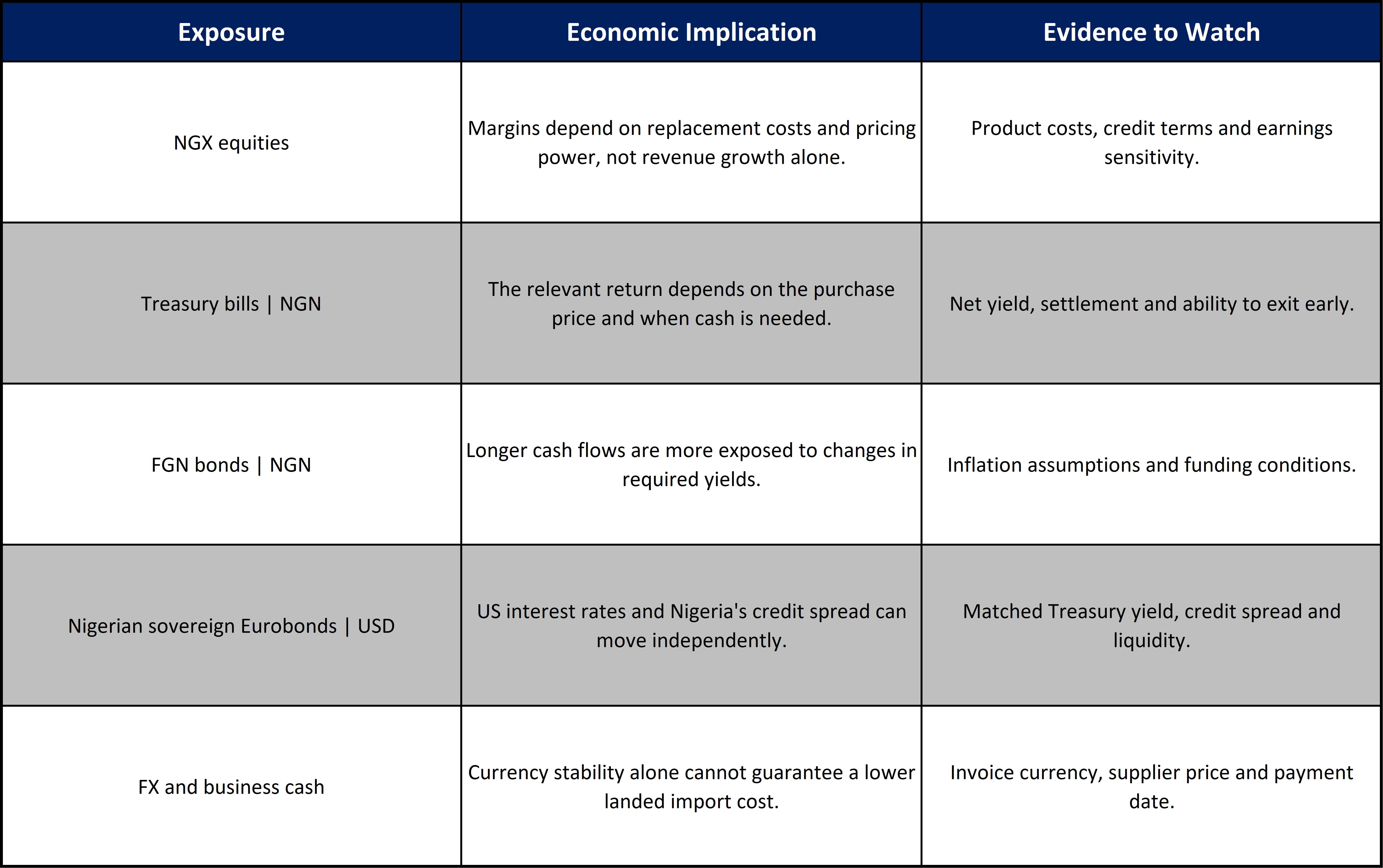
Asset Class Implications:
How the macro backdrop transmits into portfolios and business cash needs.
Investment Ideas for the Week:
No new entry qualifies this Monday. This is a decision not to issue a fresh recommendation, not a prediction that Nigerian assets must fall. The research supports useful questions, but has not established a new instrument-level opportunity with sufficiently verified valuation, access and net dealing economics.
NGX equities. Last week’s decline does not establish a valuation discount by itself. A fresh case would need an issuer-specific catalyst, a defensible earnings base and a current price against which to assess it. Where cash conversion drives the thesis, comparable operating cash flow and working-capital movements must support the argument. Corporate actions and dividend eligibility also need checking before entry. We have not completed that combination for a new candidate, so previously discussed names are not recycled merely because their prices moved.
Treasury bills in naira. The completed auction provides a dated pricing reference, not an offer that readers can still obtain. Secondary-market references likewise do not establish executable size or the rate available through a particular intermediary. The missing comparison is between obtainable after-cost proceeds at the required maturity and the economics of other accessible cash instruments. Fees, applicable taxes, purchase spreads and early-sale terms have not been verified. No net return is assumed, and no maturity is selected solely for its headline rate.
Naira FGN bonds. A coupon is not the return earned at today’s purchase price. A new duration case would require a firm price, accrued interest, settlement details and net yield-to-maturity, alongside the consequences of selling before maturity. Those inputs are insufficient here to justify a new bond recommendation or to renew an old maturity by default.
Nigerian sovereign Eurobonds in US dollars. Dollar denomination does not remove Nigerian sovereign risk. Any new case must distinguish compensation for that credit risk from exposure to US interest rates, then account for bid-offer spreads, custody costs, currency conversion and exit liquidity. A borrowing announcement or market rebound is not proof of cheapness. We have not verified a fresh executable quote and maturity-matched Treasury comparison sufficient for a new entry.
What changes this decision: a documented catalyst or valuation change, supported by current executable terms and a satisfactory net-return comparison. No new instrument or thesis identifier is introduced this week. Earlier ideas retain their dated history and are not automatically renewed; no purchase or realised return is implied.
Ranora View:
Our central interpretation is uneven margin relief, not a uniform imported-cost shock. China’s price split makes supplier-level evidence more valuable: a low consumer inflation reading cannot validate stronger Nigerian earnings forecasts on its own.
For equity investors, growth needs to remain profitable after replenishment and financing, rather than look attractive only in nominal sales. For businesses, the priority is to test the cash required for the next operating cycle before treating projected profit improvement as funding for expansion.
This concern would diminish if relevant purchase prices and financing costs fall without weakening sales. It would intensify if suppliers reprice while customer payment periods lengthen. Those developments, rather than a broad macro label, would change our assessment of earnings resilience and capital needs.
What to Watch Next:
Tuesday 10 November, 14:30 WAT: US October CPI, especially whether underlying price pressure supports the headline direction.
Friday 13 November, 14:30 WAT: US October PPI and its implications for the persistence of business cost pressures.
Nigerian supplier quotations and company commentary: whether input prices, payment terms and inventory funding needs validate expected margin improvement.
NGX participation: whether any recovery extends beyond heavyweight shares, with company evidence to support the move.
Funding execution: Nigerian external financing terms and disbursements, alongside domestic money-market conditions and actual business borrowing offers.
Question of the day:
Which is now the bigger constraint on your business or portfolio: supplier repricing, financing costs, or the ability to pass costs on?
Stay smart. Stay informed. Subscribe to Ranora Market Outlook for free and support independent market analysis.