


The Week in One Paragraph
Nigeria ended the week with a stronger investability story. The NGX All-Share Index gained approximately 2.36%, the naira strengthened into the ₦1,300 range, external reserves crossed $54 billion, and FTSE Russell’s return of Nigeria to Frontier Market status remained on course for 21 September. Yet the most revealing signal came from fixed income: investors submitted roughly ₦3.24 trillion for ₦500 billion of one-year Treasury bills, accepting a lower stop rate of 16.84%. Capital is becoming more confident in Nigeria, but it is not yet becoming materially more willing to take equity risk. Globally, a much stronger-than-expected US jobs report pushed Treasury yields and the dollar higher, reviving the possibility of a Federal Reserve rate increase. Meanwhile, Brent crude retained a substantial weekly gain as geopolitical risks kept a premium in oil prices. The result is a constructive but demanding backdrop for Nigerian assets: stronger FX buffers and oil revenue expectations support the macro story, while high domestic and global yields raise the return investors will require from equities.
Top 5 Market Stories of the Week
1. Nigerian equities recovered, but the next phase requires more than index visibility
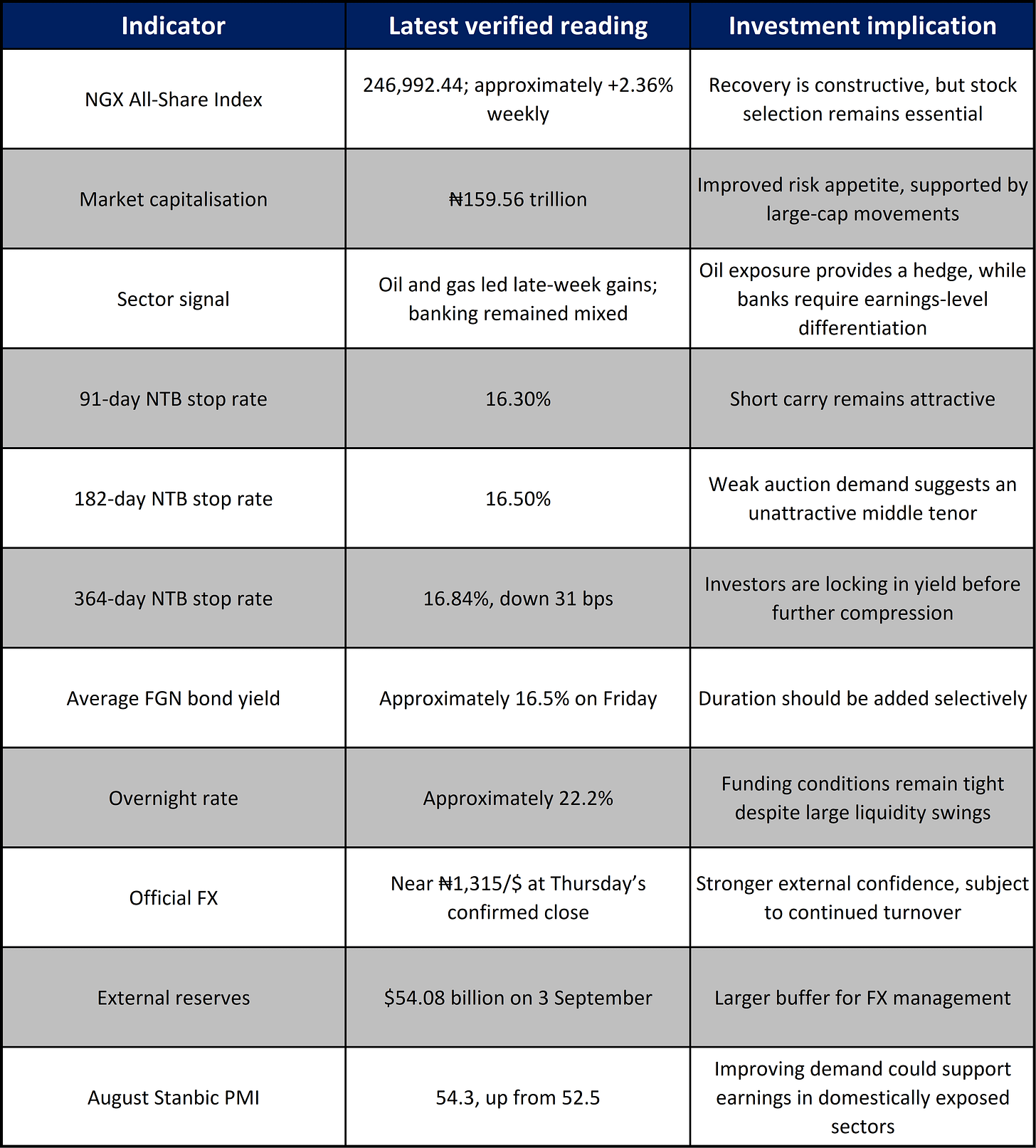
What happened: The NGX All-Share Index closed Friday at 246,992.44, up approximately 2.36% from 241,298.47 the previous Friday. The rebound came as investors positioned ahead of Nigeria’s return to FTSE Russell’s Frontier Market classification on 21 September.
FTSE Russell reconfirmed that no material settlement, operational or funding problems had emerged following Nigeria’s transition to T+1 settlement. August’s Stanbic IBTC PMI also rose to 54.3 from 52.5, indicating stronger private-sector activity and faster new-order growth.
Why it mattered: Reclassification reduces a structural barrier to international participation, but it does not guarantee immediate or indiscriminate foreign buying. Investors will still assess liquidity, free float, valuation, earnings quality and the ability to repatriate capital.
The stronger PMI gives the equity rally a better fundamental foundation, particularly for businesses exposed to domestic demand. However, the improvement must translate into revenue growth and margins before it justifies a sustained rerating.
What comes next: Watch the publication of FTSE’s indicative index files, turnover in liquid banking and telecom shares, and whether positive market breadth extends beyond a small group of large companies.
2. The one-year Treasury bill remains the market’s real allocation benchmark
What happened: The 364-day Treasury-bill stop rate fell by 31 basis points to 16.84%, following a 44-basis-point decline at the previous auction. Investors nevertheless submitted about ₦3.24 trillion for the ₦500 billion offered, while approximately ₦762.17 billion was allotted.
Demand for the 91-day and 182-day bills was much weaker, even though their stop rates remained at 16.30% and 16.50%.
Why it mattered: Investors are trying to secure relatively high yields for longer before rates decline further. The preference for one-year paper also reflects a desire to earn sovereign carry without assuming the volatility, liquidity risk and earnings uncertainty attached to equities.
For listed companies, 16.84% is more than a fixed-income statistic. It is the minimum return hurdle against which equity valuations and corporate investment projects will increasingly be judged.
What comes next: Further declines in stop rates could gradually encourage rotation into longer bonds and selected equities. But broad risk-taking is unlikely while government securities continue to offer high nominal returns with lower volatility.
3. The naira and reserves strengthened Nigeria’s external-buffer story
What happened: The latest confirmed official-market close available during the week placed the naira near ₦1,315 per dollar on Thursday, its strongest level in roughly two years. Gross external reserves reached $54.08 billion on 3 September, up about $8.51 billion since the beginning of 2026.
Why it mattered: A stronger reserve position improves the CBN’s capacity to manage periods of elevated FX demand and reduces the perceived risk of another disorderly currency adjustment. It also strengthens the credibility of Nigeria’s return to global benchmark indices.
For companies, sustained currency stability would improve inventory planning and reduce imported-input uncertainty. For foreign investors, however, the more important test remains whether liquidity and repatriation continue to function during periods of market stress.
What comes next: Monitor official-market turnover, the gap with parallel-market rates and whether reserve accumulation continues if oil prices retreat.
4. US employment reopened the rate-increase debate
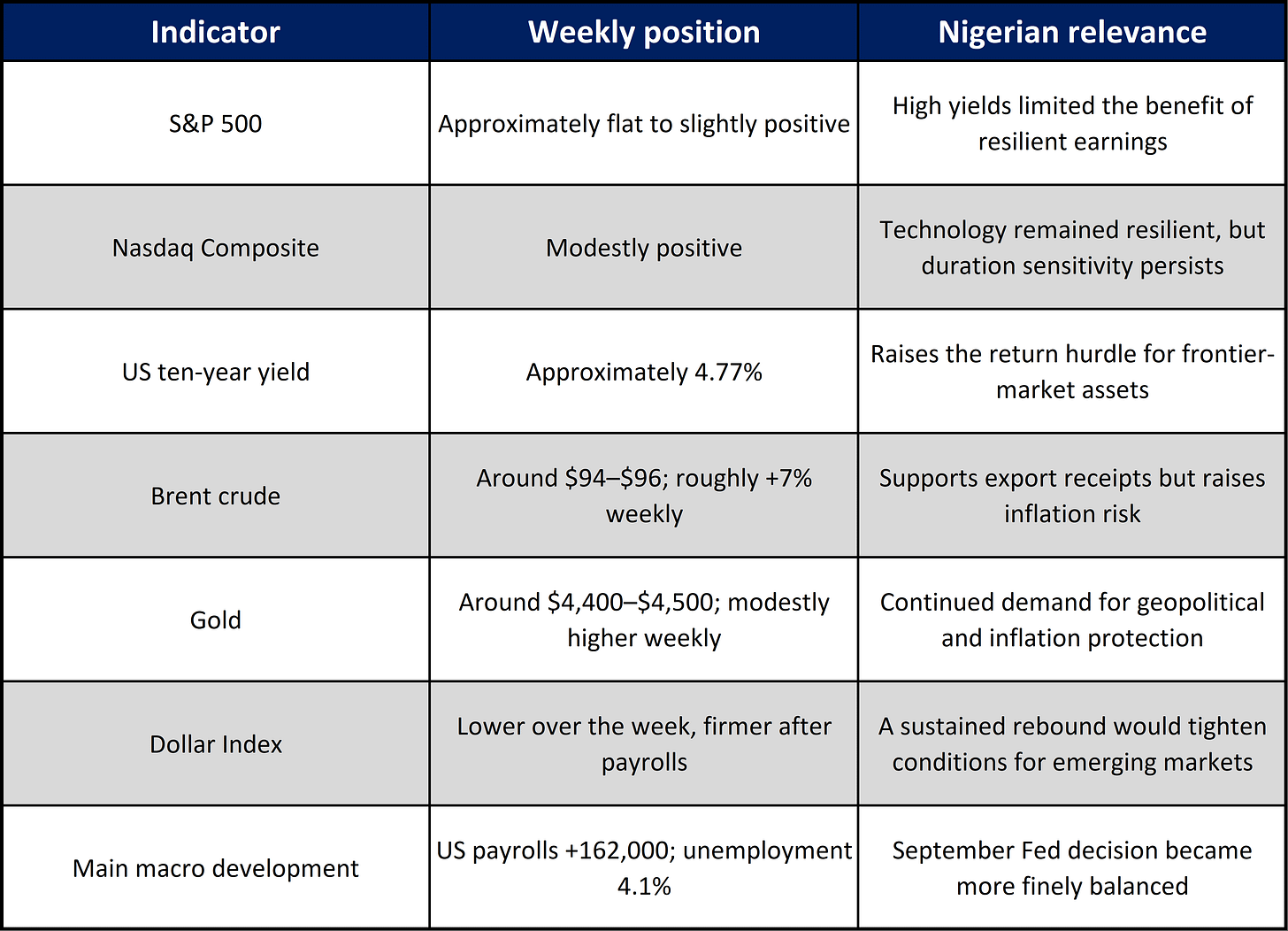
What happened: US nonfarm payrolls increased by 162,000 in August, compared with a Reuters consensus estimate of 56,000. Unemployment remained at 4.1%, while average hourly earnings rose 0.3% month on month and 3.1% year on year.
US Treasury yields and the dollar moved higher after the release. At approximately 3:00 p.m. New York time on Friday, the ten-year yield was near 4.77%, while US equities were modestly lower.
Why it mattered: The data weakened the case for near-term monetary easing and increased the probability that the Federal Reserve could raise rates if inflation remains elevated. Higher US yields make frontier-market assets compete with more attractive dollar returns.
For Nigeria, that could moderate foreign portfolio inflows even as domestic market accessibility improves. It also means that naira stability will continue to depend on a sufficiently attractive yield differential and reliable dollar liquidity.
What comes next: The US inflation report due next week is now the decisive input for the Federal Reserve’s 15–16 September meeting.
Source notes: US Bureau of Labor Statistics, 4 September 2026; Reuters, 4 September 2026; AP, 4 September 2026.
Confidence: High.5. Oil helped Nigeria’s external position but complicated the inflation outlook
What happened: Brent crude gained roughly 7% over the week and traded around $94–$96 per barrel on Friday. Renewed US-Iran hostilities sustained a geopolitical premium, although prices eased during Friday’s session.
OPEC+ will meet on 6 September after previously announcing a 188,000-barrel-per-day production adjustment for September.
Why it mattered: Elevated Brent prices can support Nigerian export receipts, fiscal revenue and reserve accumulation. The benefit is incomplete, however, if domestic production underperforms or if higher global product prices raise fuel, transport and manufacturing costs.
Oil also matters through the Federal Reserve. A sustained price shock could keep US inflation elevated, global yields high and frontier-market financing conditions restrictive.
What comes next: Watch the OPEC+ decision, developments affecting shipping through the Strait of Hormuz and Nigeria’s ability to convert higher prices into higher export volumes.
Nigeria Market Scorecard
Global Market Scorecard
The Main Lesson From This Week
Nigeria’s approaching return to the FTSE Frontier universe is an important improvement in market infrastructure, but it should not be mistaken for an automatic flow event.
International visibility is only one part of the investment decision. Nigerian equities must also compete against a 16.84% one-year sovereign instrument, US Treasury yields near 4.8% and lingering concerns about trading liquidity. This means the companies most likely to benefit are not simply those included in an index. They are liquid businesses capable of producing earnings growth, cash generation and dividend returns that justify moving away from government paper.
The market’s next phase should therefore be defined more by differentiation than by a broad valuation uplift.
Ranora View:
The portfolio anchor remains short-duration naira fixed income, but the direction of travel now supports measured equity additions.
Treasury-bill yields are compressing, the naira is strengthening, reserves are rising and business activity is improving. Together, these developments reduce some of the macro risk premium embedded in Nigerian equities. They do not eliminate the need for a high return hurdle.
We favour liquid companies with pricing power, limited refinancing pressure, credible cash generation and direct exposure to improving domestic activity. Selective oil-linked exposure can provide a hedge against geopolitical disruption, although investors should avoid treating high crude prices as an unqualified positive.
Longer-duration bonds may become more attractive if inflation continues to ease and auction yields decline. That position should be built gradually while global yields remain elevated.
What to Watch Next:
The OPEC+ meeting on 6 September and its implications for Brent crude.
US consumer and producer inflation ahead of the Federal Reserve meeting.
Further FTSE indicative files ahead of Nigeria’s 21 September reclassification.
Sustainability of the naira’s move into the ₦1,300 range.
Whether NGX turnover and market breadth confirm genuine institutional accumulation.
Question of the day:
Will Nigeria’s return to Frontier Market status trigger meaningful foreign equity demand, or will Treasury-bill yields remain too attractive for a broad rotation into stocks?
Stay smart. Stay informed. Subscribe to Ranora Market Outlook for free and support independent market analysis.