


Opening View
MTN Nigeria has given investors a reason to look beyond its profit growth. In results released on Friday, management said fibre-to-the-home now carries approximately 13% of total data traffic, freeing capacity on the mobile network. That creates a potentially valuable connection between broadband expansion and the economics of the existing cellular business.
Our reading is that fibre deserves assessment as more than an additional revenue line. Moving heavy household usage onto fixed connections could leave mobile capacity available for other customers, improving the return on infrastructure already in place. But fibre installation and maintenance also require capital. A larger traffic share does not establish that those investments earn an adequate return.
Today’s investor call, scheduled for 15:00 WAT, is therefore the immediate test: can management explain connection economics, utilisation and the spending needed to support the next stage of growth?
That question fits the wider market. Nigerian equities finished last week higher, but participation remained uneven. Overseas, investors punished technology companies amid concerns about the returns on heavy AI spending. The practical distinction for this week is between businesses adding capacity and businesses demonstrating that additional demand can make their capacity more productive. For MTN, the operational evidence warrants further work; it does not yet settle the entry-price decision
The Big Picture:
MTN’s third-quarter service revenue increased 19.7% year on year, while EBITDA, earnings before interest, tax, depreciation and amortisation, rose 32.8%. Its quarterly EBITDA margin reached 58.7%. Separately, network data traffic increased 30.1% across the nine months to September.
These figures make network efficiency a useful investment question. They do not isolate fibre’s contribution to the margin gain. Cost management and currency movements also affect reported profitability, and the release does not provide a separate return on fibre capital.
The distinction matters for valuation. Subscriber additions and rising usage can support earnings without requiring another tariff increase. Yet the same demand can become expensive to serve if connection costs, congestion or maintenance grow faster than customer revenue. Investors should ask how much cash each additional connection requires, how quickly it pays back, and whether the mobile network genuinely avoids otherwise necessary expenditure.
A credible answer would support paying for durable operating improvement. Simply extrapolating the latest margin would not.
Nigeria Market Intelligence
A stronger index still needs stock selection
The NGX All-Share Index gained 2.86% in the week ended 30 October, closing at 254,299.49. Reported breadth was less convincing: 33 equities rose and 48 fell. Financial services accounted for 89.91% of weekly traded value.
That concentration limits what headline activity tells us about the ease of entering or exiting an individual stock. This week, look for sustained turnover beyond the dominant names and evidence that new earnings information changes valuations.
Bill pricing and access remain separate questions
At the 28 October Treasury-bill auction, the 364-day discount stop rate was 15.80%. Total allotment across the three tenors was NGN71.16 billion against NGN800 billion offered. FMDQ’s overnight funding reference was 20.38% on 30 October.
An auction rate does not guarantee an allocation, and overnight funding costs are not a retail investment yield. Cash managers should compare obtainable secondary-market returns after charges and match maturity to cash needs. Limited primary allocation is not, by itself, a reason to accept longer bond duration or equity risk.
FX execution matters more than a stable closing print.
Friday’s reported NFEM close was NGN1,346/USD, unchanged on the day.
Businesses with dollar bills need the rate and amount their bank can actually deliver. Investors should separate currency stability from the cost of entering or exiting naira assets. Watch available dollar liquidity and customer quotes as the new month begins.
Global Market Intelligence:
The Fed pause leaves the inflation test intact
The Federal Reserve held its target range at 3.75%-4.00% on 28 October. September core PCE inflation, released the next day, was 3.1% year on year.
The pause does not establish a cheaper dollar-funding cycle. Friday’s US employment report will help frame the next policy debate. Nigerian issuers considering dollar borrowing should assess the all-in funding cost, rather than assuming a policy hold will reduce their credit spread or refinancing bill.
Growth investment is facing a tougher valuation test
On Friday, the S&P 500 fell 1.82% and the Nasdaq Composite lost 2.86%, amid concerns about AI investment and cash returns. US Treasuries rallied as equities sold off.
For Nigerian investors, lower US yields and weaker global risk appetite can pull in opposite directions. Sovereign Eurobond prices depend on both the US rate component and Nigeria’s credit premium. For equities, the relevant lesson is to examine how growth investment earns its return, not to assume every infrastructure-heavy business shares the same economics.
OPEC targets do not remove the energy-cost risk
On Sunday, seven OPEC+ members kept December production targets unchanged. January-delivery Brent futures settled at USD113.43 a barrel on Friday, 30 October.
For Nigeria, sustained high oil prices can support export receipts while squeezing energy-intensive businesses. Neither benefit nor cost follows automatically from an announced production target. Export volumes and realised prices determine the external benefit; actual fuel and power costs determine the pressure on corporate margins.
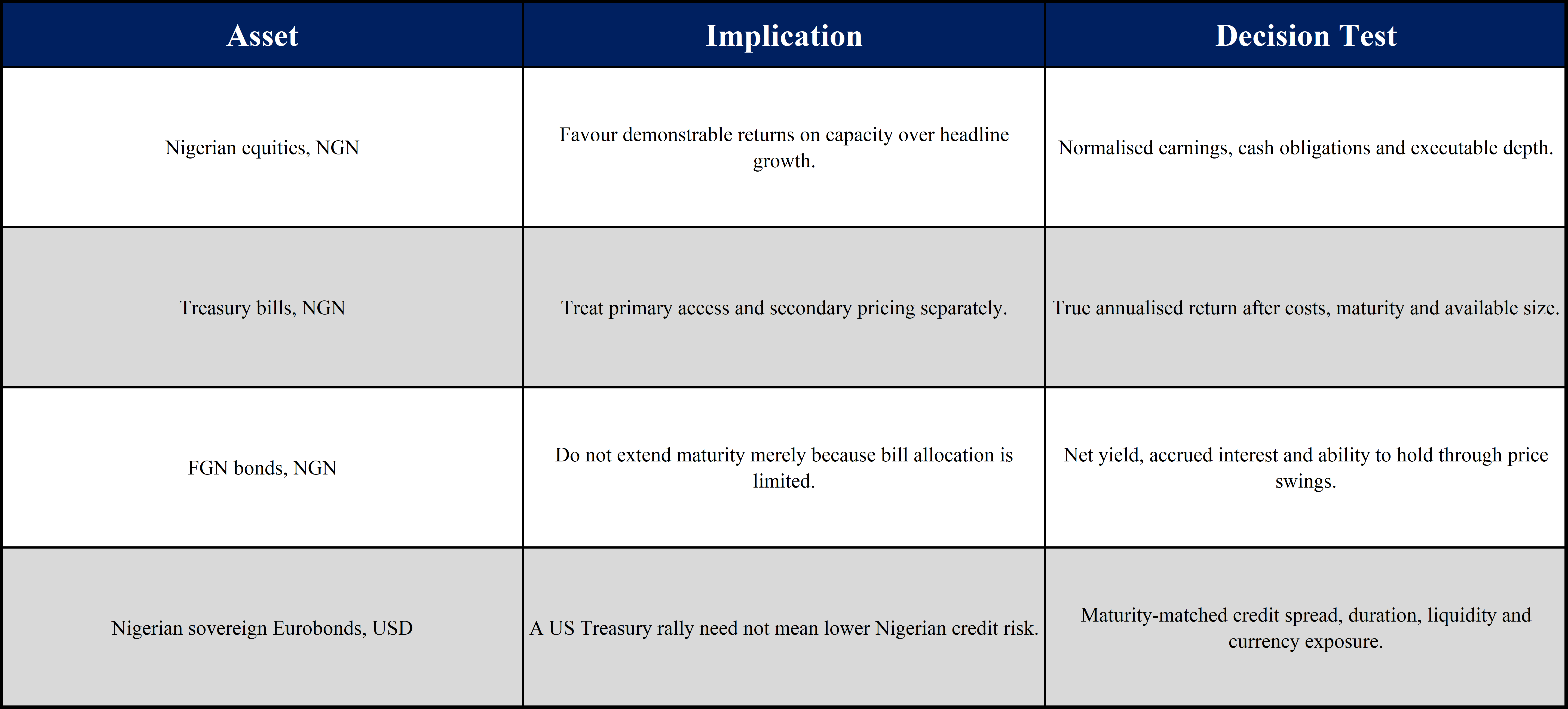
Asset Class Implications:
Investment Ideas for the Week:
MTN Nigeria Communications Plc ordinary shares
Instrument: NGX MTNN | Currency: NGN | Thesis ID: NG-EQ-MTNN-NETWORK-20261102
Stance: Pending / deferred entry. Prospective holding horizon: 12-24 months if an entry later qualifies.
MTN is this week’s sole new research candidate. The catalyst is its newly disclosed network mix and today’s investor call. The thesis is that fibre adoption could improve mobile-capacity utilisation while adding broadband customers. We need evidence on the combined return, rather than assuming that higher traffic automatically produces shareholder value.
The market reference is NGN850 per share at the 30 October close, a delayed/EOD observation, not a verified executable quote. Using that price, issued shares and reported attributable profits, we calculate a trailing earnings multiple of approximately 11.7 times for the twelve months ended September. The calculation combines full-year 2025 profit with nine-month 2026 profit and removes the matching nine-month 2025 period. It is not a forecast multiple. FX gains and the cash cost of sustaining the network must still be assessed before describing the shares as cheap.
The cash evidence is encouraging but needs qualification. Consolidated net operating cash increased to NGN2.31 trillion from NGN1.56 trillion in the comparable nine months. The working-capital reconciliation contributed NGN215.8 billion, versus NGN34.2 billion. Cash purchases of property and equipment also rose to NGN1.00 trillion from NGN539.3 billion. The operating-cash improvement therefore includes timing effects, while investment absorbs a substantial amount. These cash payments differ from the company’s capital-additions measure excluding leases.
The principal risks are energy and currency costs, fibre disruption, competitive pricing and a rollout whose capital needs exceed the revenue it generates. A stronger entry case would require clearer connection payback and utilisation evidence, cash generation that survives normal working-capital movements, and an actual purchase price that compensates for those risks. Deteriorating margins alongside heavier spending would weaken the thesis.
No net-return comparison with bills is credible yet: the live spread, available size, broker commissions, settlement charges and applicable investor taxes remain unverified. Foreign investors must also allow for conversion and repatriation costs. The historical interim dividend was paid before this edition and is not available to a new buyer.
We therefore defer entry. Treasury bills, naira FGN bonds and Nigerian sovereign USD Eurobonds remain comparison assets, but we are not adding another instrument without fresh, verified pricing and net economics. Earlier research ideas are not automatically renewed by this week’s selection.
Ranora View:
MTN’s fibre disclosure is worth more analytical attention than another headline profit-growth comparison. If fixed broadband releases mobile capacity at an acceptable total cost, the investment case could improve through better use of existing assets. The missing evidence is the cost and return of delivering that benefit.
Our stance is to investigate that mechanism, retain MTNN as a deferred-entry candidate and resist treating the NGX’s weekly gain as a market-wide invitation. For income portfolios, compare obtainable net returns and preserve the required maturity profile. For businesses, evaluate network, energy and dollar commitments together: stronger demand is valuable only if serving it leaves an adequate cash return.
What to Watch Next:
Monday 2 November, 15:00 WAT: MTN’s scheduled investor call. Look for fibre connection economics, mobile-capacity benefits and future cash investment needs.
Monday 2 November: Nigeria’s October PMI is scheduled for release. Watch new orders and input costs for evidence that demand can support margins beyond telecoms.
Tuesday 3 November: US federal elections. Assess market reactions through Treasury yields, the dollar and energy-policy expectations; do not assume a particular outcome.
Friday 6 November: The US October employment report. Wage growth and hiring will help test the policy implications of the Fed’s pause.
Through the week: Obtain fresh bill and bond quotes, check dollar availability, and watch whether NGX trading broadens beyond the dominant names.
Question of the day:
What would give you greater confidence in MTN's next investment phase: faster subscriber growth, or evidence that each additional unit of traffic requires less capital?
Stay smart. Stay informed. Subscribe to Ranora Market Outlook for free and support independent market analysis.