


Opening View
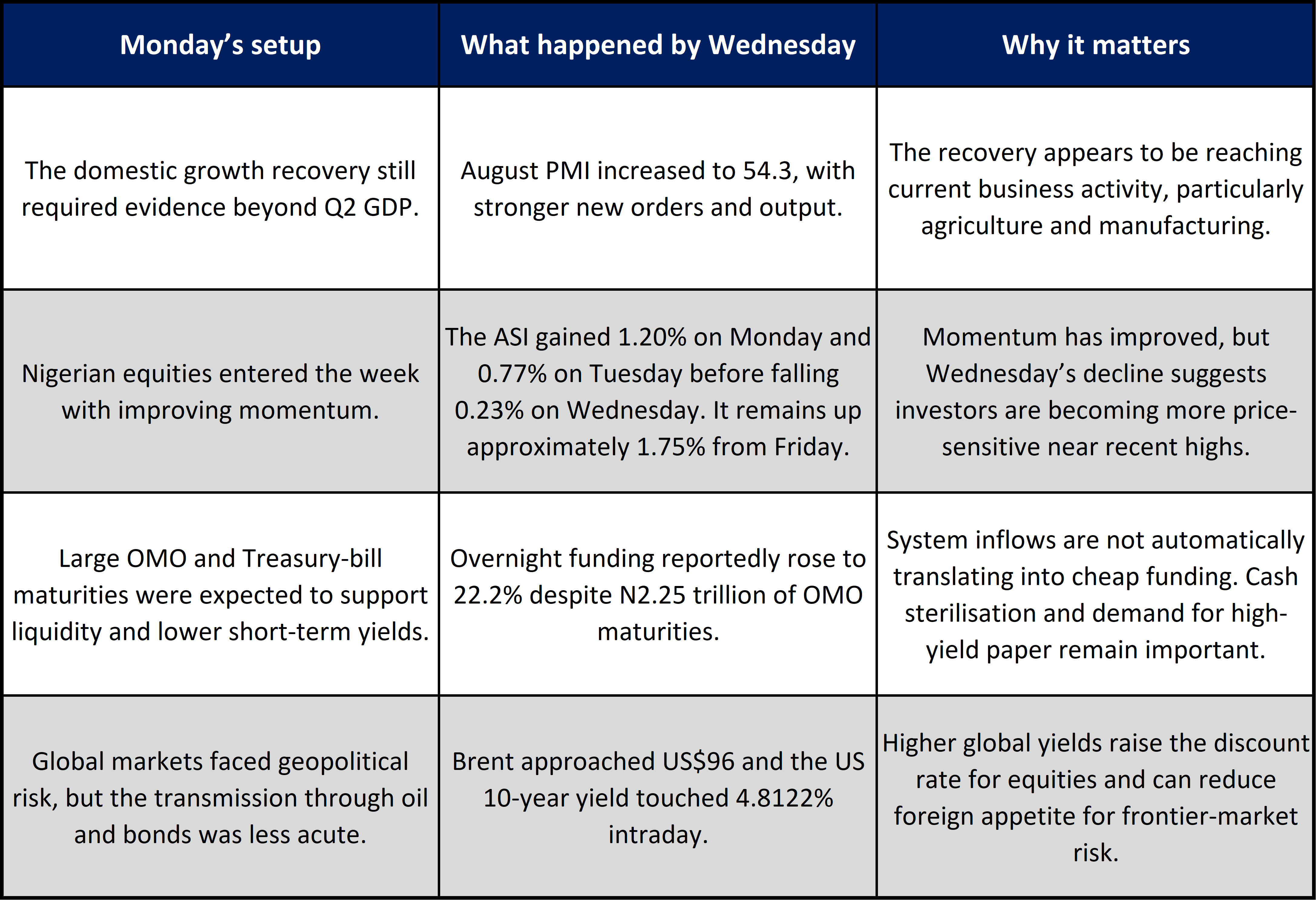
The most important change since Monday is not simply that Nigerian business activity strengthened. It is that this improvement arrived without a corresponding fall in the price of money.
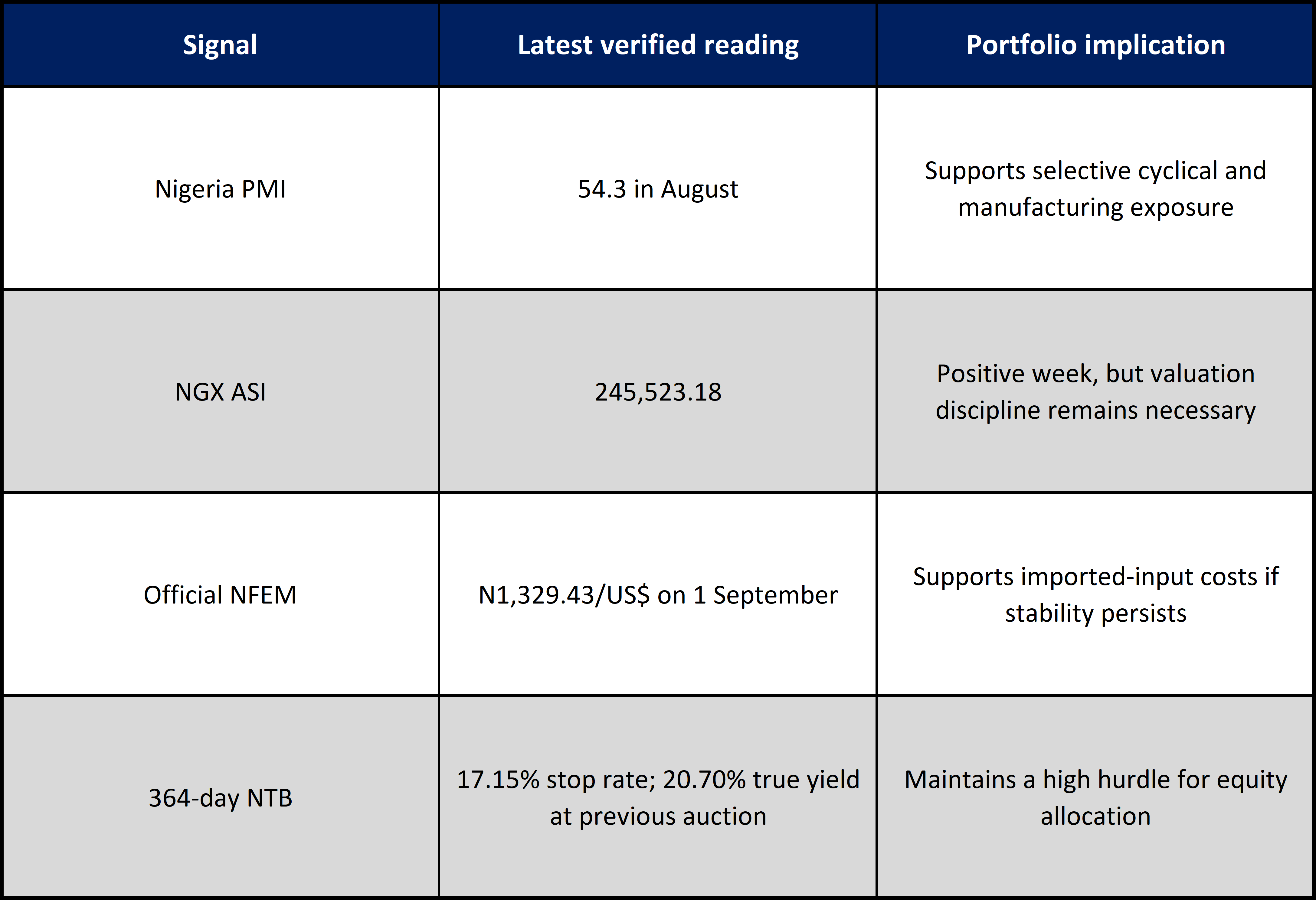
August’s Stanbic IBTC Nigeria PMI rose to 54.3 from 52.5 in July, its joint-highest level in more than two-and-a-half years. New orders expanded at their fastest pace since early 2024, while agriculture and manufacturing recorded particularly strong output growth. The NGX also remains 1.75% above last Friday’s close despite Wednesday’s modest pullback.
That would ordinarily strengthen the case for economically sensitive equities. But the hurdle rate remains demanding. Overnight funding rose to approximately 22.2% on Wednesday despite substantial OMO maturities, while the most recently verified 364-day Treasury-bill auction offered a true yield of about 20.7%.
The global backdrop has also become less supportive. Brent moved towards US$96 per barrel as conflict involving the United States and Iran intensified, pushing inflation expectations and long-term bond yields higher. Nigeria gains from stronger crude-export economics, but companies and investors still face higher fuel, logistics and global financing costs.
The midweek message is therefore selective: growth is improving, but investors should require clear earnings delivery before paying higher equity valuations.
What Changed Since Monday
Market Pulse
Nigerian equities: The NGX ASI closed Wednesday at 245,523.18, down 0.23% for the session but still above Monday’s 244,199.39 close. The rally has slowed rather than reversed. Investors should now watch market breadth and earnings participation rather than the index alone.
Fixed income: The latest verified auction before Wednesday placed the 364-day Treasury-bill stop rate at 17.15%, equivalent to a true yield of about 20.70%. Wednesday’s new N700 billion auction was scheduled across the 91-, 182- and 364-day tenors, but a reliable official result was not available at our cut-off.
Money market: Overnight funding reportedly increased by seven basis points to 22.2% despite N2.25 trillion in OMO maturities. This suggests that liquidity distribution and CBN operations matter more than the headline volume of inflows.
FX: The latest available official NFEM rate strengthened to N1,329.43/US$ on 1 September from N1,332.94/US$ on 31 August. The move is constructive, but the parallel-market premium remains a reminder that dollar access is not equally priced across the economy.
Oil and global risk: Brent traded around US$95.91 on Wednesday afternoon as renewed US-Iran hostilities sustained the energy-risk premium. US equities recovered modestly intraday after two weak sessions, but the oil and bond channels remain the more important signals for Nigeria.
Nigeria Deep Dive: Demand Is Recovering, but Pricing Power Will Decide the Winners
What happened
The Stanbic IBTC Nigeria PMI rose to 54.3 in August from 52.5 in July. Business conditions improved for a seventh consecutive month, while new-order growth reached its strongest pace since the beginning of 2024. Output increased across all four monitored sectors, led by agriculture and manufacturing.
The expansion was not entirely clean. Employment growth remained modest, sentiment fell to a three-month low, and purchase-cost inflation accelerated as businesses reported higher fuel, transportation and raw-material costs. Companies responded by increasing selling prices.
Why it matters
The survey strengthens the argument that Nigeria’s recovery is becoming more operational and less dependent on statistical base effects. Better new orders, inventory accumulation and shorter supplier delivery times could support revenue growth for manufacturers, logistics companies and selected consumer businesses.
However, the gap between output growth and muted hiring suggests that companies are still protecting margins through productivity, restrained payroll expansion and price increases. That is useful for earnings, but it may delay a stronger household-consumption cycle.
What it means for investors
The PMI should not be treated as a signal to buy the entire consumer or industrial market. The more attractive companies are likely to be those that can convert higher volumes into cash flow without a disproportionate increase in working-capital borrowing.
Investors should favour businesses with pricing power, efficient distribution, low refinancing requirements and access to locally sourced inputs. High-leverage companies remain vulnerable because financing costs can absorb the benefit of stronger sales.
What to watch next
Watch whether volume growth begins to outpace selling-price increases, whether wholesale and retail employment improves, and whether stronger orders translate into better third-quarter corporate cash flow.
Global Markets Deep Dive: Oil Is Becoming a Rates Story Again
The obvious Nigerian interpretation of Brent near US$96 is positive: higher crude prices can improve export receipts, fiscal revenue and foreign-exchange supply if production and remittances perform as expected.
That view is incomplete. The current oil move is also transmitting into global inflation expectations and sovereign yields. The US 10-year Treasury yield reached an intraday high of 4.8122% on Wednesday, while euro-area inflation accelerated to 3.3% in August from 2.9%, driven largely by a 14.3% increase in energy prices.
For Nigeria, the net effect depends on duration. Higher oil prices may support near-term dollar inflows, but persistently high prices would raise freight, fuel and production costs while keeping global monetary policy restrictive. That combination could pressure Nigerian Eurobonds, increase offshore investors’ required returns and weaken the valuation case for highly priced equities.
The better positioning is therefore not simply “buy Nigeria because oil is up.” It is to distinguish oil-linked revenue beneficiaries from businesses whose margins are exposed to imported energy and financing costs.
Chart of the Day: The Competing Signals
Ranora View:
Nigeria’s improving activity data is investable, but only through disciplined security selection.
Short-duration naira instruments remain attractive because yields still provide substantial nominal carry. Equities can outperform that carry only where stronger demand produces genuine earnings growth, cash generation and margin resilience.
Within equities, the midweek evidence supports selective exposure to manufacturers, financial institutions and oil-linked companies with sound balance sheets. It does not justify indiscriminate buying after a strong year-to-date market advance. Companies dependent on imported inputs, expensive short-term borrowing or weak household purchasing power require a larger valuation discount.
The key portfolio question has changed from “Is the economy recovering?” to “Which companies can convert the recovery into returns above a roughly 20% fixed-income hurdle?”
What to Watch Next:
The official result of Wednesday’s Treasury-bill auction, particularly the 364-day stop rate and bid-to-cover ratio.
Friday’s US employment report and its effect on Treasury yields and Federal Reserve expectations.
Whether Brent remains near US$96 or the geopolitical premium begins to unwind.
The naira’s response to the stronger oil price and any change in official-market dollar liquidity.
Whether the NGX resumes its advance with broad participation or becomes dependent on a small group of heavyweight stocks.
Question for the day:
With Nigerian business activity strengthening but short-term fixed-income yields still near 20% on a true-yield basis, what evidence would persuade you to increase equity exposure?
Stay smart. Stay informed. Subscribe to Ranora Market Outlook for free and support independent market analysis.