


Opening View
Monday’s question was whether Nigeria’s revised bond offering would bring government repayments closer. By Wednesday, the auction had supplied an important qualification: investors did not finance the advertised maturity mix in the advertised proportions.
The May 2033 bond represented 15% of the offer but received 47.8% of competitive allotments, a Ranora calculation. It was the longest maturity available in the revised sale. The government had shifted its offer toward earlier repayment dates; the outcome tilted back toward the longer end of that narrower menu.
That changes the investment reading. A shorter issuance calendar is not evidence that investors have abandoned longer-term naira exposure. Equally, concentrated demand for one sovereign maturity is not proof of abundant funding for every borrower. The auction reveals where buyers accepted the terms, not why every buyer participated or how banks will price business loans.
Elsewhere, annual inflation slowed but monthly price increases accelerated, while Monday’s equity gain gave way to declines. The practical distinction is between improving headline conditions and usable financial relief. Portfolio risk still depends on maturity and concentration; business expansion still depends on funding that lasts long enough, at a cost the project’s cash flows can support.
The Big Picture:
What changed since Monday:
Sovereign funding: · Monday’s focus was the revised maturity mix. The completed auction shows demand and allocations leaning toward the longest offered bond. The issue is now how that allocation trades after settlement, not merely what the calendar advertised.
Inflation: · Monday’s October release was still ahead. Annual headline inflation fell to 14.06% from 14.63%, but the monthly rate rose to 0.43% from 0.06%. Disinflation continued without a uniform improvement in near-term cost pressure.
Nigerian equities: Monday's 0.21% gain was reversed by Tuesday's 1.38% decline and a reported further 0.40% fall on Wednesday. The index was approximately 1.77% below Monday's close, calculated from closing levels, not a completed-week return.
Global risk: Monday's concern about expensive dollar funding now sits alongside realised equity losses. The S&P 500 and Nasdaq Composite were down 2.9% and 3.2% for the week through Tuesday. Nvidia's results arrived afterwards, so those declines cannot be described as a reaction to the earnings release.
Nigeria Market Intelligence
The Sale Followed Demand Rather Than the Offer Mix
The auction table makes the distinction visible. It compares the same four reopened bonds at the 16 November auction. Amounts are NGN billion; the yield column shows auction marginal yields, not coupon rates.
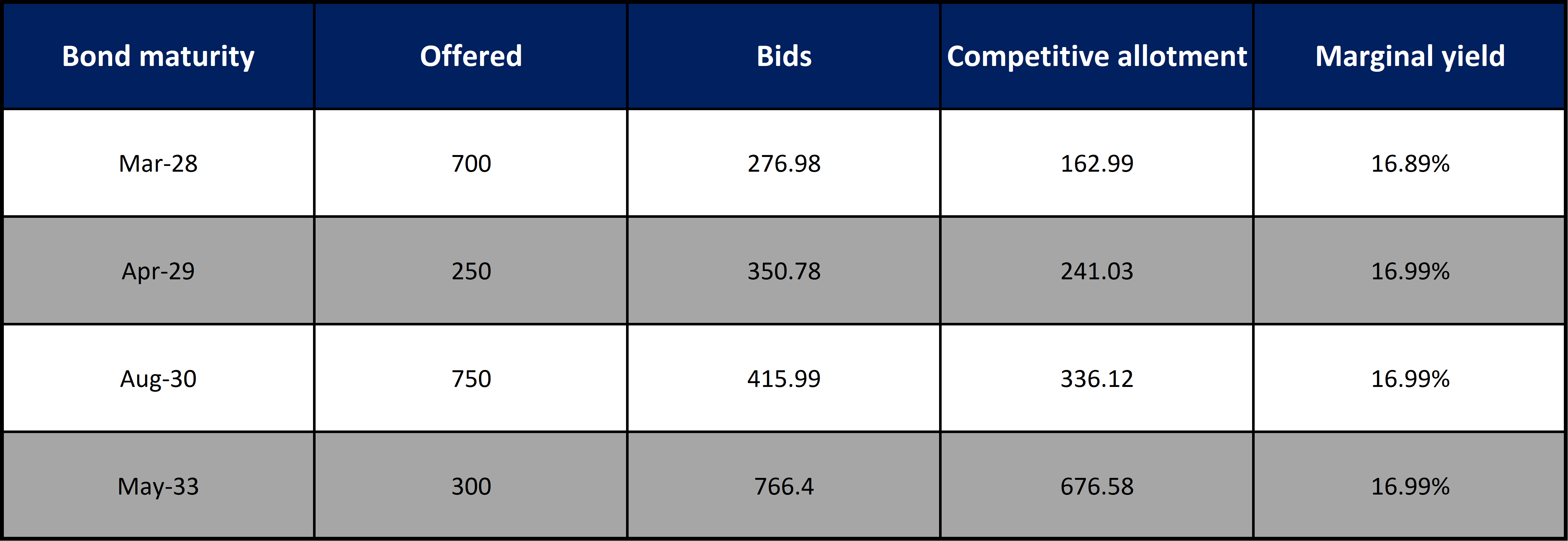
The DMO separately reported NGN80 billion of non-competitive allotments. These are excluded from the competitive column and the opening’s allocation-share calculation.
The interpretation matters more than the total. Demand for the longest offered maturity survived the shift to a shorter menu, and the DMO allocated more there than originally offered. A supply calendar therefore cannot, on its own, establish which maturities face scarcity or excess supply after an auction.
For businesses considering longer-lived projects, the relevant question is whether comparable tenor is available to them after credit spreads, collateral requirements and fees. Sovereign demand demonstrates neither those terms nor access. For investors, willingness to hold a bond for longer may reflect liability matching, reinvestment concerns or an interest-rate view; the result does not identify which explanation dominated.
The 2029, 2030 and 2033 lines all cleared at 16.99%. The same headline yield therefore came with different repayment schedules for the borrower and different interest-rate exposure for holders. A comparison with earlier auctions needs matched maturities before it can establish cheaper funding. The next test is secondary pricing in the same instruments after the scheduled Wednesday settlement.
Lower Annual Inflation Is Not a Uniform Margin Tailwind
Food prices fell 0.75% month on month in October, compared with a 1.55% decline in September. That offers some household relief, but at a slower pace, while the overall monthly price index rose faster.
Consumer businesses cannot treat the annual inflation decline as proof of recovering volumes. Manufacturers and distributors also need to distinguish cheaper inputs from the cost of financing and replacing inventory. The useful evidence now is realised selling volumes, supplier invoices and collection periods, not an assumed economy-wide margin expansion.
The Equity Reversal Needs a Concentration Check
Tuesday’s fall included a sharp decline in Dangote Cement even though market breadth remained positive. Wednesday’s reported index decline extended the reversal of Monday’s gain.
The implication is not that every company suffered the same earnings deterioration. A concentrated index can fall while other stocks advance. Portfolio reviews need both heavyweight exposure and company-specific earnings assumptions; a change in market capitalisation is not a measure of cash leaving the exchange.
Funding and FX Still Need Separate Tests
FMDQ’s 18 November reference showed overnight funding at 20.34%. Its 17 November twelve-month Treasury-bill true-yield reference was 18.62%, rounded. Neither is an executable corporate funding offer, and the bill figure is not an auction discount rate.
Tuesday’s FX reporting indicated a marginally firmer official-market naira. That is useful context, but it does not establish easier dollar access for every importer. For treasury teams, the relevant cash-flow test remains the obtainable exchange rate, settlement timing and financing cost of the purchase.
Global Market Intelligence
Nvidia Answered the Sales Question Not the Valuation Question
After Tuesday’s US close, Nvidia reported fiscal third-quarter revenue of USD115.8 billion, up 103% from a year earlier. That adds operating evidence after the equity selloff; it does not establish that every buyer of AI infrastructure will earn an adequate return on its spending.
The distinction matters for global portfolios and Nigerian businesses seeking foreign capital. Strong supplier revenue can coexist with demanding valuations or expensive financing for customers. For Nigeria, a sustained reduction in global risk appetite could narrow the pool of willing foreign investors even when local fundamentals improve. Actual cross-border flows and obtainable funding terms are the tests.
A Treasury Rally Is Not Automatically Easier Dollar Finance
US Treasury yields eased on Tuesday, but the ten-year reference remained above 5%. Gold also weakened in early Wednesday trading ahead of the Fed minutes.
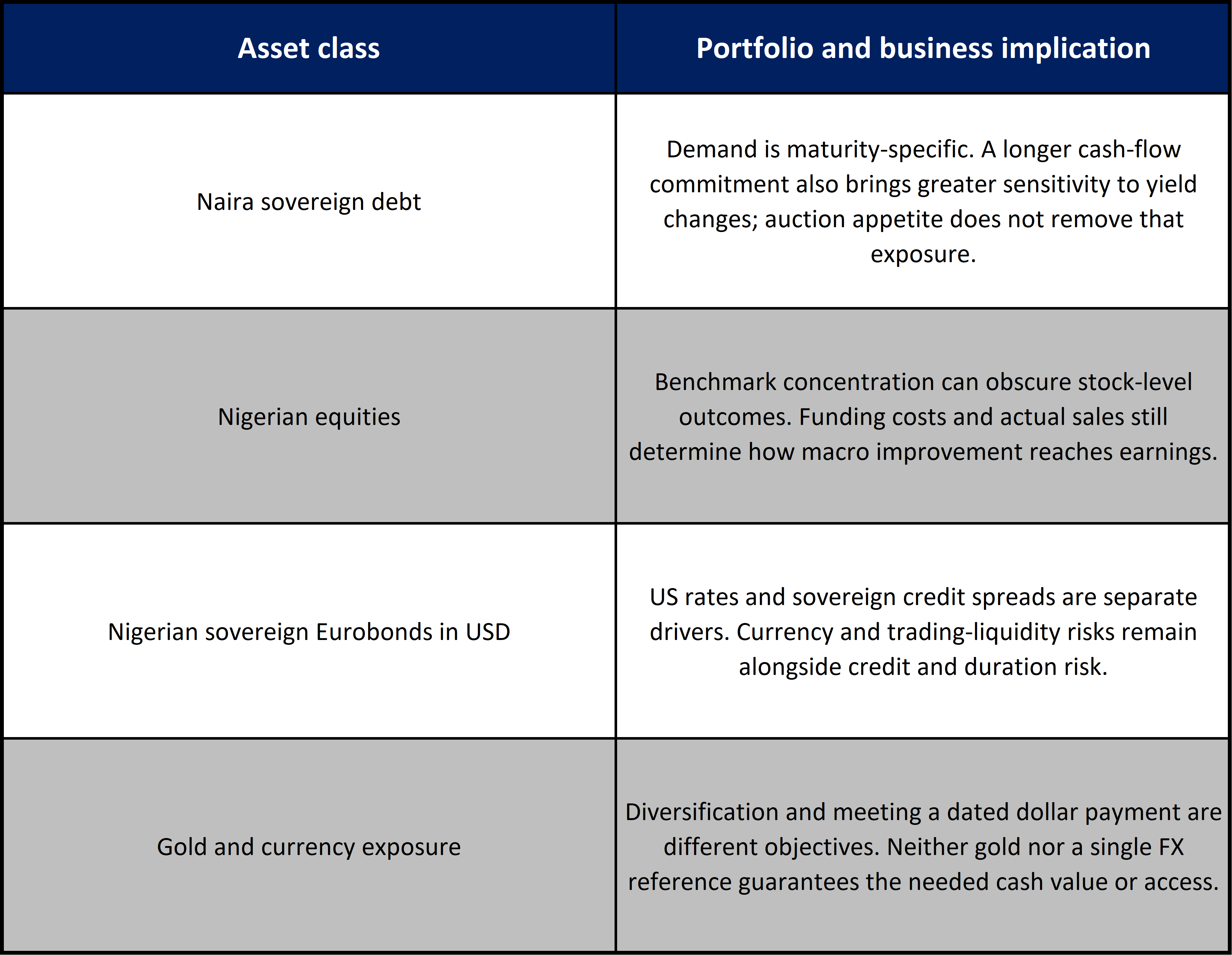
For Nigerian sovereign USD Eurobonds, the US interest-rate component and Nigeria’s credit spread can move in opposite directions. For companies, a lower benchmark does not guarantee a lower all-in dollar borrowing cost if lender margins widen. Gold’s weakness is also a reminder that a diversifying asset need not preserve the cash value of a near-term dollar obligation.
Oil Still Cuts Both Ways for Nigeria
January 2027 Brent futures settled at USD93.14 a barrel on Tuesday, up about 0.8% that session. This is a dated settlement, not Wednesday’s live price.
Stronger oil prices can support export receipts while raising fuel-sensitive operating costs; weaker prices reverse those pressures. The business impact depends on the exchange rate, product pricing and the timing of supplier adjustments. A move in Brent alone is insufficient grounds to rewrite a Nigerian company’s fuel budget or the government’s revenue outlook.
Asset Class Implications
The distinction is between the market signal and the risk it leaves unresolved
Ranora View:
The auction has qualified Monday’s conclusion: earlier maturities in the offer did not produce the same concentration in final allocations. Nigeria can attract longer-term naira commitments within this menu, but the terms and the maturity matter.
For portfolios, that strengthens the case for analysing each part of the yield curve rather than labelling the whole market an easing trade. For businesses, the decisive variable remains the cost and duration of funding actually available against expected cash generation. A sovereign clearing yield is a benchmark, not a loan approval.
The view would need reassessment if post-settlement trading shows the allocation pattern was temporary, or if shorter-maturity demand and attainable business funding terms improve broadly. Until then, the evidence supports selective transmission of financial relief, not a uniform reduction in the cost of capital.
What to Watch Next
Tonight’s Fed minutes at 20:00 WAT: how the October meeting discussion changes the interpretation of US inflation and rates. These are minutes, not a new policy decision.
Post-settlement bond pricing and overnight funding: whether the auction’s maturity preference persists, without assuming the nominal sale equals a net liquidity drain.
Equity breadth before Friday: whether weakness remains concentrated in heavyweights or becomes broader across sectors and earnings expectations.
FX access and delivered fuel costs: whether obtainable dealer terms and supplier invoices validate any apparent relief in market references.
Question for the day:
For your next capital decision, is the bigger constraint the price of funding or how long you can secure it for?
Stay smart. Stay informed. Subscribe to Ranora Market Outlook for free and support independent market analysis.