


Opening View
Monday’s edition examined how uneven Chinese production costs could complicate Nigerian margin forecasts. By midweek, a different constraint had become visible: an overseas listing can remain a contingent opportunity even for an established issuer. Investors must distinguish access to potential buyers from capital that has actually been committed.
Dangote Cement’s board decided on Tuesday not to proceed with its proposed London secondary listing and offering at this time. The company says its Nigerian listing, operations and business plans are unaffected. The immediate analytical change is therefore to the prospective market-access catalyst, not automatically to the cement business’s earnings outlook.
The benchmark for dollar financing has also risen. Tuesday’s US inflation release left underlying monthly price growth persistent, while Treasury yields rose. Nigeria’s November bond offer sets out another substantial call on domestic savings, although the eventual borrowing cost still depends on auction demand.
For portfolios, the distinction is between cash flows a business can generate and valuation benefits that require an unfinished transaction. For companies planning expansion, it is between a financing option and dependable funding. Monday’s replacement-cost test remains relevant; Wednesday adds a sharper test of whether capital will be available on acceptable terms when needed.
What changed since Monday:
US inflation moved from a scheduled test to an adverse funding signal. October headline CPI rose 0.4% month on month; core rose 0.3%. The US 10-year yield reached approximately 4.99% in Tuesday’s late-session reporting. A softer headline inflation pace than September did not produce cheaper benchmark dollar funding.
Nigerian equities recovered, then gave back a little. After the weak prior week discussed on Monday, the NGX gained 1.44% on Monday and slipped 0.06% on Tuesday. Tuesday’s positive breadth makes that decline different from a broad market retreat.
A new corporate event changed the access outlook. Dangote Cement’s London pause was not part of Monday’s baseline. It puts one prospective route to broader participation on hold, without establishing that the existing operating business has deteriorated.
The Big Picture:
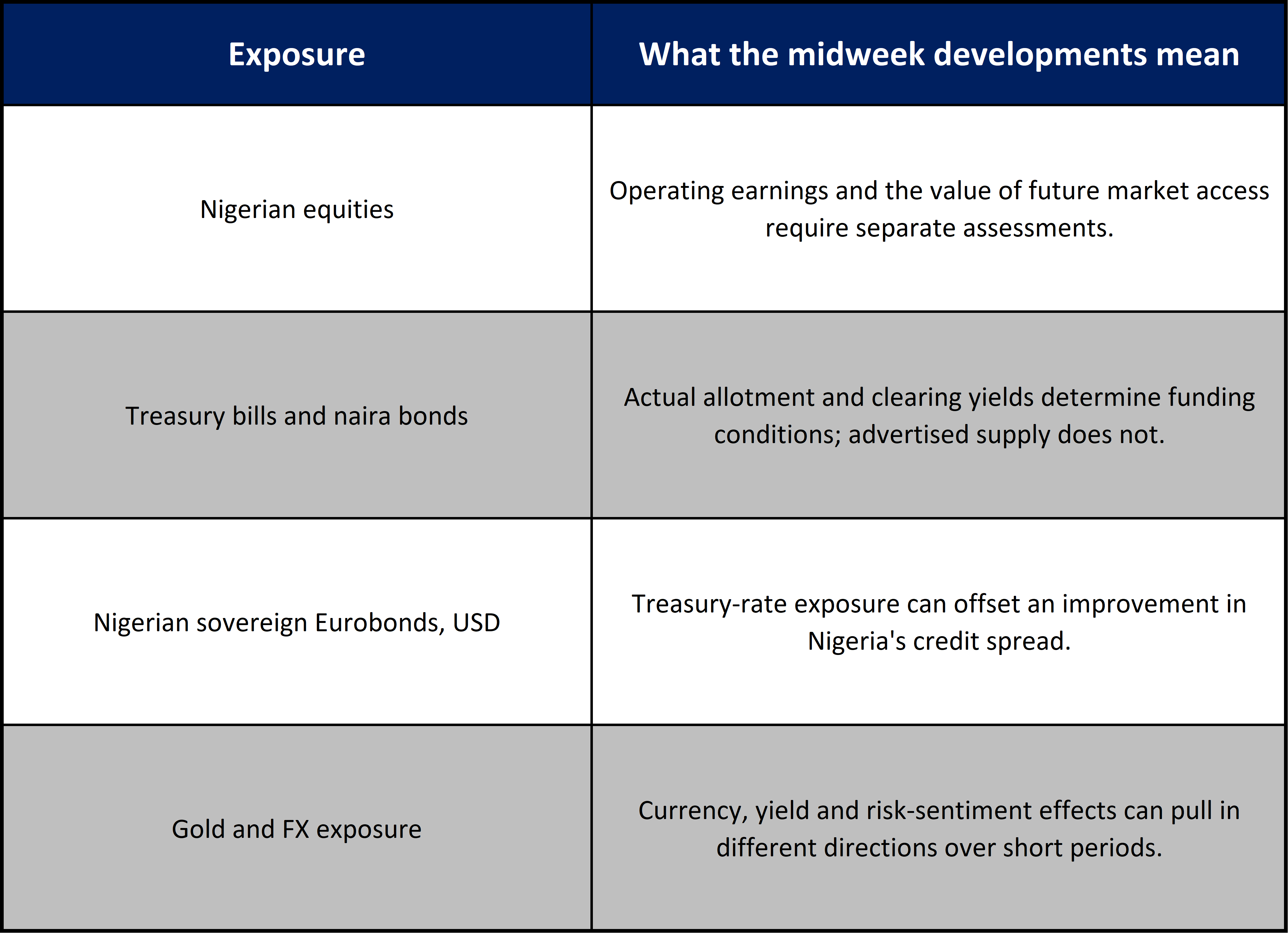
A secondary listing can make a company accessible to investors whose mandates, custody arrangements or trading systems favour another exchange. If it attracts additional sustained demand and improves liquidity, investors may accept a lower required return. But neither the listing announcement nor the listing itself guarantees those benefits.
Dangote Cement’s notice identifies Dangote Industries as a selling shareholder. A sale of existing shares generates proceeds for the seller; it is not automatically new cash for the cement company. The pause should therefore not be translated into a quantified hole in the company’s expansion budget without evidence of a corresponding funding commitment.
Our interpretation is narrower and more useful: any valuation case dependent on additional London buyers now has an execution gap. That is separate from the assessment of cement demand, margins and investment returns. The board cited market conditions and strategic priorities, not an operating downgrade. A restarted transaction with disclosed terms could restore the access catalyst; an announcement alone would still not demonstrate improved trading depth. Nor does this decision establish a withdrawal of foreign capital from Nigeria as a whole.
Nigeria Market Intelligence
Equities: The ASI closed Tuesday at 252,313.16 points. Banking fell 0.67%, while more shares advanced than declined overall. Portfolio performance can therefore diverge from the headline index. Before Friday, the useful test is whether participation and turnover strengthen beyond the companies dominating index movements.
Fixed income and liquidity: AIICO reported Tuesday overnight funding at 20.25% and broadly unchanged secondary FGN bond yields. The DMO’s new circular specifies a N2 trillion bond offer for 16 November, with settlement on 18 November. These are prospective proceeds, not cash already raised. Auction pricing will help establish the return corporate issuers must compete with. Wednesday’s N800 billion Treasury-bill offer was verified, but its result could not be independently verified for this draft; no stop rate or allotment is assumed.
FX and business cash flow: The official naira weakened on Tuesday. For an importer paying in dollars, depreciation can compound supplier-price pressure and increase the naira needed to replenish the same inventory. The decision-relevant measure is the obtainable exchange rate on the payment date, alongside supplier terms and financing costs. Watch actual dollar access and settlement conditions, not just a headline rate.
Global Market Intelligence
US rates remain the financing constraint. Core CPI increased 0.3% for a third consecutive month. a conventional annual headline should not be inferred. For Nigeria, the transmission runs through the Treasury benchmark, the borrower’s credit spread and currency costs. A better sovereign or corporate credit story can still coincide with more expensive refinancing if the US benchmark rises. For existing Nigerian USD bonds, credit improvement does not eliminate interest-rate exposure. Friday’s producer-price release is the next scheduled inflation check.
Equity sentiment is not a funding signal. US stocks and gold fell on Tuesday. Asian equities, US futures and gold recovered early Wednesday, and European shares were higher in the morning. Those observations describe a rebound in sentiment, not evidence that dollar financing has become cheaper. The distinction matters for companies depending on favourable equity markets to complete transactions.
Oil relief remains reversible. Brent futures settled at $91.49 a barrel on Tuesday, then traded at $92.71 at 15:12 WAT on Wednesday. For Nigeria, sustained lower crude prices would reduce export receipts at unchanged volumes, while potentially easing some business energy costs. That relief depends on product prices, freight and FX, and cannot be read directly from Brent. Monday’s landed-cost discipline still applies.
Asset Class Implications
The same developments affect assets through different channels.
Ranora View:
The change since Monday is not evidence of an economy-wide earnings reversal. It is a reminder that market access and financing terms can change before operating forecasts do. Dangote Cement’s pause removes a prospective access catalyst; persistent US inflation raises the hurdle for dollar funding; domestic auction prices will determine the cost of competing for naira savings.
Our portfolio conclusion is to separate earnings risk from liquidity and funding risk. A credible business can face a less supportive valuation environment without suffering weaker operations. For business owners, expansion budgets need funding contingencies that do not depend on a favourable listing window or an assumed decline in borrowing costs.
What to Watch Next
Pricing ahead of the 16 November FGN bond auction, especially whether demand absorbs the offered supply without higher clearing yields.
Any Dangote Cement disclosure on a revised listing timetable, transaction structure or financing plans.
US October producer prices on Friday 13 November at 14:30 WAT, and the response of dollar yields and credit spreads.
Question for the day:
How much weight should a prospective overseas listing carry in a Nigerian company's valuation before it delivers additional investors or demonstrably better liquidity?
Stay smart. Stay informed. Subscribe to Ranora Market Outlook for free and support independent market analysis.