


Opening View
Monday’s central question was whether earnings could justify the NGX rally after falling domestic yields encouraged investors to move beyond fixed income. GTCO has now provided the first meaningful test.
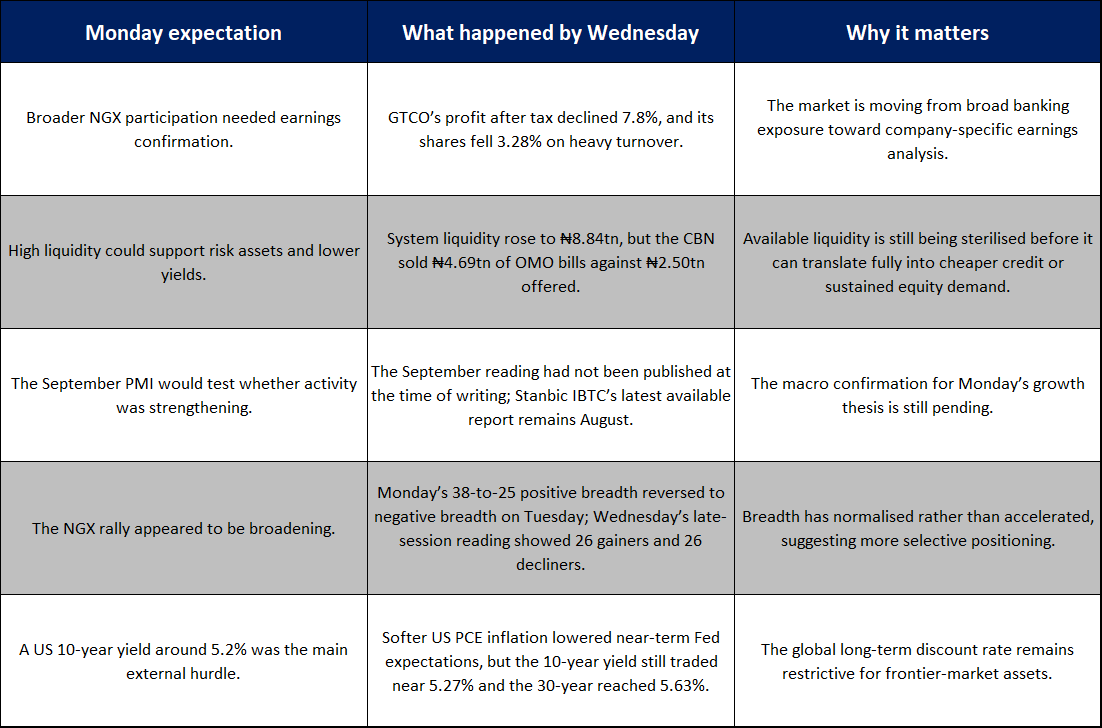
The group reported only 0.4% growth in first-half profit before tax, while profit after tax declined 7.8%. The result was not a balance-sheet warning: capital adequacy remained strong, asset quality improved and core interest income grew. The more important message was that revenue growth did not convert cleanly into shareholder earnings. A larger tax charge, weaker fee income and a ₦46.2 billion fair-value loss diluted the benefit of stronger interest and trading income.
Investors responded by pushing GTCO down 3.28% on Tuesday, with the stock accounting for roughly one-third of total market value traded. This was not simply profit-taking. It was evidence that, after a 62% year-to-date rise in the broader market, investors are beginning to distinguish between headline profitability and durable earnings conversion.
Elsewhere, the CBN absorbed ₦4.69 trillion through OMO bills even as system liquidity reached ₦8.84 trillion. Globally, softer US inflation reduced expectations of another immediate Federal Reserve increase, but the 10-year Treasury yield remained above 5.2%. The result is a market with ample cash, but a rising threshold for where that cash is allocated.
What Changed Since Monday
Market Pulse
Nigerian equities: The ASI gained 0.21% on Monday, fell 0.29% on Tuesday and was up approximately 0.18% at 3:57 p.m. WAT on Wednesday. At 252,378.86 points, the late-session reading was still slightly below Monday’s close. Wednesday breadth was evenly split.
Fixed income and liquidity: Banking-system liquidity rose to ₦8.84 trillion before settlement of the latest OMO operation. The CBN allotted ₦4.69 trillion against a ₦2.50 trillion offer, with stop rates ranging from 16.23% to 17.24%. Average secondary Treasury-bill yields remained close to 17.9%, while average benchmark bond yields eased to 15.76% on Tuesday.
FX and the naira: The naira strengthened marginally to ₦1,330.47/$ at NAFEM on Tuesday from ₦1,331.32/$ on Monday. That stability deserves a caveat: Monday’s NFEM turnover fell to $196.7 million, its lowest level in seven weeks.
Oil: Brent settled at $96.16 on Tuesday after falling 1.7%, before rebounding approximately 2.7% to $98.75 during Wednesday’s US session. The reversal illustrates how quickly geopolitical supply expectations are repricing Nigeria’s external-revenue outlook.
Global risk sentiment: Softer US inflation supported equities on Wednesday, with the S&P 500 up 0.5% and the Nasdaq up 0.9% around 11 a.m. ET. However, long-term Treasury yields remained elevated.
Nigeria Deep Dive: GTCO’s Result Changes the Banking-Sector Question
GTCO reported first-half profit before tax of ₦603.03 billion, only 0.4% above the comparable period. Profit after tax declined to approximately ₦414.2 billion from ₦449.0 billion, while earnings per share fell to ₦11.18 from ₦13.59.
The result was more complicated than the share-price reaction suggests. Interest and trading income increased by 7.5% and 24.7% respectively. Cost of risk improved to 0.6% from 2.2%, group capital adequacy remained high at 34.9%, and group Stage 3 loans improved to 4.6% from 5.0% at the end of 2025.
The weakness appeared in earnings conversion. A ₦46.2 billion fair-value loss limited pre-tax growth, while a higher tax charge and weaker fee income pulled profit after tax lower. The market’s response was decisive: GTCO fell 3.28%, with ₦11.73 billion of its shares traded, equivalent to about 34% of the entire market’s value turnover on Tuesday.
The sharper interpretation is that falling sovereign yields will not automatically rerate every bank. As monetary conditions evolve, the market will pay more attention to recurring fee income, loan growth, deposit costs, tax exposure and the durability of non-interest revenue. Strong capital remains valuable, but investors are now demanding evidence that capital can produce higher distributable earnings.
This view would be weakened if GTCO restores fee growth, reverses fair-value losses or reports stronger earnings conversion in subsequent periods.
Global Markets Deep Dive: Softer Inflation Did Not Fix the US Long End
US headline PCE inflation came in at 3.4% year on year for August, below the 3.7% expected in the market. That reduced the implied probability of another Federal Reserve increase in October to about 35% from roughly 50% a day earlier. The two-year Treasury yield fell to 4.86%.
The long end did not follow. The 10-year yield traded near 5.27%, while the 30-year reached 5.63%. This divergence suggests that the bond market’s concern extends beyond the next Fed decision. Oil volatility, resilient economic activity and the supply of long-dated government debt are keeping term premiums elevated.
For Nigerian investors, this matters in three ways. First, high US long yields keep the return hurdle elevated for foreign allocations to Nigerian equities and Eurobonds. Second, a softer dollar may provide temporary support for the naira, but that support will be fragile if US long yields continue rising. Third, Nigerian duration can rally on domestic disinflation while still facing an external ceiling imposed by global rates.
The next major test is Friday’s US employment report. A strong labour reading could restore expectations of further Fed tightening even after the softer PCE release.
Ranora View:
Monday’s thesis was that earnings needed to catch up with the NGX rally. GTCO has now shown what that test looks like in practice.
The result does not invalidate the banking-sector investment case. It narrows it. The strongest opportunities are likely to be companies that can convert balance-sheet strength into recurring earnings while protecting fee income and controlling funding, impairment and tax costs.
In fixed income, the latest OMO operation confirms that abundant liquidity will not be allowed to circulate without restraint. Short-duration carry remains attractive, while additions to longer duration should be gradual because domestic supply and the US long end can interrupt further yield compression.
For equities, the appropriate response is greater selectivity rather than a retreat from the market. The NGX index has held close to Monday’s level, but breadth and GTCO’s high-volume reaction show that investors are raising the evidence threshold. Earnings quality is beginning to matter more than the simple availability of cash.
What We Are Watching Before Friday
September Nigerian PMI: Evidence that new orders and output remained firm would support consumer, industrial and banking earnings expectations.
The OMO settlement effect: A meaningful fall in system liquidity or rise in overnight rates would confirm that the ₦4.69 trillion operation is tightening cash conditions.
Banking-sector follow-through: Whether GTCO stabilises and whether selling spreads to other large banks will show if Tuesday’s move was company-specific or the start of a sector reassessment.
US employment data: The September jobs report is scheduled for Friday and could move Fed expectations, the dollar and global yields.
Brent and the naira: A renewed move above $100 would support Nigeria’s revenue expectations but could also revive global inflation pressure and keep US yields elevated.
Question for the day:
Do you expect the CBN’s reset to produce genuinely cheaper credit, or will high reserve requirements and continued liquidity sterilization keep borrowing costs elevated?
Stay smart. Stay informed. Subscribe to Ranora Market Outlook for free and support independent market analysis.