


Opening View
Monday’s baseline treated October’s Nigerian business survey as a pending test. The result now in view sustains the expansion story, but exposes a weak link between stronger company activity and a wider household-spending recovery.
The Stanbic IBTC Nigeria PMI eased to 55.7 from 56.4 in September, remaining above the 50-point expansion threshold. More important than that modest decline: new orders and output continued to rise strongly, hiring remained limited, and firms reduced outstanding work. Businesses were meeting additional demand without a comparable recruitment surge.
Our interpretation is that better use of existing resources can support individual companies’ operating margins before it creates a broad increase in employment income. That distinction matters for consumer-facing businesses, lenders and investors building earnings forecasts. Higher fuel-related costs and faster selling-price increases also mean that stronger activity is not automatically improving purchasing power.
Elsewhere, Wednesday’s reported Treasury-bill allotment increased without another reduction in stop rates. Global markets began repricing the US election outcome, but the new US services survey still showed elevated price pressure.
The midweek distinction is between companies serving visible demand and those whose growth plans require a wider rise in household incomes. Their earnings can diverge even within an expanding economy.
The Big Picture:
What changed since Monday:
Activity: The survey on Monday’s watchlist is now available. It supports continuing expansion, but its hiring detail limits what can be inferred about the next wave of consumer demand.
Access to bills: Monday’s reference was the unusually small 28 October allotment. FMDA reports a larger sale today at the same stop rates. Availability improved; the government’s auction pricing did not ease further.
Global risk: The US vote has moved from an event ahead to a reported outcome being priced. The immediate market response must now contend with today’s services data and Friday’s employment report.
These are different transmission channels. More orders affect operating earnings; more securities allotted affect cash deployment; lower US yields can affect dollar funding. None alone establishes easier credit for Nigerian businesses.
Nigeria Market Intelligence
1. The Hiring Gap Changes the Consumer Test
The survey suggests that companies can accommodate stronger orders with existing capacity and only modest staffing additions. For an individual business, spreading fixed costs across more output can improve profitability. For the wider economy, however, limited recruitment means a weaker route from business expansion to additional household wages.
That is why a strong activity reading is insufficient evidence for a broad discretionary-spending recovery. A manufacturer supplying business customers may benefit from fuller order books while a household-facing retailer still encounters affordability constraints. Both can be operating in the same expanding economy.
For founders and executives, the capital-allocation question is whether additional equipment or permanent staffing is required to fulfil visible orders, or whether current resources can meet them. For lenders, a busy borrower still needs collections sufficient to service debt; revenue growth does not remove that test.
This is a survey-based interpretation, not a measured national productivity gain. The view would change with stronger hiring, improving real incomes and broader consumer-volume growth. The next company updates should distinguish those developments from price increases alone.
2.More Bill Allocation Is Not Cheaper Business Funding
FMDA reports NGN509.4 billion allotted at Wednesday’s Treasury-bill auction, compared with NGN71.16 billion on 28 October. The 91-day, 182-day and 364-day stop rates remained 15.40%, 15.79% and 15.80%. These are auction discount rates, not true yields or current secondary-market offers.
The change is the amount issued at those rates. FMDA also reports a NGN2.95 trillion OMO sale on Tuesday, a reminder that liquidity availability can change with central-bank operations. That gross sale is not a measure of the net change in system cash.
Before Wednesday’s auction, Cordros placed Tuesday’s overnight funding reference around 20.2% and its average secondary FGN bond yield around 16.2%, the latter unchanged on the day. Neither is a corporate borrowing quote. The immediate test is how settlement affects funding and secondary-market pricing.
3.The Index Has Not Established a Broad Advance
The NGX All-Share Index closed Tuesday at 254,289.35 points, up 0.02% from Monday’s 254,245.21. Tuesday still had 20 advancing stocks against 32 decliners.
The index recovered slightly, but participation remained narrow. That makes a general market rise a weak substitute for evidence on an individual company’s demand, costs and earnings. Watch whether subsequent gains become more widely shared.
4.FX Stability Still Needs an Execution Check
Cordros reported Tuesday’s official-market reference at NGN1,347.43 per US dollar, slightly firmer on the day. It is not a Wednesday executable conversion quote.
For importers, the business benefit depends on obtainable dollars, the dealing spread and payment timing. A stable reference rate cannot by itself establish a lower landed cost.
Global Market Intelligence
1. Election Repricing Is Not Yet a Funding Regime
Reuters reported Democratic wins in both chambers of the US Congress. Wednesday’s trading moved from early equity weakness to recovery, alongside lower Treasury yields and a softer dollar in the European morning. Later US trading showed broad equity gains but pressure on data-centre-related shares.
For Nigeria, a lower US benchmark yield can reduce the base-rate component of dollar financing. It does not prove that Nigerian sovereign spreads have narrowed, that corporate refinancing is cheaper after fees, or that foreign money has entered the NGX. Political expectations also remain distinct from enacted policy.
2.Services Prices Limit the Easing Interpretation
The US ISM services index slipped to 54.5 in October from 54.9, but its prices-paid index remained elevated at 73.0, down from 74.0. These are survey indices, not inflation percentages.
A modest slowdown in activity therefore coexists with persistent cost pressure. Friday’s jobs and wage data will help test whether the fall in Treasury yields is supported by the economic evidence. Nigerian dollar borrowers remain exposed to both the US rate component and their own credit premium.
3. Oil Relief Must Reach Delivered Costs
Brent futures reversed earlier losses in early Wednesday trading after Tuesday’s decline. Gold was also firmer in early trading as the dollar softened. Those were intraday observations, not completed-day returns.
For Nigeria, sustained lower oil prices would reduce the price component of export receipts while potentially easing energy costs. Companies benefit only when the change reaches delivered fuel and transport charges. The Nigerian survey’s fuel-cost pressure is a reason to distinguish that pass-through from movements on an overseas screen.
Asset Class Implications
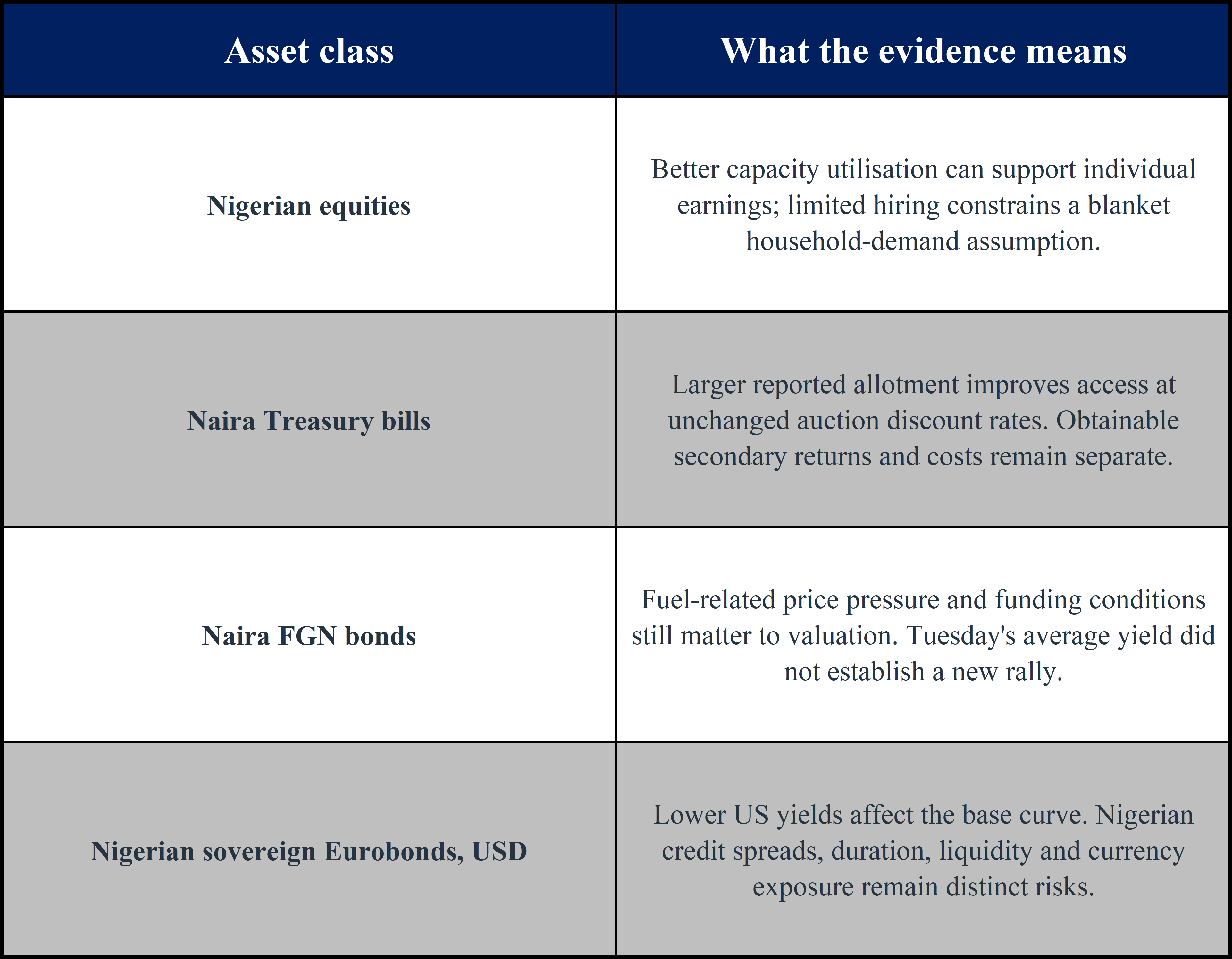
The transmission matters more than a single headline market move.
What Changed in Our Investment Ideas
MTN Nigeria Communications Plc ordinary shares | NGX MTNN | NGN
Thesis ID: NG-EQ-MTNN-NETWORK-20261102 | Status: Pending, entry deferred.
Monday’s call added an important qualification to the fibre thesis. Management said home fibre does relieve mobile traffic, but greater scale is needed before that benefit becomes material. It also indicated that radio and backhaul would continue to take the largest share of capital spending.
The opportunity remains a network-efficiency and connection-economics question, but the call does not justify bringing forward substantial savings in the valuation. The prospective horizon remains 12-24 months after any qualifying entry, not a near-term savings trade.
No verified executable quote, dealing costs or new valuation evidence resolves Monday’s entry conditions. Payback, cash-investment requirements, energy and FX exposure, and customer adoption remain central risks. Evidence of material capacity benefits with acceptable connection returns could strengthen the case; spending ahead of adoption would weaken it. No purchase or investment return is implied.
Ranora View:
The evidence supports a distinction between an operating recovery and an income-led expansion. A company can improve earnings through stronger utilisation without a matching improvement in its customers’ spending power. Portfolio earnings assumptions should recognise that difference, particularly where valuations depend on broad discretionary demand.
For businesses, expansion spending needs visible orders and collectible cash, not simply a positive PMI. For funding decisions, larger bill allotments and a softer US yield curve are useful developments, but neither substitutes for actual borrowing terms.
Our view would become more constructive on the breadth of the recovery if hiring, real incomes and consumer volumes begin to reinforce the improvement in business activity.
What to Watch Next
Auction settlement and funding: Does Wednesday’s larger bill allotment change overnight conditions and obtainable secondary-market yields?
Equity participation: Do Thursday and Friday gains, if any, extend beyond a narrow group of stocks?
Company demand and costs: Look for volume, hiring and delivered-energy-cost evidence in new disclosures, rather than treating nominal revenue growth as sufficient.
US employment, Friday 6 November at 14:30 WAT: Watch wages and hiring alongside the headline jobs number, and whether Treasury yields sustain their post-election response.
Question for the day:
In your business or portfolio, is stronger demand translating into new hiring, or mainly into heavier use of existing capacity?
Stay smart. Stay informed. Subscribe to Ranora Market Outlook for free and support independent market analysis.