


Opening View
Two important assumptions from Monday have changed.
The first is that the NGX could build on its strong start to the week. After advancing 1.20% on Monday, the All-Share Index fell by 0.73% on Tuesday and another 1.12% on Wednesday. It closed at 243,967.09, leaving it 1.84% below Monday’s close and 0.65% below last Friday’s level.
Monday’s rally had already carried a warning: 37 stocks declined while only 27 advanced. The index rose, but participation was weak. The subsequent reversal suggests investors are becoming more selective after a strong market run.
The second change came from the United States. July inflation did not deliver the upside surprise investors feared. Headline inflation slowed to 3.4%, while core inflation eased to 2.5%. Treasury yields declined and expectations of a September Federal Reserve rate increase moderated.
That relief is useful for emerging and frontier markets, but it is not decisive. Brent crude remained close to $89 per barrel, keeping energy-driven inflation risk alive.
For Nigerian investors, the midweek message is clear: avoid treating either the NGX decline or the US inflation relief as a complete trend signal. Equity selection, fixed-income yields, oil and naira liquidity remain the more important portfolio drivers.
The Big Picture:
What has changed since Monday is not simply that Nigerian equities have declined. The more important change is that Monday’s narrow rally failed to attract broader participation.
Monday expectation: The NGX could extend its opening-week advance.
What happened by Wednesday: The ASI fell for two consecutive sessions and is now 1.84% below Monday’s close.
Why it matters: Index gains supported by a small group of heavily weighted companies are vulnerable when those stocks reverse. The decline does not automatically signal a wider market breakdown, but it raises the threshold for buying momentum-driven names.
Monday expectation: US inflation could strengthen the case for another Fed rate increase.
What happened by Wednesday: Headline CPI rose 0.1% month on month and 3.4% year on year. Core CPI increased 0.2% monthly and 2.5% annually.
Why it matters: The immediate risk of a September rate increase has declined. This reduces one source of pressure on global bonds, growth equities and emerging-market capital flows.
Monday expectation: Oil would remain the week’s main geopolitical variable.
What happened by Wednesday: Brent remained around $88.84 per barrel, while the US Energy Information Administration projected an average of approximately $85 per barrel in the third quarter.
Why it matters: Higher oil can support Nigeria’s export receipts and fiscal revenue, but it may also keep global inflation and US yields elevated. Nigeria benefits only when stronger prices are matched by production and dollar remittances.Thanks for reading! Subscribe for free to receive new posts and support my work.
Nigeria Market Intelligence:
The NGX has surrendered Monday’s advance
What happened: The NGX All-Share Index closed Wednesday at 243,967.09, falling 1.12% during the session. This followed Tuesday’s 0.73% decline. Market capitalization fell to ₦157.49 trillion from ₦160.42 trillion on Monday, a reduction of approximately ₦2.93 trillion.
Why it matters:The market has moved from a narrow Monday rally to a large-cap-driven reversal. BUA Foods declined by 10% on Wednesday, demonstrating how weakness in heavily weighted companies can pull the index lower even when overall breadth is balanced.
What it means for investors: The pullback increases the importance of earnings quality, valuation and position sizing. Companies supported by cash flow, dividends and defensible margins should be separated from stocks whose recent gains have depended primarily on liquidity.
What to watch next: Thursday’s market breadth will help determine whether the decline is spreading or remains concentrated in a limited number of index-heavy stocks.
Monday’s market breadth was the warning
What happened: The ASI gained 1.20% on Monday, but 37 stocks declined while only 27 advanced. By Wednesday, breadth was balanced at 32 gainers and 32 losers, yet the headline index still fell by 1.12%.
Why it matters: The contrast shows that breadth and index direction can tell different stories. A few large companies can lift or depress the index even when the average listed stock is moving differently.
What it means for investors: The ASI should not be used as the sole signal for portfolio decisions. Investors should monitor sector performance, company-specific earnings and trading liquidity before concluding that the entire market is strengthening or weakening.
What to watch next: A sustainable recovery would be more convincing if it combines a rising ASI with positive market breadth and stronger participation across banking, consumer, industrial and telecom stocks.
The Treasury-bill auction remains the key local rates test
What happened: An approximately ₦700 billion Treasury-bill offer was scheduled for 12 August. The latest result verified before publication was the 15 July auction, when the 364-day stop rate eased marginally to 17.66% from 17.70%.
Why it matters: The 364-day stop rate remains a meaningful hurdle for equities. If investors can obtain attractive government-security yields, companies must offer stronger earnings growth, dividends or valuation upside to justify additional risk.
What it means for investors: Short-duration fixed income remains relevant for liquidity management and capital preservation. The next allocation decision should depend on the published stop rates and subscription levels, not assumptions about the auction outcome.
What to watch next: The 364-day stop rate, bid-to-offer ratio and total allotment. Strong demand accompanied by lower stop rates would indicate continued liquidity seeking government securities.
Global Market Intelligence:
US inflation reduced the immediate Fed risk
What happened: US headline inflation rose 0.1% in July and slowed to 3.4% year on year from 3.5% in June. Core inflation increased 0.2% during the month and eased to 2.5% annually from 2.6%.
Why it matters: The report did not provide the upside surprise that could have strengthened the case for a September rate increase. Market-implied expectations of a September hike fell to approximately 38% from around 50% a day earlier.
What it means for investors: Lower Fed tightening risk is marginally positive for bonds, growth equities and emerging-market carry. It may also reduce immediate upward pressure on the dollar.
What to watch next: US producer-price data and retail sales. These will show whether inflation relief is consistent with easing pipeline costs and sustainable consumer demand.
US yields eased, but remain restrictive
What happened: The US 10-year Treasury yield declined to approximately 4.66% from 4.70% late Tuesday following the inflation report.
Why it matters: The decline reduces some pressure on long-duration assets, but a yield above 4.6% still offers global investors a substantial return in a deep, dollar-denominated market.
What it means for Nigerian investors: Nigeria must continue offering sufficient naira carry, credible FX liquidity and attractive valuations to compete for international capital. A small decline in US yields helps, but it does not guarantee renewed frontier-market inflows.
What to watch next: Whether the 10-year yield holds below 4.70% after producer-price data, retail sales and further US Treasury issuance.
Oil remains both support and risk for Nigeria
What happened:Brent traded around $88.84 per barrel on Wednesday. The EIA expects Brent to average approximately $85 per barrel in the third quarter, based partly on continued constraints affecting oil shipments through the Strait of Hormuz.
Why it matters: Higher crude prices can improve Nigeria’s export and fiscal receipts. However, expensive oil also raises transportation, freight and production costs globally, potentially delaying disinflation and keeping international interest rates high.
What it means for investors: Oil-linked Nigerian companies may benefit from stronger realised prices, while consumer and industrial businesses could face renewed cost pressure. The sovereign benefit depends on production volumes, operating costs and the conversion of oil sales into official dollar liquidity.
What to watch next: Strait of Hormuz developments, Nigerian production data and evidence that higher export prices are translating into stronger reserves or NFEM supply.
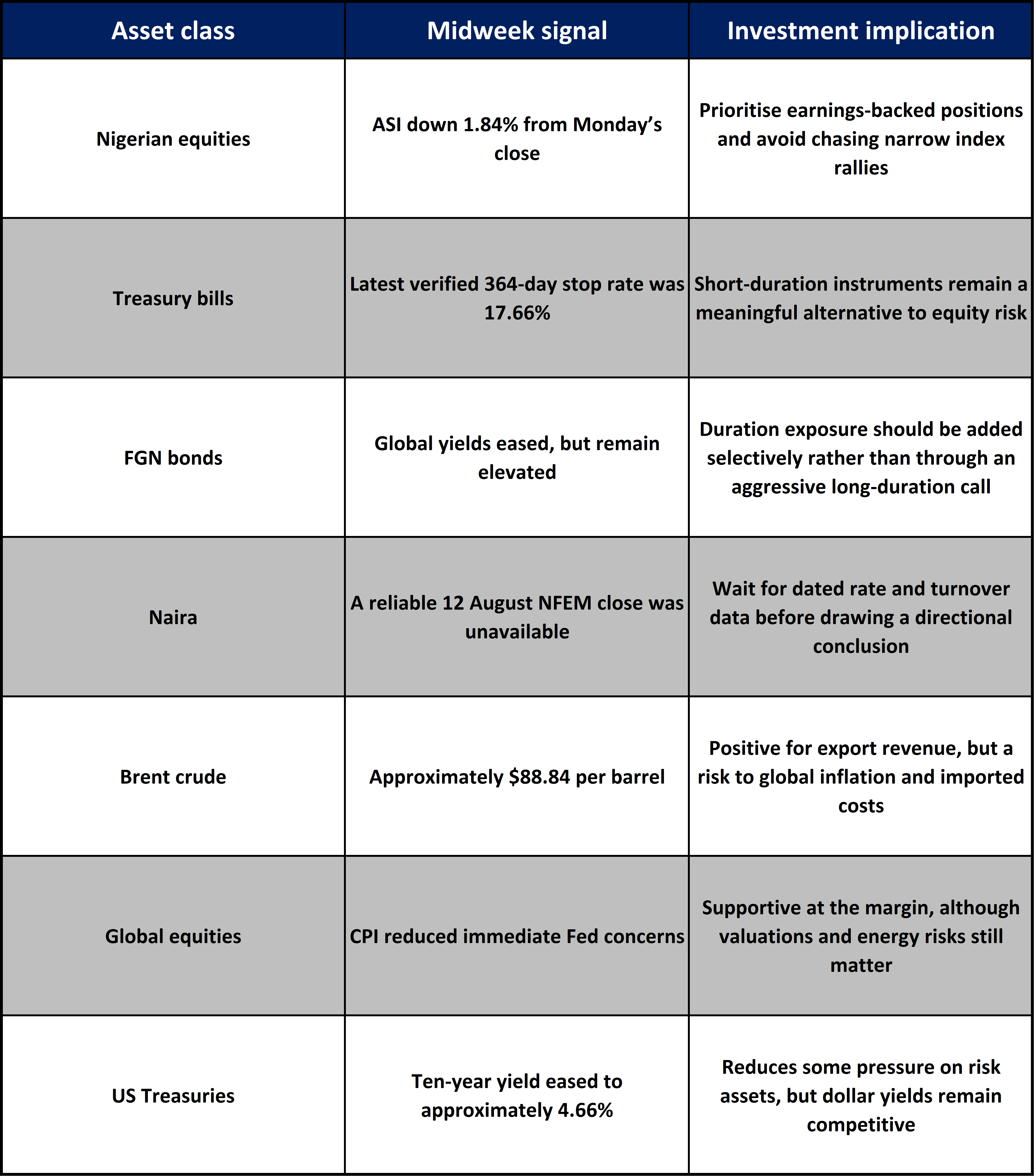
Asset Class Implications:
Ranora View:
The evidence available by Wednesday supports selectivity rather than a broad risk-on or risk-off position.
On the NGX, Monday’s negative breadth and the subsequent 1.84% reversal argue for disciplined entry prices and lower tolerance for liquidity-driven momentum. The pullback is not yet evidence of a market-wide breakdown, but it has raised the burden of proof for further gains.
In fixed income, the last verified 364-day Treasury-bill stop rate of 17.66% remains a meaningful hurdle for equities. Investors should compare expected dividend yields and earnings growth with the return available on government securities.
Globally, the US inflation report has reduced the immediate probability of another Fed increase. However, Brent near $89 means the inflation story remains exposed to energy and geopolitical developments.
Our preferred positioning is therefore to keep short-duration naira assets relevant, retain exposure to Nigerian companies with pricing power and reliable cash generation, and wait for broader NGX participation before interpreting the pullback as a market-wide buying opportunity.
What to Watch Next:
The published 12 August Treasury-bill stop rates, subscription and allotment figures.
Whether NGX breadth strengthens before Friday.
US producer-price inflation and retail-sales data.
Brent’s response to developments around the Strait of Hormuz.
A dated CBN NFEM rate and turnover reading.
Question for the day:
Does the NGX pullback represent a healthy reset after a strong run, or is Monday’s weak breadth the first sign that investors are becoming more selective?
Stay smart. Stay informed. Subscribe to Ranora Market Outlook for free and support independent market analysis.
Interesting read.
Wow magnificent