


Opening View
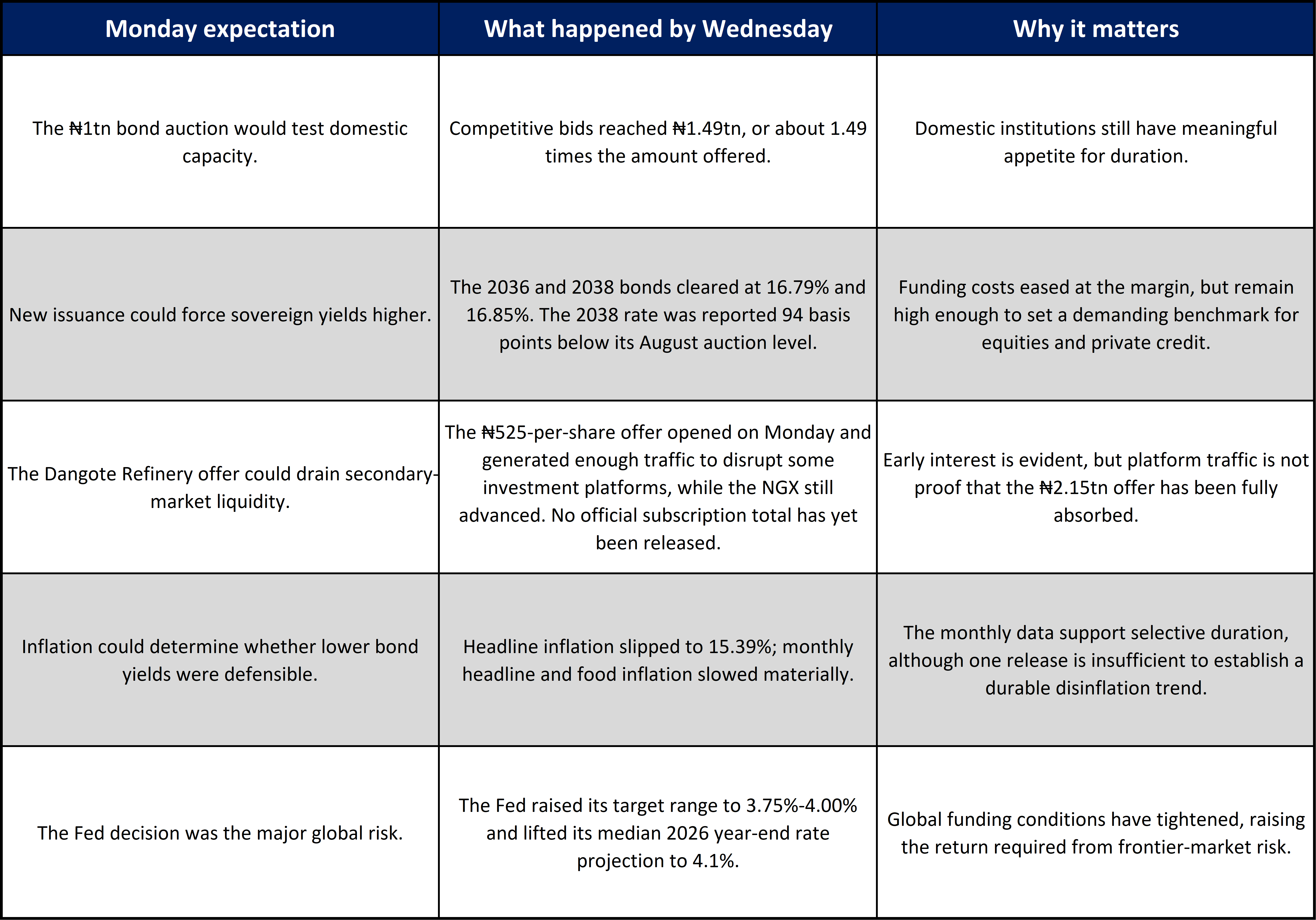
Monday’s question was whether Nigeria could absorb a ₦1tn sovereign bond auction alongside the opening of Dangote Refinery’s ₦2.15tn public offer without destabilising existing assets. By Wednesday, the initial answer was more constructive than expected.
Investors submitted ₦1.49tn of competitive bids for the two FGN bonds, while the NGX All-Share Index advanced approximately 0.72% from Friday’s close. August inflation also offered some relief: headline inflation eased to 15.39%, while month-on-month food inflation fell sharply to 1.02% from 5.56% in July.
Yet this is not a cheap-money story. The new 2036 bond cleared at 16.79% and the reopened 2038 bond at 16.85%. Overnight money remained above 22% on Tuesday. Globally, the Federal Reserve raised rates by 25 basis points and projected a year-end policy rate of 4.1%, implying that another increase may follow.
The market has therefore passed the first test of capacity, but not the test of affordability. Capital is available for credible sovereign and corporate issuers. The harder question is whether listed companies and new equity offers can produce earnings and cash flows strong enough to compete with a near-17% sovereign return.
What Changed Since Monday
Market Pulse
Nigerian equities: The NGX ASI closed Wednesday at 244,791.79, approximately 0.72% above Friday’s 243,052.74 close. Tuesday’s 0.41% gain was supported by NGX Group, Aradel and selected banking stocks; Wednesday also finished positive, with 38 gainers against 28 decliners.
The rebound is encouraging, but still too small to prove that the market can absorb the entire Dangote offer without portfolio rebalancing.
Fixed income: The auction established new sovereign benchmarks at 16.79%-16.85%. Competitive allotment was ₦748.64bn, while a further ₦850bn was allocated through the non-competitive window. FMDQ reported the overnight rate at 22.21% and the open repo rate at 22.00% on Tuesday.
This is the central midweek signal: long-duration demand strengthened, but short-term funding conditions remain firm.
FX and the naira: The official NFEM closing rate moved only marginally, to ₦1,329.50/$ on Tuesday from about ₦1,329/$ on Monday. Stability during a large domestic issuance week is constructive, although it does not remove the need to monitor dollar turnover and post-Fed portfolio flows.
Oil: Brent traded around US$108-US$109 a barrel on Wednesday after a sharp September rise, while gold strengthened ahead of the Fed decision. Expensive oil supports Nigeria’s potential export receipts but also increases imported fuel, transport and production-cost risks.
Global risk sentiment: The US 10-year Treasury yield reached approximately 5.04% on Tuesday before the Fed decision. US equities subsequently surrendered earlier gains after the rate increase and the Fed chair’s emphasis on persistent inflation.
For Nigeria, a near-5% US risk-free yield makes foreign demand more selective. Stable FX, liquidity and sufficiently wide local yields become more important.
Nigeria Deep Dive: Demand Is Not the Same as Cheap Capital
The auction’s 1.49-times bid cover confirms that Nigeria can still mobilise substantial domestic capital. The stronger demand was concentrated in the reopened 2038 bond, which attracted ₦947.83bn of bids against ₦600bn offered.
The sharper insight, however, comes from price rather than volume.
Investors accepted 16.85% on the 2038 bond, reportedly down from 17.79% in August. That 94-basis-point decline suggests institutions are becoming more willing to lock in duration as inflation moderates. But a sovereign yield near 17% still creates a formidable opportunity cost for equity investors.
A listed company or new issue must therefore offer more than a compelling national-development narrative. It must demonstrate earnings growth, cash conversion, dividend capacity and governance strong enough to justify taking greater risk than an FGN bond.
That standard matters particularly for the Dangote Refinery IPO. The offer may deepen participation and expand the NGX’s investable universe, but investors must distinguish strategic importance from valuation. The official offer remains open until 13 October, and no verified subscription total was available by Wednesday evening.
Global Markets Deep Dive: The Fed Has Raised Nigeria’s External Hurdle
The Fed’s 25-basis-point increase was not merely a one-off adjustment. Its median projection places the federal funds rate at 4.1% at year-end, above the new 3.75%-4.00% range. That points to at least one additional move if inflation and activity follow the Fed’s central forecast.
For Nigerian assets, the transmission mechanism is straightforward:
Higher US yields reduce the relative attraction of frontier-market debt.
A firmer dollar could raise pressure on the naira and imported costs.
Higher global discount rates lower the present value investors assign to long-duration equity earnings.
Refinancing becomes harder for companies with dollar debt or weak cash generation.
Nigeria’s easing inflation and lower domestic bond clearing rate provide some insulation. They do not fully offset a global tightening cycle, especially with Brent near US$109 and the US 10-year yield around 5%.
Ranora View:
The week’s capital-allocation test has produced a qualified positive result.
Nigeria found buyers for sovereign duration, the equity market did not sell off under the initial weight of the Dangote offer, and August’s monthly inflation data gave investors a reason to accept lower long-bond yields. The fear that new supply would immediately overwhelm the market has not materialised.
But the decisive number is still approximately 17%.
That is the return available from long-dated sovereign paper before investors assume company-specific execution, governance and liquidity risk. Equities and new issues must clear that hurdle through credible earnings growth and cash distributions, not simply through scarcity or narrative.
Our positioning implication is to retain short-duration naira carry as the portfolio anchor, add sovereign duration selectively where disinflation evidence strengthens, and concentrate equity exposure in companies whose prospective earnings can outpace the sovereign benchmark. The Fed’s renewed tightening cycle argues against relaxing that discipline.
What We Are Watching Before Friday
Whether the new 2036 and reopened 2038 bonds hold their auction pricing in secondary trading after settlement.
Post-Fed movement in the US 10-year yield and dollar, particularly whether the 5% yield level persists.
NGX breadth and turnover for signs that investors are selling existing holdings to fund IPO subscriptions.
Any official update on Dangote Refinery’s subscription level rather than unverified platform or social-media claims.
Brent’s effect on the naira, domestic fuel costs and the sustainability of August’s inflation slowdown.
Question for the day:
Does the decline in Nigeria’s long-bond clearing rate justify adding duration now, or does a near-17% sovereign yield still make short-term instruments the better risk-adjusted position??
Stay smart. Stay informed. Subscribe to Ranora Market Outlook for free and support independent market analysis.