


Opening View
Monday’s edition asked whether corporate profits were supported by recoverable cash, using Transcorp Hotels as the test case. It also put sovereign income on the watchlist, conditional on actual entry economics. By midweek, that second question has acquired firmer evidence: the government’s bond auction is complete.
The important distinction is between money raised and competitive demand. The DMO secured substantial funding, including non-competitive allotments, but bids were uneven across maturities and the longer bonds cleared above their September rates. That does not establish a funding crisis. It does challenge the idea that a large sale, by itself, validates buying duration across the board.
Tuesday’s return of buyers to the auctioned bonds also matters. Higher clearing yields can attract demand; they are not automatically a reason to avoid fixed income. For investors, the work has moved from anticipating the auction to comparing what can actually be bought, at what net return, and for how long. The equity test remains different: assess collectible cash and financing obligations before paying for earnings growth. A sovereign coupon and a company’s reported profit are both starting points, not complete investment cases.
The Big Picture:
What changed since Monday:
Sovereign income: Monday’s pending auction has become a completed pricing event. The next decision is whether current net yields justify the maturity and resale risk, not whether the funding headline looks impressive.
Equities: Tuesday’s rebound was uneven across sectors. It gives no reason to replace Monday’s company-level cash-conversion test with a broad market call.
Global risk: Wednesday’s earnings news improved appetite for AI-linked shares. That is a sentiment improvement, not proof that the financing concerns highlighted on Monday have disappeared. The supporting market evidence follows below.
Nigeria Market Intelligence
1. Read the auction through its components. The DMO’s rows imply approximately N2.02 trillion in total allotments, including N800 billion of non-competitive allocations. Competitive bids were approximately N1.75 trillion against N1.75 trillion offered. These are Ranora calculations from the complete result, not interchangeable measures of demand. The February 2034 bond attracted N304.08 billion against N500 billion offered. Non-competitive allotments contribute to financing, but they do not demonstrate additional competitive bids. For investors, maturity-specific pricing matters more than the aggregate borrowing number. Watch executable secondary quotes after the scheduled settlement.
2. The equity recovery was selective. The NGX All-Share Index rose 0.26% to 245,911.13 points on Tuesday from Monday’s close. Industrial and consumer goods indices advanced, while the banking index declined. That is sector divergence, not evidence of a general rerating. Prefer companies whose margins, collections and funding needs support the valuation; watch whether subsequent sessions and company filings validate the rebound.
3. Cash availability and investment pricing are separate signals. AIICO reported Tuesday system liquidity of N7.74 trillion, an overnight rate of 20.30% and flat secondary Treasury-bill yields. Separately, Nairametrics reported an FX closing rate of N1,334.99/$ and a volume-weighted NFEM rate of N1,333.65/$. Those exchange-rate measures must not be confused. Neither a cash surplus nor a stable weighted FX reference guarantees an attractive bond entry. Watch funding rates, dollar access and instrument-level quotes together.
Global Market Intelligence
1. Better AI earnings do not settle the financing question. Reuters reported renewed appetite for AI-linked shares on Wednesday, including support from Super Micro’s stronger-than-expected guidance. The distinction is between demand for equipment and the eventual return earned by businesses financing that equipment. For Nigerian investors, improved global sentiment may help risk appetite, but it is not evidence of new foreign inflows into Nigerian assets. Watch cash-generation guidance and financing terms alongside revenue growth.
2. Dollar funding still carries a high base cost. The US ten-year Treasury yield remained above 5% in Reuters’ Wednesday Asian-session report. An equity recovery therefore cannot be treated as cheaper dollar financing for Nigerian borrowers. Separate the US interest-rate component from Nigeria’s sovereign credit premium, using maturity-matched references before assessing Eurobond value. Watch both components rather than the bond’s coupon alone.
3. Energy and gold reversed course within the session. Brent futures were $109.04 a barrel at 14:50 GMT after larger earlier gains faded. Spot gold had recovered earlier losses to $4,138.17 an ounce at 13:28 GMT. For Nigeria, elevated crude can support export receipts while pressuring fuel-intensive businesses; gold is not a guaranteed offset to every energy shock. Watch delivered fuel costs and interest rates before assuming either commodity move improves portfolio protection.
Asset Class Implications
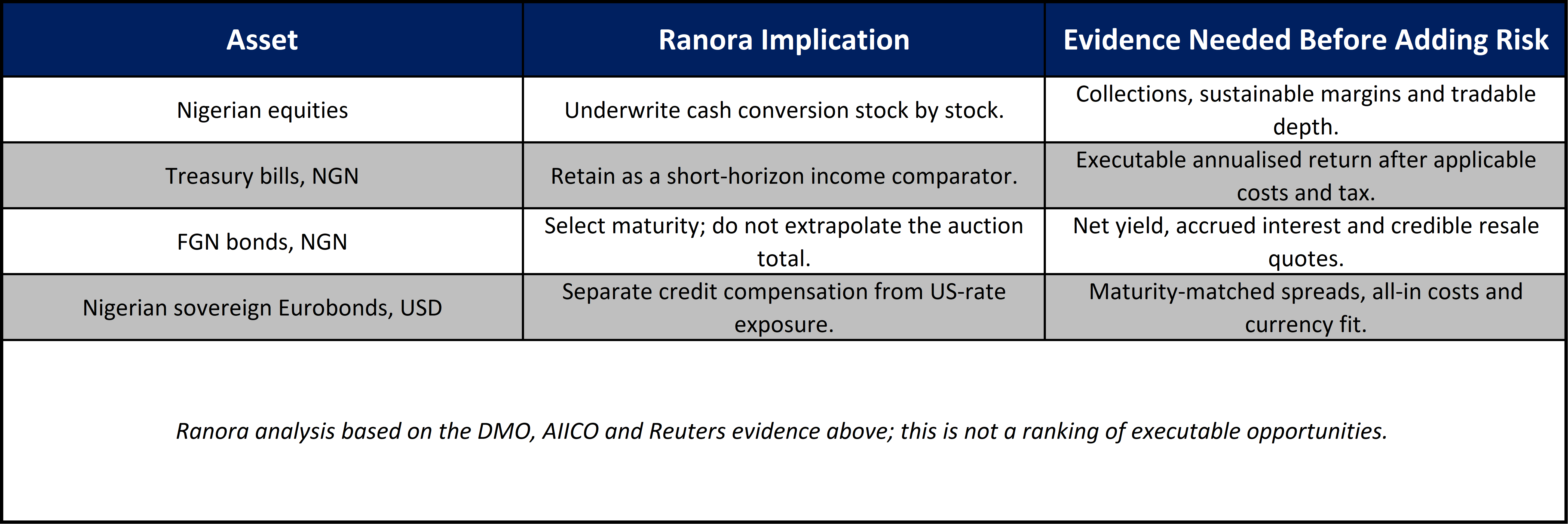
What Changed in Our Investment Ideas:
19.00% FGN FEB 2034, NGN | NG-FGN-2034-INCOME-20261019. Monday’s auction catalyst has occurred: the bond cleared at a 16.99% marginal auction yield; its 19.00% coupon is unchanged. This is a completed auction reference, not today’s executable yield. The September 2036 and June 2038 bonds cleared at 17.29% and 17.19%, respectively, up 50 and 34 basis points from their September auctions. Longer maturity did not produce a uniform yield progression. Entry remains deferred pending current net terms. Compare bills and shorter bonds after spreads, fees, applicable taxes and accrued interest; none of those costs is assumed here. A holding horizon compatible with February 2034, inflation risk, sovereign credit and potential losses on early sale remain central. Reconsider when executable terms establish adequate compensation, not merely because the auction is complete.
Ranora View:
The week’s new evidence supports selective income underwriting, not an automatic extension of maturity. A larger financing result is not the same as stronger competitive demand at every point on the curve. We would become more constructive on duration where sustained secondary buying and executable net yields compensate for the longer commitment. For equities, retain Monday’s discipline: pay for cash that can be collected, and assess the obligations it must meet. These are distinct investment tests, even when both assets appear to offer attractive headline income.
What to Watch Next
Post-settlement bond quotes and funding conditions, rather than waiting for an auction result already released.
Whether equity participation broadens beyond Tuesday’s sector pattern.
Company disclosures on collections, working capital and refinancing obligations.
AI earnings, US Treasury yields and Nigerian USD credit spreads, assessed separately.
Question for the day:
What evidence would make you extend duration now: better net pricing, broader market demand, or greater confidence in disinflation?
Stay smart. Stay informed. Subscribe to Ranora Market Outlook for free and support independent market analysis.