


Opening View
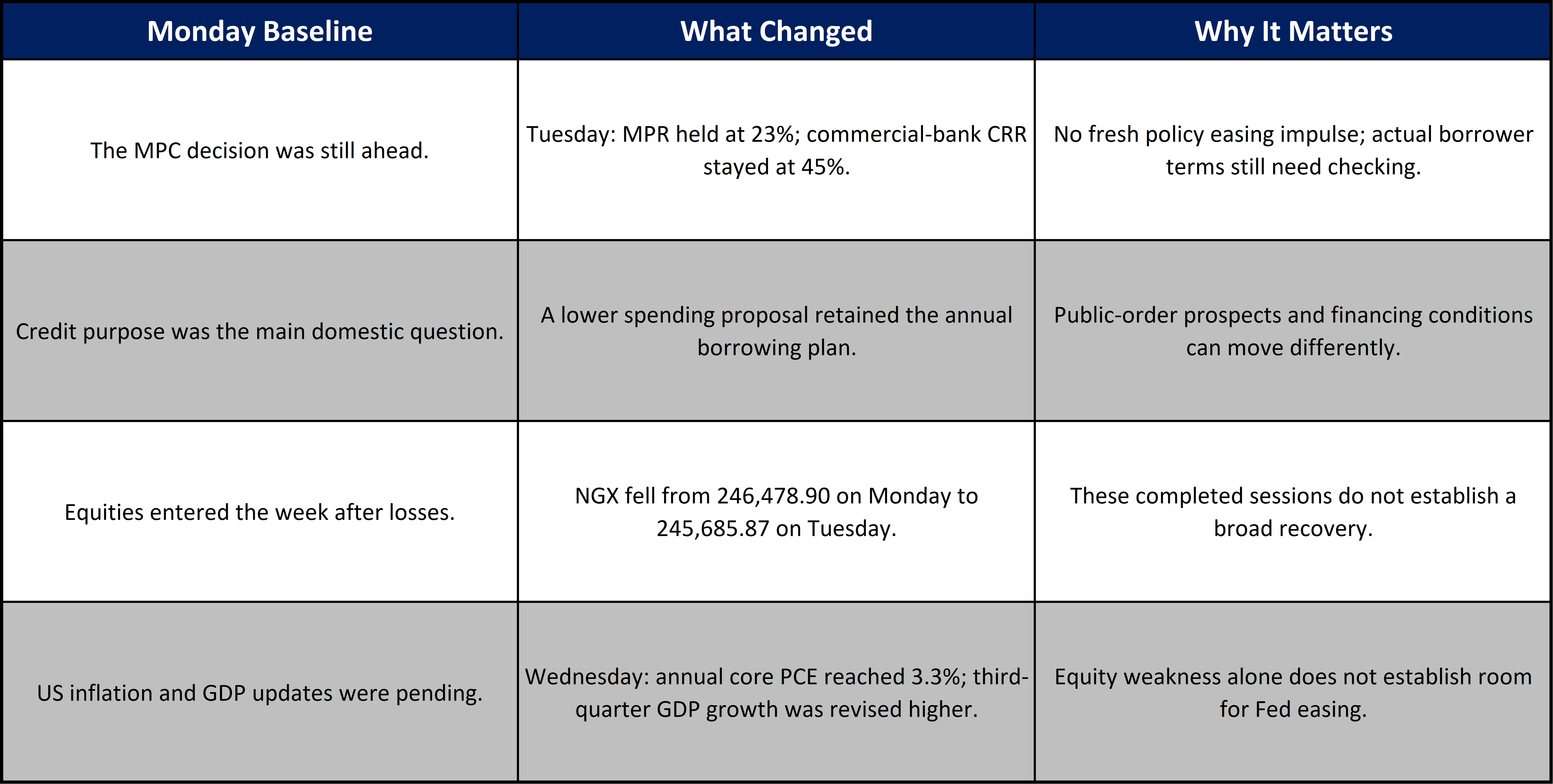
Monday’s question was whether improving credit access was financing inventory and trading activity before a broader expansion in productive capacity. By Wednesday, the policy and fiscal backdrop had become clearer: the CBN had held its benchmark rate at 23%, while the government had proposed reducing budgeted expenditure without reducing planned borrowing.
That distinction matters more than the smaller budget headline. A spending ceiling concerns what government intends to spend; a borrowing programme concerns how much financing it intends to seek. Reducing the former without reducing the latter does not automatically release bank balance-sheet capacity or make private-sector loans cheaper.
For businesses dependent on public contracts, the relevant questions are which projects retain funding and when approved obligations turn into cash. For banks and investors, the test is whether borrowers can finance delivery and collect payment within their loan tenors. The proposal does not yet establish cancelled projects, delayed payments or a measured crowding-out effect.
The global backdrop adds another constraint. Wednesday’s US releases showed stronger reported growth and higher annual core inflation, even as equities remained volatile. Nigeria’s financing outlook therefore needs to be judged through actual borrowing, lending and payment terms, rather than assumed relief from either a smaller budget or softer US bond yields.
The Big Picture: The key change is a separation between proposed fiscal restraint and actual financing relief. Monday’s policy questions now have answers, but the implications for business credit still depend on implementation.
What changed since Monday:
Nigeria Market Intelligence
The budget is a financing test as well as a spending plan. Tuesday’s proposal reduces expenditure to NGN65.18 trillion from NGN68.32 trillion while retaining planned new borrowing of NGN29.22 trillion, including NGN18.43 trillion domestically. These are annual plans, not additional issuance or remaining funding needs. Legislative approval is still required.
Recognising existing obligations and capital warrants may improve execution, but recognition is not cash payment. Contractors still need to finance delivery between approval and collection. For investors assessing public-sector exposure, the test is which projects receive funding, when customers pay and whether financing lasts long enough to bridge that interval.
The policy event is complete; loan pricing remains separate. The CBN retained its 23% MPR and 45% commercial-bank cash reserve requirement. That resolves Monday’s policy event without a new rate cut. It does not fix every loan’s price: lender funding, borrower risk, collateral and maturity still matter.
Tuesday’s overnight money-market reference was 20.30%. The 19.00% FGN February 2034 bond displayed a secondary yield of 16.85%, unchanged on the day. These are market references, not executable investor offers or business lending rates. Wednesday’s additional Treasury-bill auction result could not be independently verified for this cutoff; no new stop rate or allotment is assumed here.
Equity participation remains uneven. The NGX All-Share Index lost 0.32% on Tuesday to 245,685.87. Reported sector data showed insurance rising while banking weakened. The next test is whether participation broadens alongside earnings and funding conditions. Isolated strength does not establish a market-wide recovery, and price movements alone do not identify investor motives.
The naira reference barely moved on Tuesday. The reported official-market reference was NGN1,394.12 per US dollar, against Monday’s NGN1,394.01. Businesses buying imported inputs still need obtainable bank quotes and settlement dates. A reference exchange rate is not a procurement price.
Global Market Intelligence
US data complicate the case for easier dollar funding. October core PCE inflation reached 3.3% year on year, up from September’s 3.1%. Monthly core inflation remained 0.3%. Separately, third-quarter real GDP growth was revised from 3.4% to 4.3% at a seasonally adjusted annual rate.
Annual inflation rose, but monthly core inflation did not accelerate. Even so, these releases do not provide a clean disinflation signal. For Nigerian borrowers, financing costs reflect dollar benchmark rates, credit spreads and fees. A lower Treasury yield alone cannot establish cheaper all-in refinancing.
The equity rebound has not removed financing risk. The Nasdaq Composite rose 6.5% on Monday, then fell 1.5% on Tuesday; the S&P 500 lost 0.5% on Tuesday. At 16:27 WAT on Wednesday, the S&P 500 was reported down 2.7% and the US ten-year Treasury yield at 4.83%. These are intraday observations, not Wednesday closes.
Ranora’s interpretation is that demand for US government bonds can coexist with a retreat from risky assets. Nigerian sovereign USD debt carries separate US-rate and Nigerian credit exposures. No verified spread measurement in this review establishes which is dominating Nigerian Eurobond prices.
Oil and gold are sending different signals. January Brent futures settled at USD91.40 a barrel on Tuesday, up 2.3%, while spot gold fell. Firmer Brent can support Nigerian export receipts if production and collections hold, but can also raise fuel and transport costs. Gold’s decline illustrates why a defensive label does not guarantee gains during an equity selloff.
Asset Class Implications
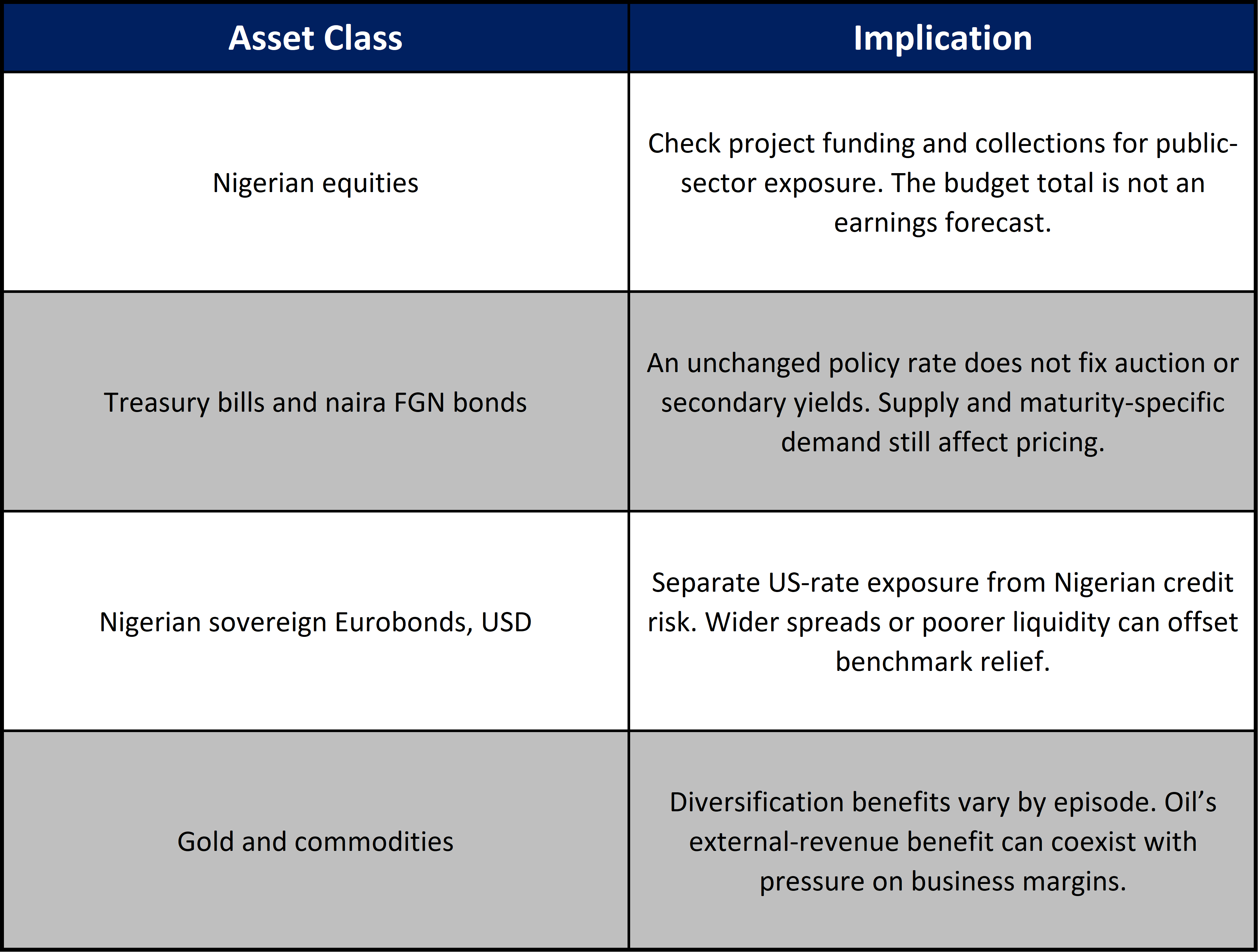
These are portfolio decision tests, not instrument recommendations.
Ranora View:
The change since Monday is a clearer policy setting and a new fiscal proposal, not demonstrated relief in business financing. Planned borrowing has not shrunk alongside proposed expenditure. Earnings and expansion plans should therefore be assessed against attainable credit terms and funded demand, not a presumed fall in the cost of capital.
This is not a claim that government borrowing has already crowded out private lending. That requires lending and funding evidence. A lower implemented financing requirement, more reliable budget releases and easier borrower terms would improve the assessment. Until then, the distinction between an approved order and a financeable, collectible order remains central to capital allocation.
What to Watch Next
Budget follow-through: Legislative clarification and project allocations, distinguishing approval from actual cash releases.
Treasury-bill results: Verify Wednesday’s tender outcome and its effect on comparable secondary pricing, without confusing auction discount rates with true yields.
Business credit and FX: Changes in lending spreads, tenors, collateral demands and obtainable import-financing terms.
Market participation: Completed Wednesday-to-Friday NGX sessions, particularly whether strength extends beyond the sectors already holding up.
US holiday liquidity: US cash equities close for Thanksgiving on Thursday 26 November and close early at 13:00 Eastern on Friday 27 November. Thinner participation can complicate price interpretation.
Question for the day:
Which is the tighter constraint for your business today: the cost of credit, its availability, or the time it takes customers to pay?
Stay smart. Stay informed. Subscribe to Ranora Market Outlook for free and support independent market analysis.