


Opening View
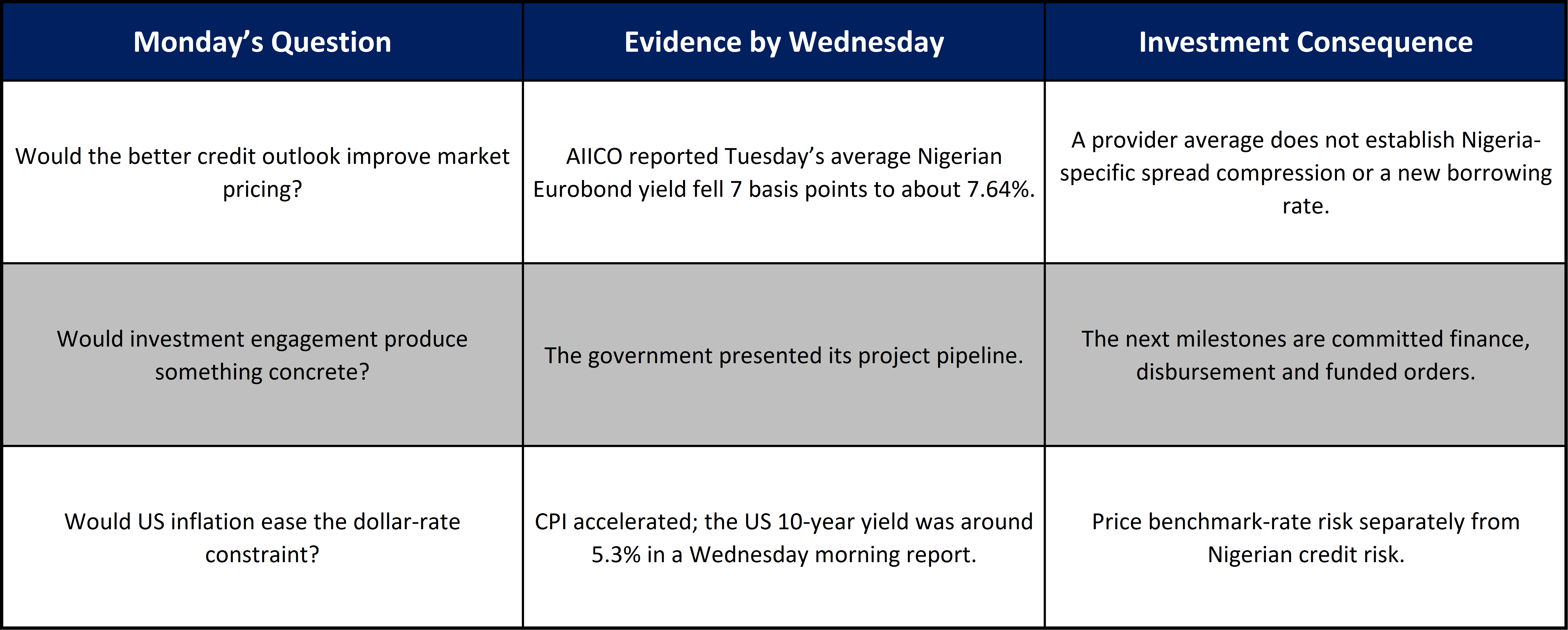
Monday’s question was whether Nigeria’s improved sovereign credit outlook would translate into better funding conditions. By Wednesday, the investment agenda had become more concrete: the government presented a pipeline of 65 projects with stated capital requirements of $78.5 billion. These are funding needs, not investment commitments. The distinction matters for anyone translating the announcement into expected capital inflows or corporate earnings.
The external financing backdrop also changed. US annual consumer inflation accelerated to 3.7% in September from 3.4% in August, and Treasury yields rose after Wednesday’s release. That makes dollar funding a more demanding hurdle even where Nigeria’s own credit story is improving.
Our reading is that the next investable distinction is between projects that can service their financing and projects that merely attract interest. For a business considering dollar debt against naira receipts, the relevant cost includes currency protection, collection delays and refinancing exposure, not just the loan coupon. Investors should therefore look first for funded contracts and credible revenue arrangements. A larger project pipeline alone does not justify higher earnings forecasts for banks, contractors or industrial suppliers.
The Big Picture:
What changed since Monday: Fitch’s starting signal was a Positive outlook revision, not an upgrade from Nigeria’s B rating. We now have a project-financing agenda and renewed US inflation pressure to test it against.
Nigeria Market Intelligence
The financing structure is the real project test. The pipeline spans energy, transport, industry and other sectors. Ranora’s interpretation: assess the currency of net cash receipts, enforceable customer contracts and debt-service timing before treating a project as financeable. A dollar-linked tariff paid in naira is not the same as dollars collected. Local-currency borrowing can remove that mismatch, but tenor and refinancing risks remain. For listed companies, financing agreements and funded orders are stronger evidence than inclusion in an investment programme.
Watch for financial close, disclosed funding terms and identifiable beneficiaries.
Equities recovered modestly, with better participation. After Monday’s 0.25% decline and Tuesday’s 0.09% fall, Tribune reported a 0.06% NGX gain on Wednesday, with 30 advancers against 16 decliners. Banking gained 0.14% and oil and gas 0.57%, while consumer goods lost 0.23%. Better breadth is useful, but one session does not establish a durable rotation.
Watch whether participation persists alongside earnings disclosures.
Domestic pricing does not establish broad funding relief. AIICO’s Tuesday summary put average secondary FGN bond yields at 16.25%, up 2 basis points, with Treasury-bill references broadly unchanged. It also reported mild official-market naira weakness. For businesses, actual borrowing and FX execution terms remain the relevant test.
Watch Thursday’s bill settlement and subsequent secondary pricing.
Global Market Intelligence
The dollar-rate risk is now observable. Alongside higher headline inflation, US core CPI rose 0.3% month on month and 2.6% year on year. Yahoo Finance’s 09:58 EDT report, equivalent to 14:58 WAT, put the US 10-year yield around 5.3%, up 9 basis points. For Nigerian USD sovereign bonds, a stronger credit outlook can coexist with price losses if benchmark yields rise sufficiently.
Watch matched-maturity credit spreads, not just headline yields.
Risk assets face a tougher valuation hurdle. Post-CPI reporting showed US stocks weaker and the dollar stronger. The Nigerian transmission is conditional: a higher dollar return hurdle can make foreign capital more selective, but it is not evidence that Nigerian outflows have occurred.
Watch actual country flows and FX liquidity before claiming contagion.
Oil remains a two-sided exposure. Brent futures were near $105 a barrel in Yahoo Finance’s Wednesday morning snapshot. That can support Nigerian export receipts while raising fuel and logistics costs for domestic businesses. Project appraisals should stress-test both revenue and operating costs. Gold, meanwhile, should be assessed against dollar and real-yield risk, not inflation alone.
Asset Class Implications
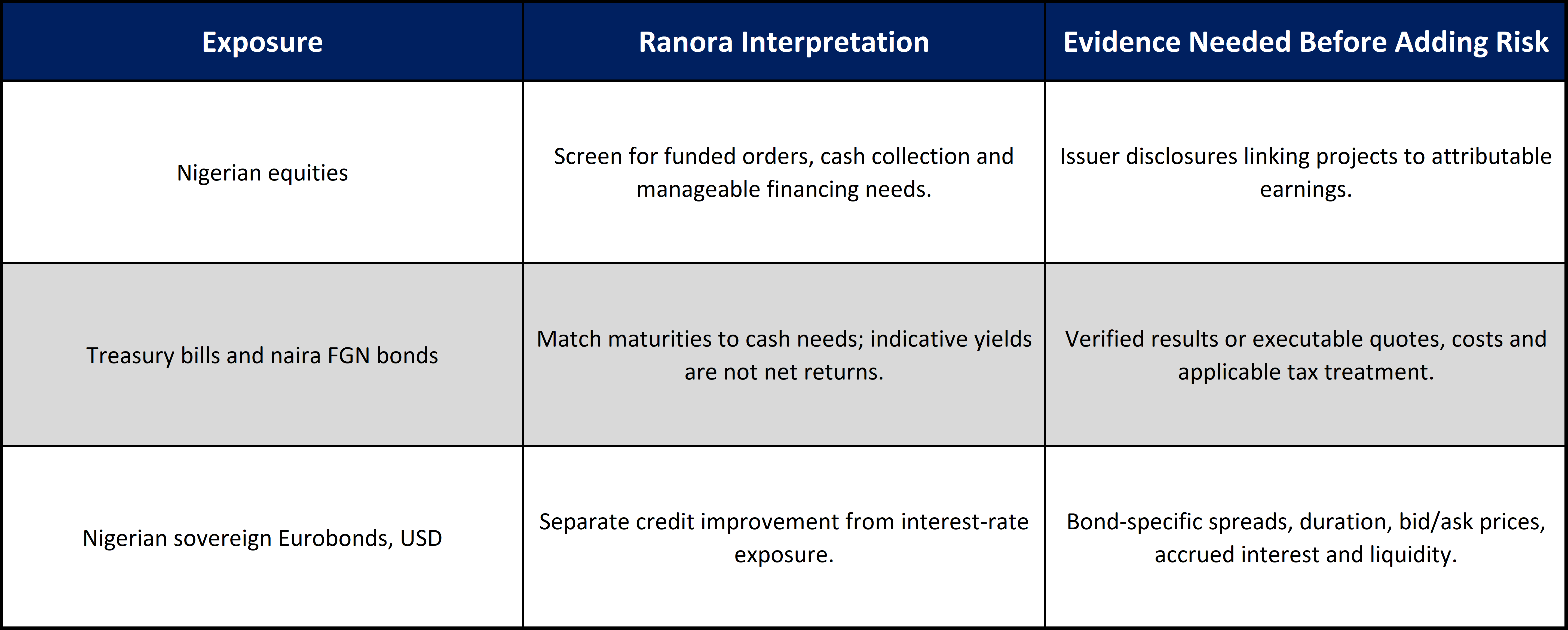
These are analytical implications, not instrument recommendations. Eurobonds retain sovereign-credit, duration, liquidity and currency risks.
Ranora View:
Do not lower project hurdle rates automatically because Nigeria’s sovereign outlook improved. The more useful distinction is whether revenues, financing currency and repayment schedules fit together. For equities, require evidence that investment announcements become funded work and collectible cash. For USD bonds, require compensation for both Nigerian credit risk and exposure to US rates. Monday’s credit signal remains constructive; Wednesday’s evidence makes financing structure more important, not less. We would revisit this view if committed funding and durable credit-spread compression demonstrate that improving Nigerian fundamentals are overcoming the external-rate headwind.
What to Watch Next
Bill settlement and secondary pricing: Thursday’s announced settlement date is 15 October.
Nigeria’s September CPI: focus on monthly food and core pressures.
Further US inflation evidence: producer prices on Thursday and import/export prices on Friday, both scheduled for 13:30 WAT.
Investment follow-through: signed financing, currency terms and disbursement milestones from the project pipeline, alongside whether NGX breadth holds through Friday.
Question for the day:
Which would change your view on a Nigerian infrastructure investment most: cheaper funding, reliable customer payments or protection against currency mismatch?
Stay smart. Stay informed. Subscribe to Ranora Market Outlook for free and support independent market analysis.