


Opening View
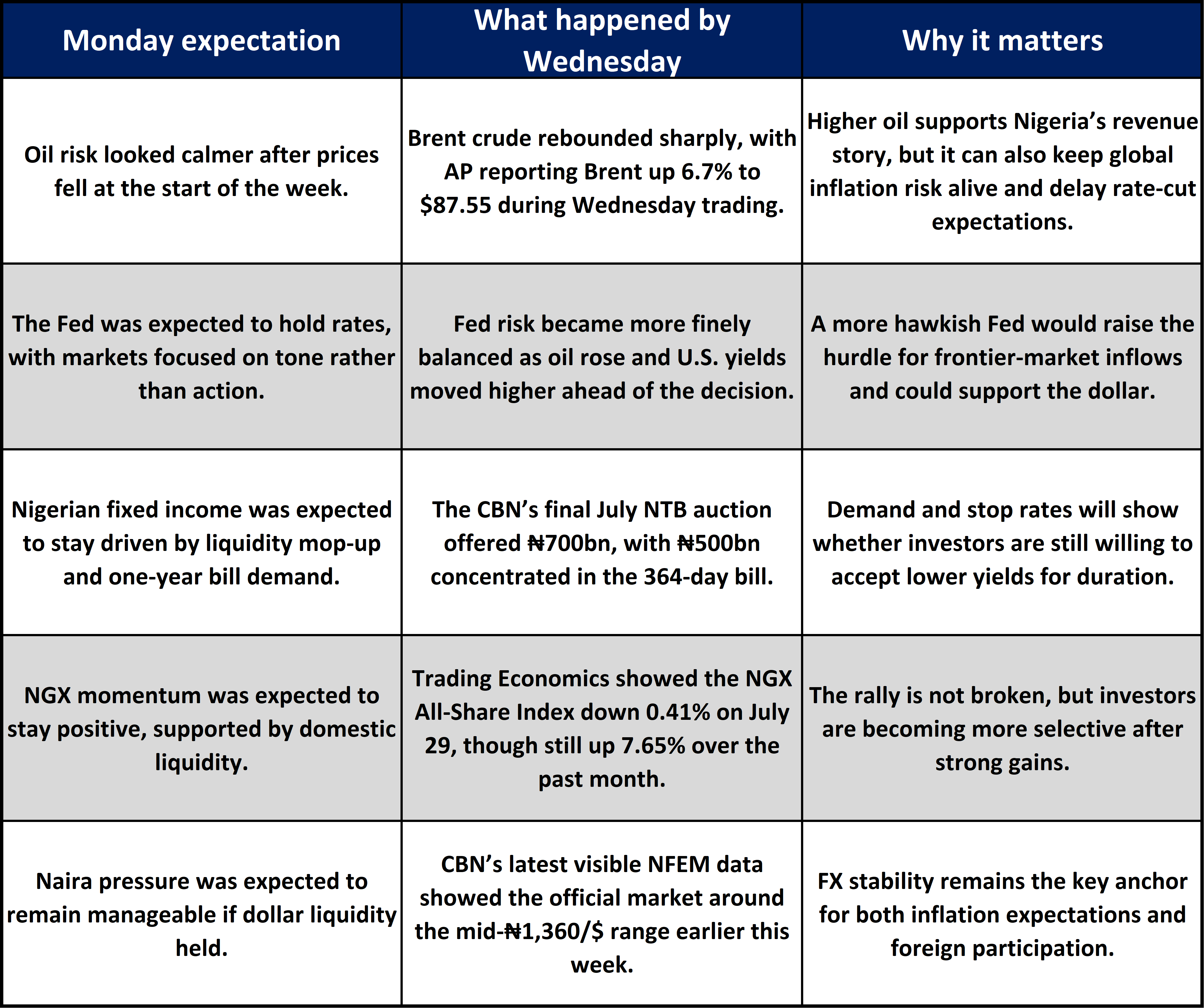
The main change since Monday is that global risk has become more fragile. At the start of the week, investors were working with a calmer oil backdrop, lower Treasury yields, and an expectation that the U.S. Federal Reserve would most likely hold rates steady. By Wednesday, that setup had changed. Brent crude jumped sharply after renewed Middle East fighting, U.S. equities weakened, Treasury yields moved higher, and the Fed decision became more sensitive to inflation risk.
For Nigeria, this matters in two directions. Higher Brent can improve oil-revenue expectations and support external-account sentiment, but it can also revive imported inflation risk if energy prices stay elevated globally. That leaves the naira, fixed income, and banking-sector positioning at the centre of the market conversation.
Locally, the CBN’s recent hold at 26.5% keeps the carry trade alive, while Wednesday’s final July Treasury bills auction gives investors a clearer test of demand for one-year paper. Nigerian equities remain structurally supported by domestic liquidity, but Wednesday’s pullback in the NGX All-Share Index shows that valuation discipline is becoming more important after a strong run.
The question before Friday is whether this becomes a temporary oil shock or the start of a broader repricing of frontier-market risk.
What Changed On Monday:
Nigeria Market Intelligence:
Fixed income: the one-year bill remains the market’s pressure point
What happened: The CBN, on behalf of the DMO, scheduled a ₦700bn Treasury bills auction for July 29, with ₦500bn allocated to the 364-day tenor.
Why it matters: This confirms that the long end of the bills curve remains the main battleground for liquidity management. At the July 15 auction, investor demand was heavily concentrated in the 364-day bill, while shorter tenors were weaker. If the latest auction clears at a lower or stable stop rate, it would show that liquidity is still chasing duration despite inflation and FX risk.
What to watch next: The stop rate on the 364-day bill. A softer stop rate would reinforce demand for carry; a higher stop rate would suggest investors are asking for more compensation.
Policy: the CBN hold keeps carry attractive
What happened: At its July 20-21 MPC meeting, the CBN retained the MPR at 26.5%, kept the standing facilities corridor at +50/-450 basis points, and retained CRR at 45% for deposit money banks.
Why it matters: The hold tells investors that policy is still tight enough to support naira assets, even though headline inflation has moderated. For banks and money-market funds, this keeps short-duration fixed income attractive. For equities, it means liquidity is still expensive, but domestic investors with cash continue to search for real-return opportunities.
What to watch next: Whether the CBN leans more on OMO and NTB issuance to manage liquidity before the September MPC meeting.
Inflation: the headline number improved, but food remains the problem
What happened: CBN’s inflation data show headline inflation at 15.91% in June, down slightly from 15.93% in May. Food inflation, however, rose to 17.52% from 16.96%.
Why it matters: The market should not overread the headline decline. Food inflation is more politically and economically sensitive because it affects household purchasing power, wage pressure, and consumer-sector margins. For listed consumer companies, the issue is not just inflation direction; it is whether price increases can still be passed through without damaging volumes.
What to watch next: July food inflation, petrol and transport pass-through, and whether naira stability continues to soften imported-price pressure.
Equities: the rally is intact, but selection matters more
What happened: Trading Economics showed the NGX All-Share Index at 246,980.17 on July 29, down 0.41% on the day but up 7.65% over the past month.
Why it matters: This is a healthy reminder that liquidity-led rallies eventually become valuation-sensitive. Banking names remain important because of earnings, capital raising, and recapitalisation themes, but investors should separate strong balance sheets and credible capital plans from simple momentum.
What to watch next: Market breadth, banking-sector flows, and whether consumer and industrial names can defend margins in a high-rate environment.
Global Market Intelligence:
Oil has become the week’s macro swing factor
What happened: Brent’s rebound changes the tone for Nigeria. Higher crude can support fiscal receipts and reserves expectations, but the benefit depends on production, export volumes, subsidy exposure, and import costs. For investors, the cleaner implication is that oil strength may help naira sentiment at the margin, while also making global inflation risk harder to dismiss.
The Fed decision is now more important for frontier flows
What happened: The Fed was already the key global event this week. Wednesday’s oil move makes the decision more consequential because higher energy prices can complicate the inflation path. If the Fed sounds more hawkish, frontier assets may face stronger competition from U.S. yields and a firmer dollar.
U.S. tech weakness is a risk-sentiment warning
What happened: The weakness in AI and semiconductor-linked stocks matters beyond Wall Street because those names have been central to global risk appetite. If investors rotate away from crowded growth trades, emerging and frontier markets may still benefit selectively, but only where local yields, earnings, and FX stability offer enough compensation.
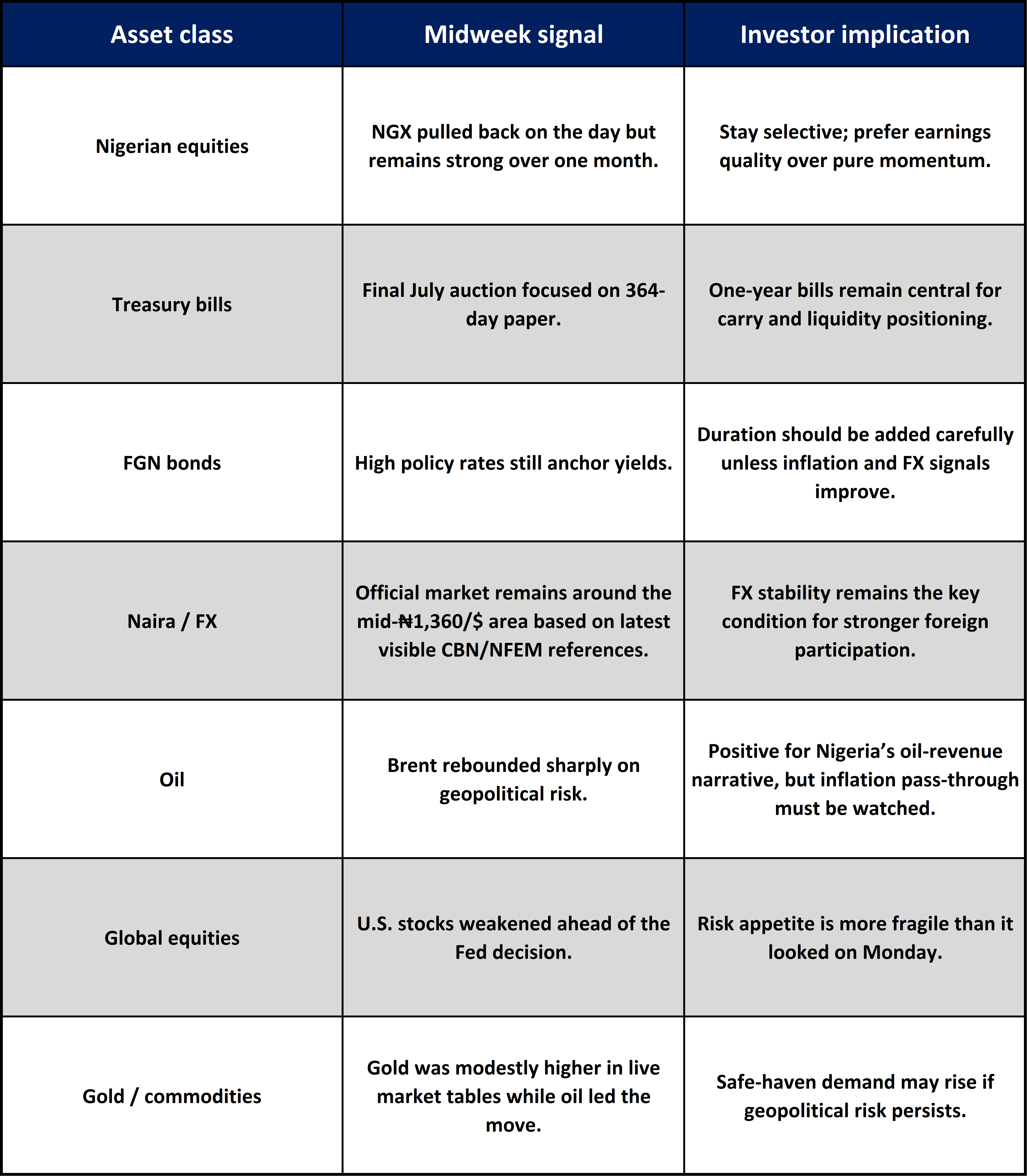
Asset Class Implications:
Ranora View:
The market’s message is not that Nigerian assets have become unattractive. It is that the easy part of the liquidity trade is fading.
With the CBN still tight, one-year Treasury bills remain useful for investors who want high nominal carry without taking full equity-market risk. Nigerian equities can still perform, but the bar is rising: investors should now demand stronger earnings visibility, credible dividend capacity, and balance-sheet resilience.
The most important shift since Monday is external. If oil stays elevated while the Fed sounds hawkish, Nigeria receives a mixed signal: better oil optics, but a tougher global funding backdrop. That combination favours disciplined allocation, short-to-medium-duration fixed income, selective banking exposure, and caution on richly valued equities that depend mainly on liquidity rather than earnings growth.
What to Watch Next:
The July 29 NTB auction result, especially the 364-day stop rate and subscription level.
The Fed decision and press conference later on July 29, especially any signal on inflation risk from oil.
Brent crude’s next move: a retreat would ease inflation anxiety; a further rise would tighten global financial conditions.
Naira liquidity and NFEM turnover, because FX stability remains the anchor for local confidence.
NGX market breadth before Friday, to see whether the pullback is broad risk reduction or only profit-taking in crowded names.
Question for the day:
If oil stays high but the Fed turns more hawkish, should Nigerian investors lean more into fixed income carry or stay with equities that can pass inflation through earnings?
Stay smart. Stay informed. Subscribe to Ranora Market Outlook for free and support independent market analysis.