


Opening View
Nigeria’s monetary-policy headline changed dramatically on Tuesday. Its underlying financial conditions changed much less.
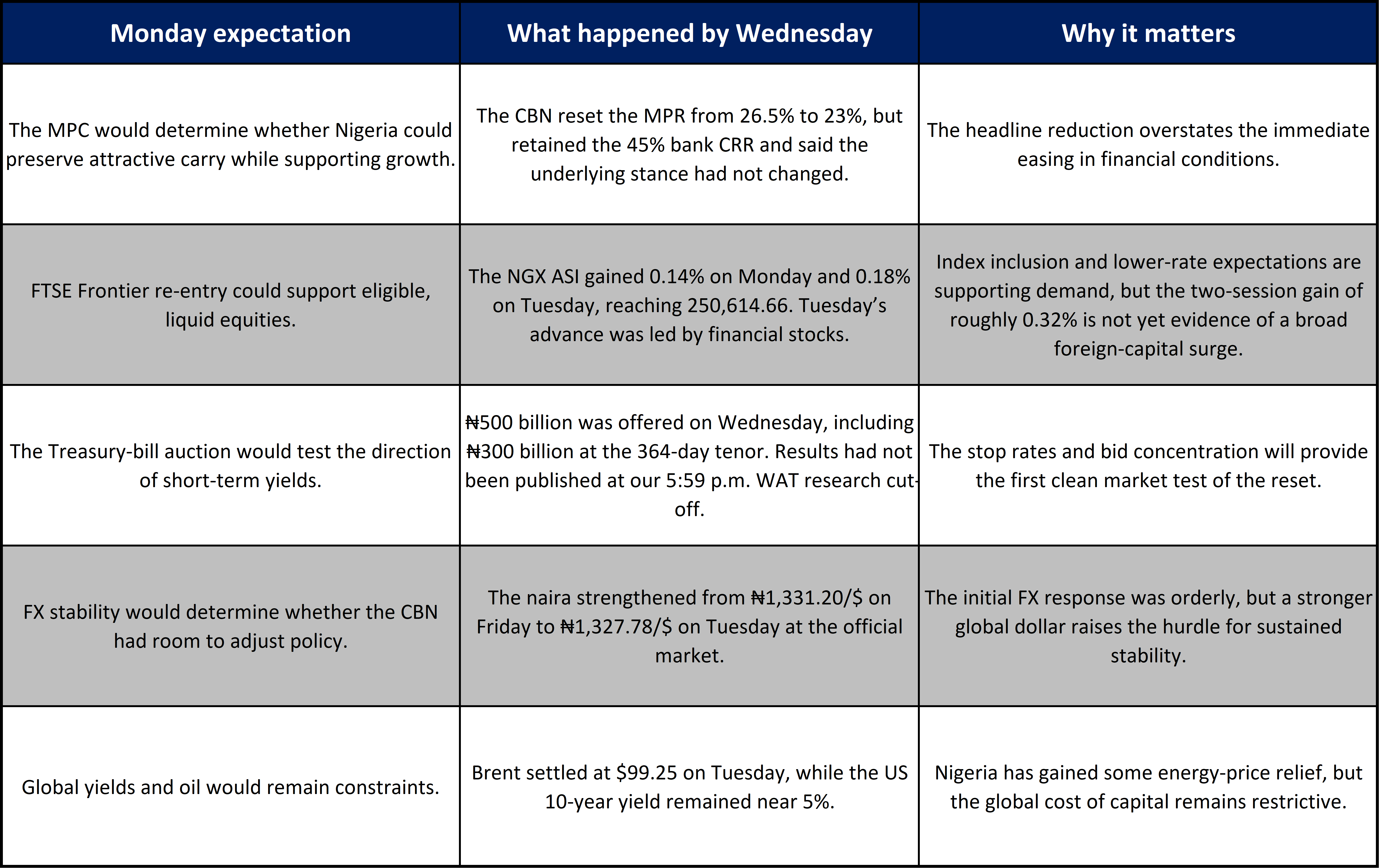
The Central Bank of Nigeria reset the Monetary Policy Rate from 26.5% to 23%, a 350-basis-point reduction. However, the MPC explicitly described the decision as an operational realignment rather than a change in the underlying policy stance. That distinction matters because overnight money-market rates were already trading around 22%, well below the old MPR.
The CBN has therefore brought its policy signal closer to the price at which banks were already exchanging liquidity. It has not yet demonstrated that credit, government funding or corporate capital will become 350 basis points cheaper.
Three details reinforce that interpretation. The Cash Reserve Requirement for deposit money banks remains at 45%. Overnight rates did not fall immediately after the announcement. And the domestic bond curve showed only limited initial repricing.
Since Monday, Nigerian equities have continued higher and the naira has firmed modestly. But the market’s reaction has been measured rather than euphoric. Investors appear to be waiting for confirmation from Wednesday’s ₦500 billion Treasury-bill auction, subsequent OMO pricing and commercial-bank lending rates.
The new MPR is important. The transmission data will be more important.
What Changed Since Monday
Market Pulse
Nigerian equities: The ASI advanced in both completed sessions since Monday’s open. Financial stocks led Tuesday’s trading, but MTN Nigeria fell 4.49%, showing that the advance was not uniform across large-cap names.
Fixed income: AIICO Capital reported that only the seven-year benchmark moved materially on Tuesday, declining 15 basis points to 16.68%, while the average bond yield slipped to 16.69%. The curve had not priced anything close to a 350-basis-point easing.
Money market: System liquidity increased to approximately ₦6.91 trillion, but the Open Buy Back Rate and Nigerian Overnight Reference Rate remained around 22%, with the overnight rate at 22.27%. This is the clearest evidence that the new MPR initially formalised existing conditions rather than immediately changing them.
FX and naira: The official rate strengthened 0.15% on Tuesday to ₦1,327.78/$. For foreign investors, this stability is more important than the headline MPR: lower domestic yields become much less attractive if accompanied by currency depreciation.
Oil: Brent settled at $99.25 on Tuesday after briefly trading below $98. Lower oil reduces imported inflation risk, but it also moderates Nigeria’s fiscal and external-revenue windfall.
Global risk sentiment: The S&P 500 gained 1.5% on Monday and was essentially flat on Tuesday. The Nasdaq added 0.5% on Tuesday, but the US 10-year yield rose to approximately 4.98%.
Dollar and commodities: The dollar reached its strongest level in almost two months on Wednesday as markets priced further Federal Reserve tightening. Gold weakened under the combined pressure of the stronger dollar and higher-for-longer rate expectations.
Nigeria Deep Dive: A Reset Is Not Yet an Easing Cycle
The old policy framework placed the MPR at 26.5%, the Standing Lending Facility at 27% and the Standing Deposit Facility at 22%. Yet overnight money was already trading close to 22%.
The new framework places the MPR at 23%, the lending facility at 23.5% and the deposit facility at 20%. This gives the policy corridor a more credible relationship with prevailing interbank rates.
The most important change is the reduction in the ceiling at which banks can access CBN liquidity. That could lower marginally funding costs when institutions need central-bank support.
But three transmission barriers remain.
First, a 45% CRR still removes a large share of deposits from banks’ deployable liquidity. Second, commercial lending rates include credit risk, operating costs and deposit competition, not only the MPR. Third, the CBN can maintain tight conditions through Treasury-bill and OMO issuance even with a lower headline policy rate.
For banks, the earnings effect is therefore mixed. Lower rates could support loan growth and improve borrower repayment capacity. They could also compress treasury income and asset yields faster than deposit costs adjust.
For fixed-income investors, existing duration may benefit if yields continue to decline. New money faces reinvestment risk, particularly if investors chase bonds before auction and OMO pricing confirm the direction.
Global Markets Deep Dive: Nigeria Is Easing Into a Stronger Dollar
The Federal Reserve raised its target range by 25 basis points from 3.75%-4.00% on 16 September. By Wednesday, the dollar was near a two-month high and the US 10-year yield remained close to 5%.
This creates an awkward external backdrop for Nigeria. A lower domestic policy rate can support local activity, but it also narrows the relative return available to foreign portfolio investors just as developed-market yields are rising.
The immediate naira response has been stable. That gives the CBN room to improve its operating framework. But the durability of that room will depend on dollar supply, reserve deployment and whether Nigerian bill yields remain sufficiently attractive after accounting for currency risk.
The relevant comparison for foreign investors is not Nigeria’s 23% MPR against US policy rates. It is the attainable Nigerian security yield, after currency expectations and transaction costs, against a near-5% US Treasury yield.
Ranora View:
The CBN has improved the credibility of its monetary-policy framework by moving the MPR closer to actual market pricing. That is useful institutional repair, but investors should not treat the full 350-basis-point move as immediately investable easing.
The portfolio implication is selective rather than binary.
Existing bondholders may benefit from gradual yield compression, but new duration should be added with discipline. Short-term investors should compare Wednesday’s bill stop rates with secondary-market yields and future OMO pricing before accepting materially lower returns.
Bank equities could benefit from credit growth and improved asset quality, but weaker treasury income and margin compression may separate winners from the sector as a whole. Businesses should also avoid assuming that bank lending rates will fall by 350 basis points.
The bullish case becomes stronger if bill and bond yields decline, the naira remains stable and private-sector borrowing costs follow. It weakens if the CBN continues to sterilise liquidity at elevated rates, the dollar strengthens further or FX demand begins to pressure the naira.
The MPR has moved. The investment regime changes only when the market rates move with it.
What We Are Watching Before Friday
The final stop rates, allotments and bid-to-cover ratios from the ₦500 billion Treasury-bill auction.
Whether OPR and NOFR move sustainably below 22%.
Any change in OMO issuance or pricing after the corridor reset.
The naira’s response to a stronger dollar and near-5% US Treasury yields.
Whether NGX gains broaden beyond financial stocks and index-eligible large caps.
Question for the day:
Do you expect the CBN’s reset to produce genuinely cheaper credit, or will high reserve requirements and continued liquidity sterilization keep borrowing costs elevated?
Stay smart. Stay informed. Subscribe to Ranora Market Outlook for free and support independent market analysis.