


Opening View
Monday’s central question was whether Nigeria’s equity market could absorb FTSE-related positioning and the upcoming Dangote Refinery offer without sacrificing market breadth. By Wednesday, that concern had become more immediate, but the most important development came from the money market.
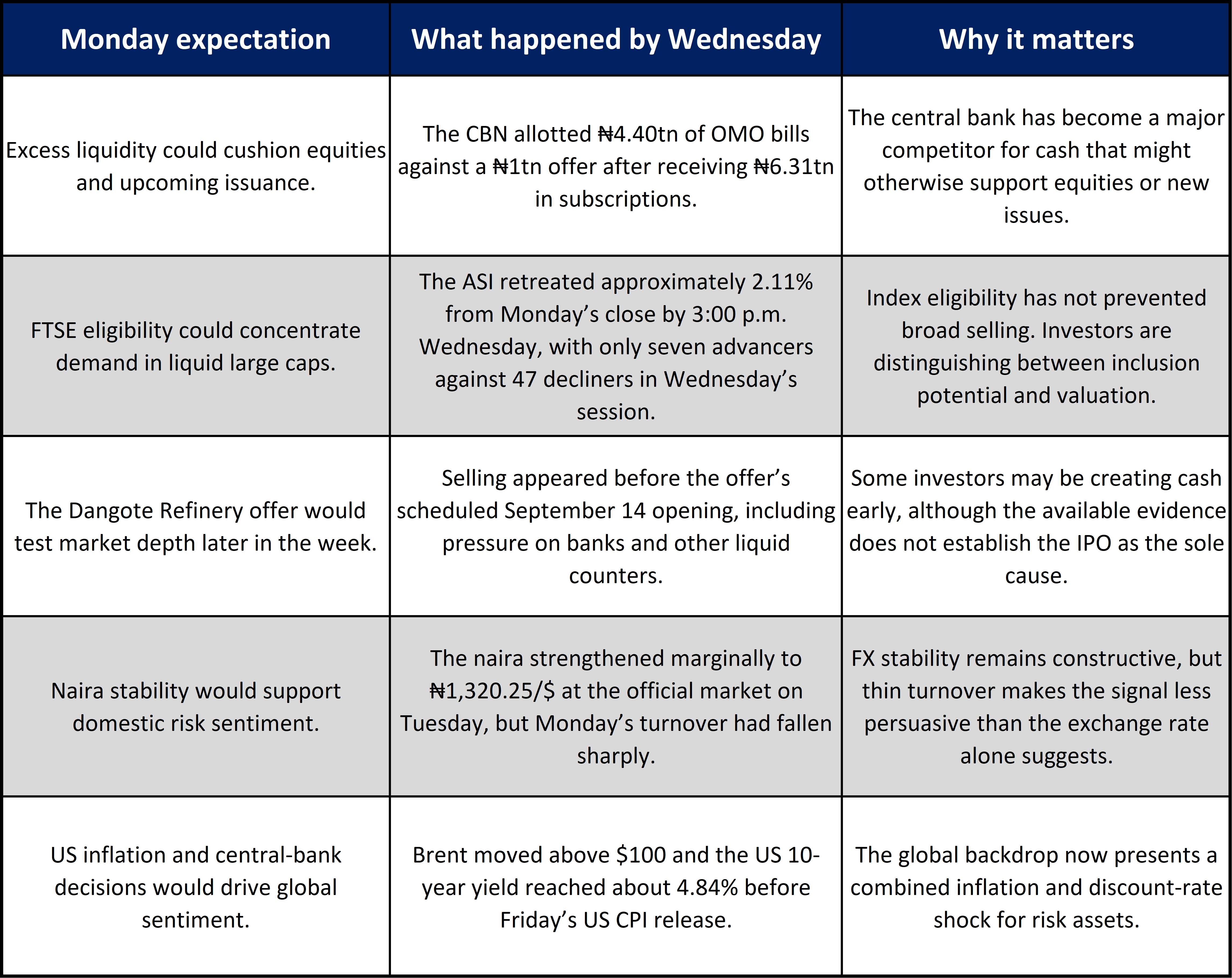
The Central Bank of Nigeria allotted ₦4.40 trillion of OMO bills on Tuesday, more than four times the initial ₦1 trillion offer. Investors submitted ₦6.31 trillion of bids even though stop rates across the three tenors fell below 20%. This matters because the liquidity expected to cushion equities is being actively redirected into high-yielding central-bank paper.
The NGX response has been revealing. After gaining 0.29% on Monday, the All-Share Index fell 1.17% on Tuesday and was down another 0.95% by 3:00 p.m. Wednesday. That represents a decline of approximately 2.11% from Monday’s close, accompanied by weak breadth.
The global environment has also deteriorated. Brent crossed $100 per barrel and the US 10-year Treasury yield approached 4.84%, raising both inflation risk and the return investors can earn outside frontier equities.
The midweek conclusion is therefore sharper: Nigeria may have ample financial-system liquidity, but investors should not assume that liquidity will flow into stocks.
What Changed Since Monday
Market Pulse
Nigerian equities: Broad selling has displaced Monday’s modest gain. Banks were prominent in Tuesday’s decline, while Wednesday’s losses included heavyweights such as BUA Cement. The weak breadth suggests more than an isolated adjustment in one or two index names.
Fixed income: The CBN cleared its OMO auction at 19.14%, 18.49% and 18.41% across the 84-day, 147-day and 154-day instruments. Falling rates alongside ₦6.31 trillion of demand show that investors still place a high value on short-dated, low-credit-risk naira assets.
FX and the naira: The official rate remained near ₦1,320/$ through Tuesday. External reserves had reached $54.08 billion on September 3, but Monday’s NFEM turnover fell 78.4% from the previous session. The buffer is stronger; market depth still deserves attention.
Oil: Brent traded above $100 on Wednesday as conflict in the Middle East threatened supply routes. Higher prices can support Nigeria’s export earnings, but they also increase the risk of domestic fuel-cost and inflation pressure.
Global risk sentiment: The S&P 500, Nasdaq and Dow were all lower in Wednesday’s midday trading as investors reduced risk exposure.
US yields: The 10-year Treasury yield rose to approximately 4.84%, its highest level since late 2023. That raises the valuation hurdle for emerging and frontier-market assets.
Commodities: Gold rose toward $4,417 per ounce as geopolitical hedging demand strengthened, despite pressure from higher bond yields.
Nigeria Deep Dive: Liquidity Is Available, but It Is Not Free
The obvious interpretation of Nigeria’s large financial-system liquidity is that cash should eventually support equities and new issuance. Tuesday’s OMO auction shows why that conclusion is incomplete.
The CBN offered ₦1 trillion but accepted ₦4.40 trillion. This came as approximately ₦2.94 trillion of OMO maturities were projected to return to the system during the week. On a simple gross comparison, the new allotment exceeded those projected maturities by about ₦1.46 trillion, although the final liquidity effect depends on settlement timing and other market flows.
More importantly, the auction revealed investor preference. Buyers accepted rates below 20% and still submitted more than six times the initial offer. Sovereign and central-bank instruments therefore remain capable of absorbing very large pools of capital without offering higher yields.
This creates three implications:
Equities must deliver stronger earnings growth or cheaper entry valuations to compete.
Banks may retain attractive treasury-income opportunities, but persistent sterilisation can limit the liquidity available for credit creation.
The Dangote Refinery offer is entering a market where investors already have several competing uses for cash.
The risk to this view would be a rapid return of liquidity after settlement, a material fall in short-term yields or strong foreign buying ahead of FTSE implementation on September 21.
Nigeria Market Intelligence
1. The Trade Surplus Is Stronger, but Not Yet Broad-Based
Nigeria recorded a ₦12.60 trillion merchandise trade surplus in Q2 2026, up 101.32% year on year. Exports reached ₦27.02 trillion while imports stood at ₦14.42 trillion.
However, crude oil and other oil products contributed ₦23.29 trillion, or roughly 86% of total exports. Agricultural exports declined 36.09% year on year, while manufactured exports fell 51.10%.
For investors, the external account is improving faster than export diversification. The immediate beneficiaries remain the naira, reserves and oil-linked fiscal expectations rather than a broad range of export-oriented manufacturers.
2. Petrol Imports Rebounded Despite Refining Expansion
Nigeria’s petrol import bill rose to ₦952.15 billion in Q2 from ₦87.40 billion in Q1, although it remained substantially below its year-earlier level.
The quarter-on-quarter rebound shows that domestic refining has not removed the need for imports during periods of supply, pricing or distribution adjustment. With Brent above $100, renewed import dependence could transmit global energy costs into domestic inflation more quickly.
3. The Treasury-Bill Result Is Now the Next Domestic Test
The government offered ₦500 billion across the 91-day, 182-day and 364-day tenors on Wednesday, the smallest single auction in the Q3 programme. At the time of drafting, a reliable final result had not been verified.
The key question is whether heavy OMO absorption leaves enough demand to push the one-year Treasury-bill stop rate below the previous 16.84%, or whether investors demand a concession as competing instruments absorb liquidity.
Global Markets Deep Dive: $100 Oil Is Not a Simple Nigeria Bull Case
Higher oil can improve Nigeria’s export receipts and strengthen the fiscal and FX buffers. But the portfolio effect is now more complicated.
Brent above $100 is reviving global inflation concerns just before the September 15–16 Federal Reserve meeting. The US 10-year yield has already moved toward 4.84%, increasing the return available from dollar assets and raising the discount rate applied to equities.
For Nigeria, the transmission runs in both directions. Stronger petroleum receipts can support reserves and the naira. At the same time, higher imported energy costs can slow domestic disinflation, encourage the CBN to retain restrictive liquidity management and reduce foreign appetite for frontier-market equities.
The important signal is therefore not the $100 level alone. Investors should watch whether oil remains elevated long enough to affect inflation expectations and global policy pricing. A short-lived geopolitical spike would favour Nigerian external balances. A sustained oil shock would make domestic rate cuts harder and preserve the appeal of short-duration fixed income.
Chart of the Day: The Competing Signals
Ranora View:
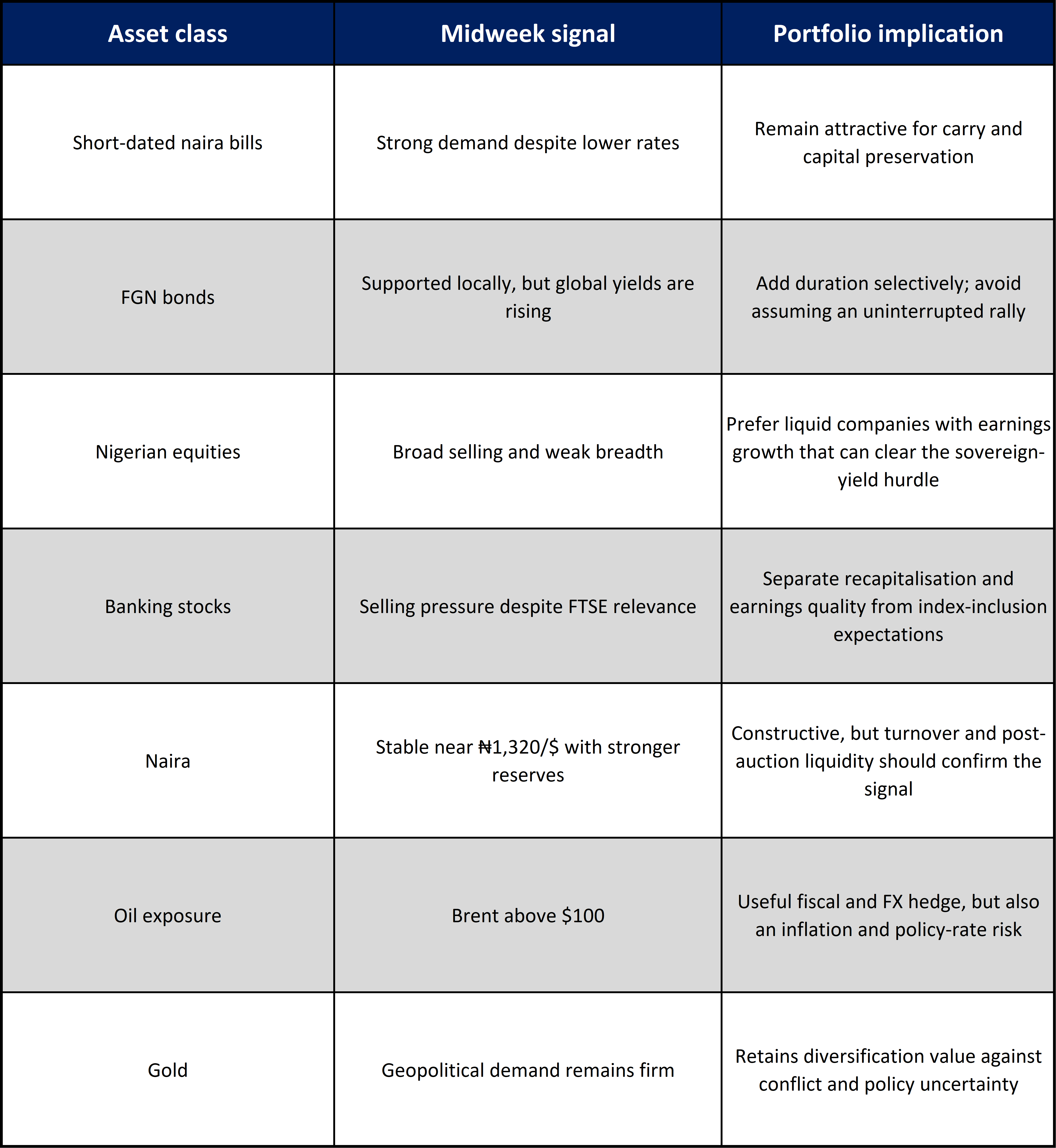
The market has moved from a question of whether Nigeria has enough liquidity to whether investors can be persuaded to deploy that liquidity outside government and central-bank securities.
Tuesday’s OMO result shows that the CBN can still absorb trillions of naira without raising rates. That makes short-duration carry the portfolio anchor and raises the required margin of safety for equities.
We would avoid treating the NGX decline as an automatic buying opportunity. The stronger approach is to prioritise liquid companies with visible earnings growth, low refinancing pressure and a credible path to returns above the sovereign-yield benchmark.
FTSE implementation may still create concentrated demand, while the Dangote Refinery offer could deepen the market over time. Neither development removes the near-term competition for cash.
What to Watch Next:
Whether the NGX sell-off stabilises and market breadth improves before FTSE implementation.
Friday’s US CPI release and its effect on Treasury yields ahead of the Federal Reserve meeting.
Thursday’s ECB policy decision and its implications for global yields and the dollar.
Whether Brent remains above $100 or retreats as geopolitical risk is repriced.
Question for the day:
With the CBN absorbing ₦4.40 trillion through OMO bills, what would persuade you to move capital from short-term fixed income into Nigerian equities today?
Stay smart. Stay informed. Subscribe to Ranora Market Outlook for free and support independent market analysis.