


Opening View
The main change since Monday is that policy uncertainty has narrowed, but market risk has not disappeared. The CBN’s MPC concluded its July 20-21 meeting by keeping the MPR at 26.5%, confirming that the central bank is not yet ready to extend the easing cycle even with headline inflation easing slightly to 15.91% in June. That keeps Nigeria’s investment conversation anchored around real yield, liquidity management, and FX confidence rather than aggressive duration extension.
By midweek, Nigerian equities had pulled back, with NGX Pulse reporting the All-Share Index down 0.50% on Wednesday to 245,418.37, even as market breadth remained positive. That suggests profit-taking in heavyweight names rather than a broad collapse in risk appetite.
Globally, the pressure point has become oil and yields. Brent and WTI-sensitive energy markets are being pushed by Middle East risk, while U.S. Treasury yields moved higher. For Nigeria, higher oil prices can support fiscal and FX expectations, but they also complicate global inflation, Fed expectations, and frontier-market flows. The result is a market where short-duration yield still has a strong argument, equities need selectivity, and the naira story depends on whether reserve strength translates into durable dollar liquidity.
The Big Picture:
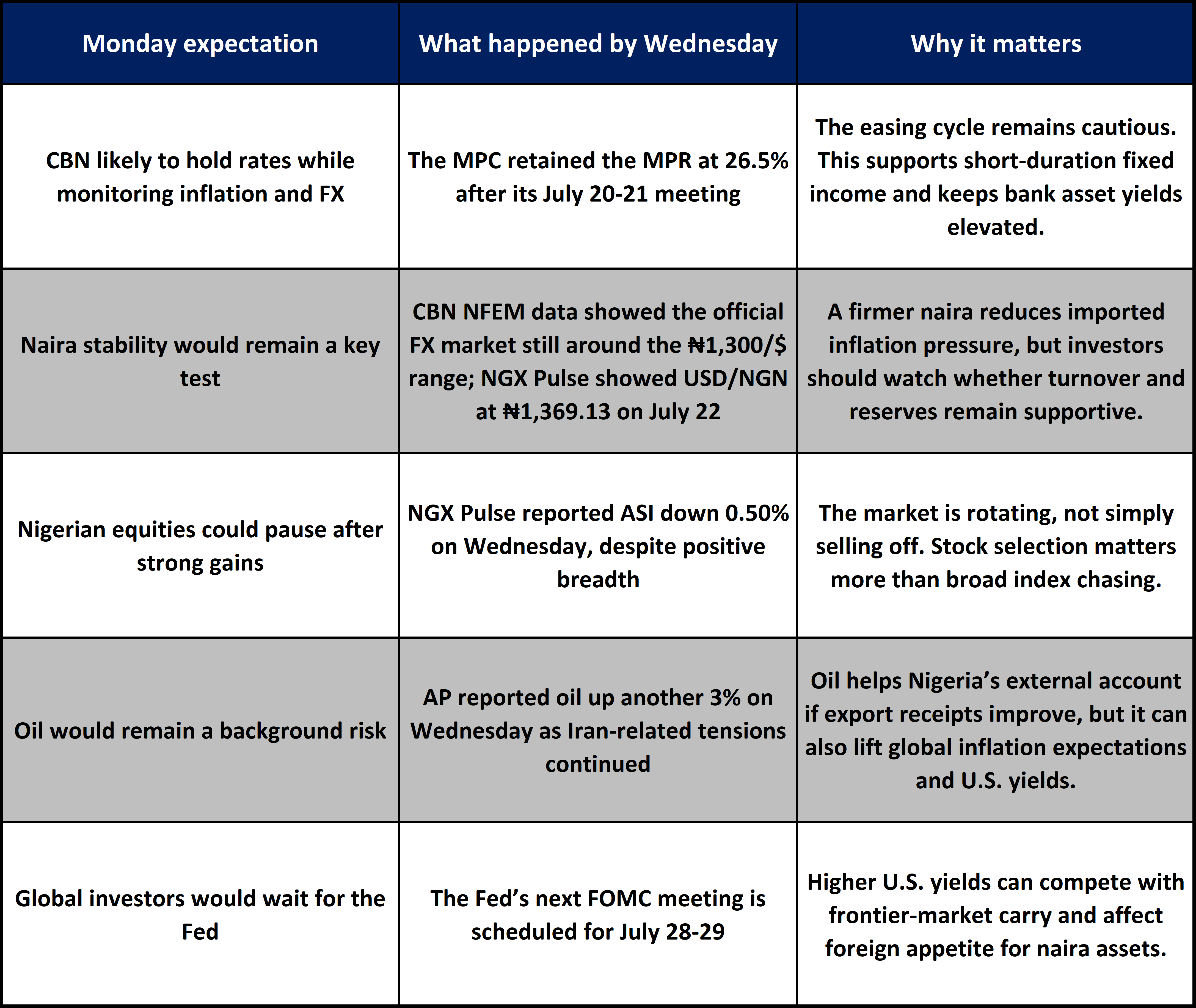
What changed since Monday is not just that the CBN held rates. It is that the rate hold came alongside three signals investors cannot ignore.
What Changed On Monday:
Nigeria Market Intelligence:
CBN holds at 26.5%, keeping policy restrictive
What happened: The CBN retained the MPR at 26.5% after the 306th MPC meeting held July 20-21. Channels TV reported the decision on July 21, while CBN’s own policy decisions page shows the May baseline at 26.5% and the February cut from 27.0% to 26.5%.
Why it matters: The hold tells investors that the central bank is prioritising inflation credibility and FX stability over faster monetary easing.
What to watch next: The next inflation print, CBN liquidity operations, and whether the September MPC meeting opens the door to renewed easing.
Inflation eased, but not enough to force policy easing
What happened: CBN’s inflation data showed headline inflation at 15.91% in June 2026, compared with 15.93% in May and 15.69% in April.
Why it matters: The direction is helpful, but the pace is not decisive. A two-basis-point decline from May does not give the CBN enough cover to cut quickly.
What to watch next: Food inflation, fuel prices, exchange-rate pass-through, and whether month-on-month inflation momentum continues to soften.
Equities pulled back, but the weakness was selective
What happened: NGX Pulse reported that the All-Share Index fell 0.50% to 245,418.37 on Wednesday, July 22, while market breadth was positive with 41 gainers against 30 decliners.
Why it matters: Positive breadth during an index decline suggests pressure in large-cap names rather than broad investor capitulation.
What to watch next: Banking sector flows, telecom price action, heavyweight consumer names, and whether profit-taking spreads into broader market breadth.
External reserves are now part of the naira confidence story
What happened: The Guardian reported on July 22 that CBN Governor Olayemi Cardoso said gross external reserves had risen to $52.52 billion, helped by crude-oil-related taxes and third-party receipts.
Why it matters: Stronger reserves improve the credibility of FX management and can reduce panic demand for dollars if market liquidity holds.
What to watch next: NFEM turnover, reserve drawdowns, parallel-market gap, and whether oil receipts convert into visible FX supply.
Global Market Intelligence:
Oil has moved from support factor to inflation risk
What happened: AP reported oil prices rising another 3% on Wednesday as conflict involving Iran continued.
Why it matters: For Nigeria, higher oil prices can support fiscal revenues and reserves. For global markets, they can revive inflation concerns and keep yields elevated.
Investor implication: Nigeria benefits only if production, exports, and dollar inflows respond. If the main effect is higher global inflation and higher U.S. yields, frontier-market flows may become more selective.
U.S. yields are back in focus
What happened: MarketWatch showed the U.S. 10-year Treasury yield at 4.658% on Wednesday.
Why it matters: Higher U.S. yields raise the hurdle rate for emerging and frontier-market carry trades.
Investor implication: Nigerian fixed income still offers attractive nominal yield, but foreign participation will depend on confidence in FX stability, repatriation, and inflation-adjusted returns.
U.S. equities are not giving a clean risk-on signal
What happened: MarketWatch showed the S&P 500 slightly higher intraday, Nasdaq slightly lower, and gold up 1.81% on Wednesday.
Why it matters: Equity markets are still supported by earnings and technology expectations, but rising gold and yields point to hedging demand.
Investor implication: Global risk appetite is not collapsing, but it is becoming more price-sensitive. That matters for Nigerian equities because foreign flows tend to return when global risk-taking is broad, not merely concentrated in U.S. mega-cap technology.
The Fed meeting is now the next global checkpoint
What happened: The Federal Reserve lists its next FOMC meeting for July 28-29, 2026.
Why it matters: Any Fed signal that oil-driven inflation risk could delay easing or renew tightening would matter for dollar strength, U.S. yields, and frontier-market flows.
Investor implication: Nigerian asset pricing may remain locally supported, but foreign inflows could pause until the Fed’s tone is clearer.
Asset Class Implications:
Ranora View:
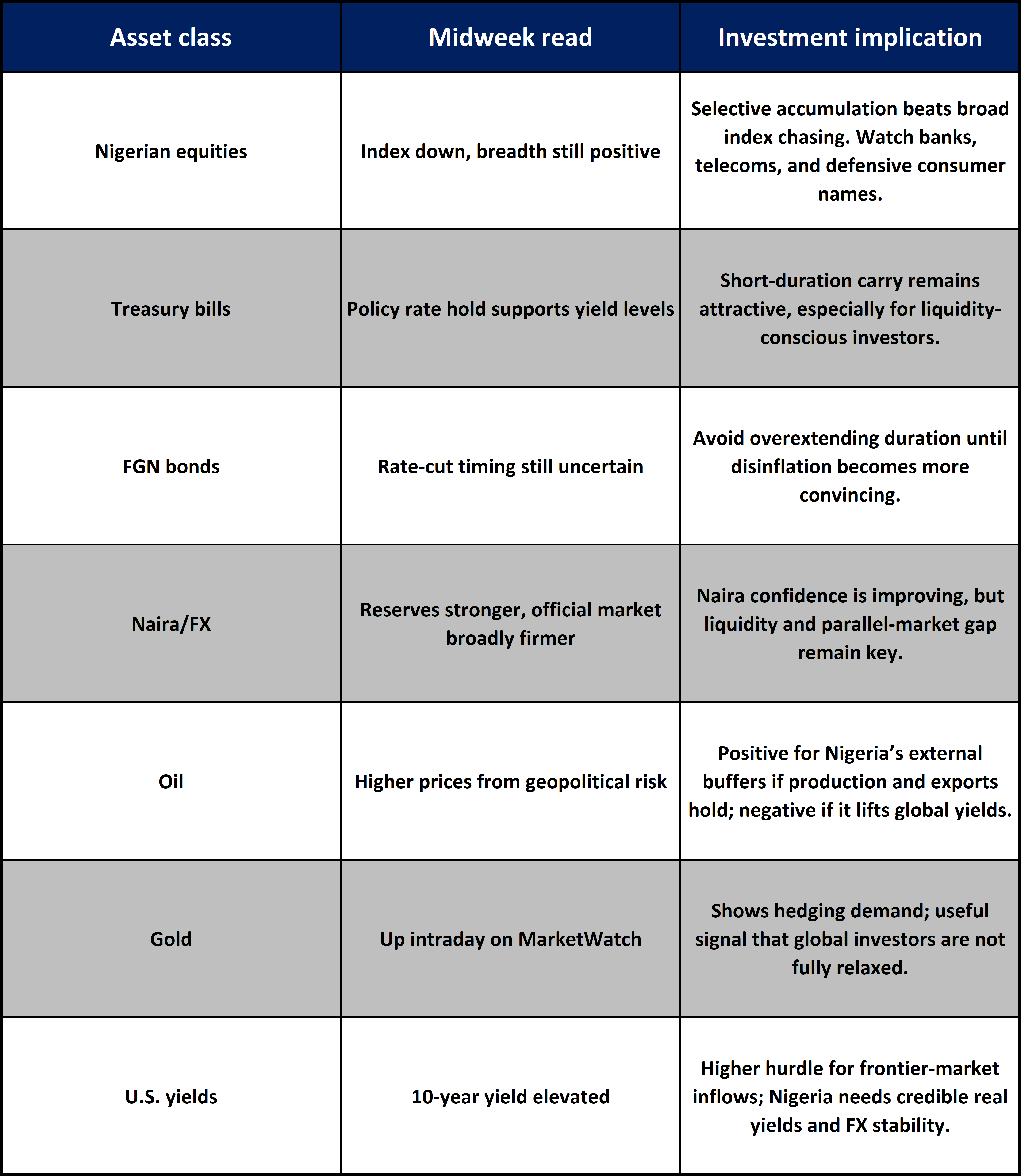
The most important investment message from midweek is that Nigeria’s market is still being priced through the yield-and-FX lens. The CBN’s hold at 26.5% keeps carry attractive, but it also confirms that the policy authorities are not yet comfortable declaring victory on inflation. That supports short-duration fixed income and money-market positioning.
For equities, the Wednesday pullback should not be read as a simple bearish reversal. Positive breadth suggests investors are still buying selectively, but the easy index-level momentum trade is less compelling after the scale of recent gains. Earnings quality, capital strength, pricing power, and dividend visibility should matter more from here.
The naira story has improved because reserves are stronger and the official market has shown firmer signs, but this is still a liquidity story, not just a headline reserves story. If higher oil prices feed actual FX supply, Nigerian assets could receive support. If higher oil mainly pushes U.S. yields higher, foreign investors may demand more compensation before adding frontier risk.
What to Watch Next:
Whether the CBN publishes fuller July MPC details confirming the full policy parameter mix beyond the MPR.
NFEM turnover and the official-parallel market spread through Friday.
Whether NGX weakness remains concentrated in large caps or spreads into broader market breadth.
U.S. Treasury yields and Fed pricing before the July 28-29 FOMC meeting.
Oil prices and any evidence that stronger crude markets are translating into Nigerian FX inflows.
Question for the day:
If the CBN keeps rates high while inflation eases only gradually, should Nigerian investors prioritise short-term fixed income carry or begin positioning earlier for a longer-duration bond rally?
Stay smart. Stay informed. Subscribe to Ranora Market Outlook for free and support independent market analysis.