


Opening View
Opening View:
Nigeria begins the week with an unusually large capital-allocation test. The Debt Management Office is offering ₦1 trillion of FGN bonds today, including a new 10-year September 2036 benchmark, while the ₦2.1525 trillion Dangote Petroleum Refinery public offer also opens. The refinery subscription window runs until 13 October, so the full amount is not due immediately. Even so, both transactions begin competing for investor attention and funding at the same time.
That matters because the NGX entered the week on weak breadth. The All-Share Index fell 1.60% last week, while banking, insurance, industrial and consumer-goods indices all declined. The market is therefore approaching the new supply from a position of profit-taking, not accelerating momentum.
The conventional interpretation is that strong domestic liquidity can absorb both offers. Ranora’s view is more demanding: subscription headlines alone will not prove market depth. The real evidence will be the bond auction’s clearing yields, turnover and breadth in existing equities, and whether investors fund the refinery offer from idle cash or by selling liquid securities.
Tuesday’s Nigerian inflation release and Wednesday’s Federal Reserve decision will add a second test. They will determine whether investors can justify accepting lower domestic yields or must continue demanding substantial compensation for inflation and duration risk.
The Big Picture:
This week is about the price of capital, not merely the amount raised. The DMO’s new 2036 bond will help establish a fresh medium-to-long-term benchmark, while the refinery offer creates a competing claim on equity capital. If both attract strong demand without disrupting existing securities, Nigeria will have demonstrated a broader funding base. If secondary-market liquidity weakens or bond yields rise materially, the market will be signalling that available cash is less abundant than headline liquidity suggests.
Globally, that test is occurring with the US 10-year Treasury yield near 5%, Brent above US$100 and several major central banks considering tighter policy. These conditions raise the return international investors can obtain without accepting Nigerian currency, liquidity or governance risk.
Nigeria Market Intelligence
A ₦3.15tn capital-allocation test begins
What happened: The DMO is offering ₦400 billion of a new September 2036 bond and ₦600 billion of the reopened 15.45% June 2038 bond. Separately, 4.1 billion refinery shares are being offered at ₦525 each.
Why it matters: Sovereign debt and a landmark equity transaction are drawing on overlapping institutional and retail capital pools.
What to watch: The 2038 clearing yield relative to August’s 17.79%, total bond subscriptions, NGX turnover and selling in liquid large-cap stocks.
Inflation’s composition matters more than the headline
What happened: July headline inflation eased to 15.43%, but annual food inflation rose to 20.31% and monthly food inflation accelerated to 5.56%. The August release is scheduled for Tuesday.
Why it matters: Another decline in headline inflation would not automatically imply stronger consumer purchasing power if food prices remain elevated.
What to watch: Monthly food inflation, core inflation and whether the data support lower bond yields ahead of the CBN’s 22 September meeting.
The NGX correction has become broad
What happened: The ASI declined 1.60% last week. Insurance fell 5.52%, banking 4.07%, industrial goods 3.36% and consumer goods 2.55%; oil and gas gained 2.83%.
Why it matters: Selling has extended beyond isolated profit-taking and into liquid sectors that could be used to fund the refinery subscription.
What to watch next: Market breadth, turnover and whether oil-and-gas leadership broadens or merely reflects crude-price momentum.
FX buffers provide support, but not immunity
What happened: Nigeria’s gross external reserves rose by US$1.9 billion to US$53.8 billion in August, while the official naira rate ended last week around ₦1,330/US$. This gives the CBN more room to manage volatility, but a stronger dollar and higher global yields could still reduce foreign appetite for naira assets.
Global Market Intelligence:
The Fed faces a live rate-hike decision.
What happened: US inflation rose 0.4% month-on-month in August and remained 3.4% year-on-year. With the US 10-year yield at approximately 4.98% on Monday morning, a hike or hawkish projection would increase the valuation hurdle for frontier-market assets. The Fed decides on Wednesday.
Global tightening is no longer only a US story.
What happened: The ECB raised its key rates by 25 basis points last week; the Bank of England decides Thursday and the Bank of Japan concludes its meeting Friday. A coordinated upward shift in global rates could restrain emerging- and frontier-market flows even where domestic fundamentals improve
Brent is both a buffer and a tax.
What happened: Brent traded around US$107.94 early Monday after fresh supply disruption concerns. Higher oil can support Nigerian export receipts and reserves, but it also raises transport, production and inflation risks. Consumer-facing businesses may therefore face margin pressure even as Nigeria’s external accounts benefit
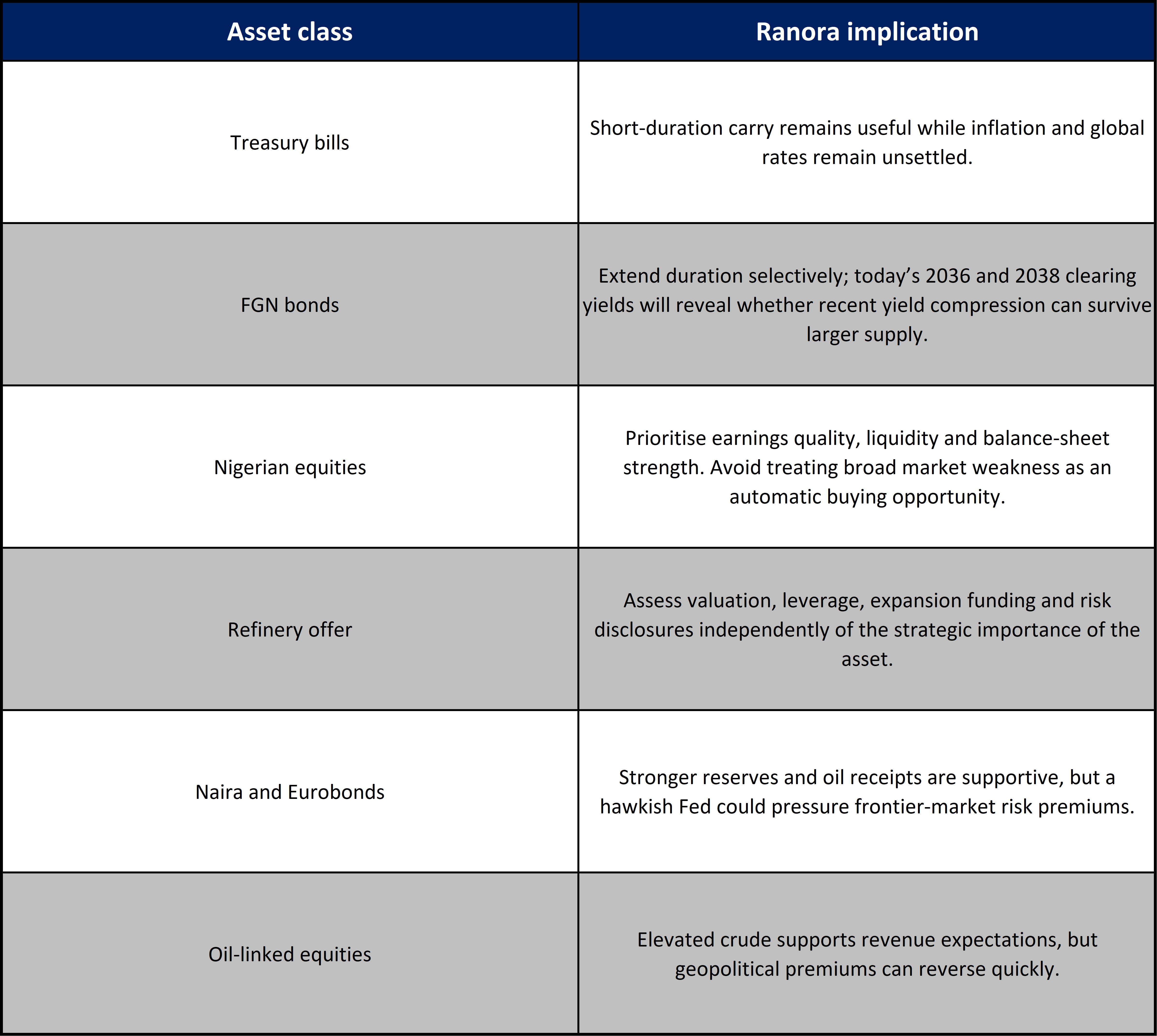
Asset Class Implications:
Ranora View:
The base case is that Nigeria can attract substantial demand for both transactions, but probably not without repricing elsewhere. The critical signal will be where that adjustment occurs: higher bond yields, weaker secondary-market equity liquidity, slower money-market yield compression or some combination of the three.
For now, liquidity has option value. Short-duration naira instruments remain a practical portfolio anchor, while equity exposure should favour companies with visible cash generation and limited refinancing requirements. A decisive extension into duration should wait for evidence that Nigerian inflation is moderating beyond base effects and that the new sovereign supply can clear without the issuer paying a material premium.
What to Watch Next:
The clearing yield and bid-to-offer ratio at today’s ₦1 trillion FGN bond auction.
Early subscription indicators and funding channels for the refinery offer.
Nigeria’s August food, core and month-on-month inflation readings on Tuesday.
The Fed’s decision, projections and US 10-year Treasury reaction on Wednesday.
NGX turnover and breadth ahead of Nigeria’s planned FTSE Frontier implementation on 21 September.
Question of the day:
Will Nigeria’s ₦3.15 trillion capital call deepen the market, or force investors to sell existing assets to finance the next generation of supply?
Stay smart. Stay informed. Subscribe to Ranora Market Outlook for free and support independent market analysis.