


Opening View
Nigerian markets enter the final week of September with a notable change in positioning. The NGX All-Share Index gained 0.92% last week, but the more important signal was beneath the headline: 17 of 20 tracked indices advanced, while 61 stocks gained against 32 decliners. This was broader participation, not simply another heavyweight-driven index move.
Lower domestic yields helped. Treasury-bill and bond yields compressed after the CBN reset the Monetary Policy Rate to 23%, encouraging investors to look beyond sovereign carry. Yet falling yields do not automatically make equities attractive. With the ASI already up 62.01% in 2026, the market increasingly needs earnings growth, stronger business activity and credible cash flows to justify further gains.
That test arrives this week. September’s Nigeria PMI should indicate whether August’s acceleration in private-sector activity continued. Meanwhile, newly released DMO data show that public debt rose by ₦7.44tn during the second quarter to ₦166.79tn. This matters because a growing sovereign funding requirement could eventually limit how far yields can fall.
Globally, Brent has returned to about US$106 per barrel and the US 10-year Treasury yield is near 5.2%. Friday’s US employment report may therefore matter as much for Nigerian asset pricing as any domestic release.
The Big Picture:
The market is moving from a policy trade to an earnings trade.
Immediately after the CBN’s rate reset, investors rushed to lock in yields: ₦4.23tn chased ₦600bn of Treasury bills, while ₦5.74tn was submitted at an OMO auction offering ₦900bn. That demand compressed sovereign yields and improved the relative case for equities.
The first phase of this rotation was mechanical: when risk-free yields fall, equity valuations receive support. The next phase must be fundamental. September PMI data, company results and market breadth now need to demonstrate that corporate earnings can grow fast enough to compensate investors for equity risk.
There is also a fiscal constraint. Nigeria’s public debt rose 4.7% quarter-on-quarter to ₦166.79tn, with domestic obligations accounting for 54.91%. Strong demand currently allows the government to refinance at lower rates, but persistent supply could establish a floor under yields and prevent an unrestricted re-rating of equities.
Nigeria Market Intelligence
Equity breadth is improving, but the valuation test is harder
The ASI gained 0.92% last week to 252,113.41 points, taking its year-to-date return to 62.01%. Sixty-one equities appreciated, 17 of 20 tracked indices advanced, and turnover rose to 4.69bn shares worth ₦240.82bn. This broader participation is healthier than a rally concentrated in a few large stocks.
What to watch: whether positive breadth survives profit-taking and whether September PMI and corporate disclosures support earnings expectations.
Lower yields are pushing capital outward, but investors are already paying more for duration
At the September 23 auction, the 91-day, 182-day and 364-day stop rates declined to 15.50%, 15.80% and 15.89%. Secondary-market bond yields also compressed across the curve. Investors who bought before the decline have benefited; new buyers now face lower entry yields and greater sensitivity to inflation, liquidity operations and sovereign supply.
What to watch: secondary-market yields and any new OMO issuance. OMO pricing will show whether the CBN is comfortable allowing the post-MPC rally to continue.
The debt stock complicates the falling-yield narrative
Nigeria’s total public debt increased from ₦159.35tn in March to ₦166.79tn in June. Domestic debt stood at ₦91.59tn, while Treasury bills accounted for ₦19.48tn of Federal Government domestic obligations.
This does not imply an immediate funding problem. It does mean investors should distinguish between short-term yield compression caused by excess liquidity and a structural reduction in government borrowing requirements.
What to watch: issuance volumes, debt-service costs and whether revenue growth is keeping pace with the expanding stock.
The naira has support, although external conditions still matter
The naira ended Friday around ₦1,329.51/US$ in the official market and ₦1,385/US$ in the parallel market. Nigeria’s Q2 current-account surplus widened to US$7.54bn, while the overall balance of payments recorded a US$3.51bn surplus.
These buffers reduce immediate FX stress, but portfolio inflows remain sensitive to the gap between Nigerian yields and rising global yields.
What to watch: official-market turnover, the official-parallel spread and whether reserves continue to rise without renewed FX restrictions.
Global Market Intelligence:
US payrolls will decide whether 5% Treasury yields become entrenched
The US 10-year yield approached 5.2% after the Federal Reserve resumed tightening. Friday’s September employment report will show whether labour-market strength can support another increase. August payrolls rose by 162,000.
For Nigeria, stronger US data would reinforce dollar yields, raise the return hurdle for frontier-market assets and limit foreign demand for naira duration unless domestic carry remains competitive.
Oil remains both a Nigerian buffer and an inflation threat
Brent rose to about US$106 per barrel on Monday as doubts returned over a US-Iran agreement and the reopening of the Strait of Hormuz. Higher oil can support Nigerian export receipts and fiscal revenue, but prolonged disruption would raise transport, production and imported inflation costs.
What to watch: diplomatic negotiations, actual shipping flows and whether product prices remain elevated even if crude retreats.
Global equities are tolerating higher yields, but the tolerance may be temporary
US equities ended Friday higher despite multi-decade highs in long-dated Treasury yields. This suggests investors are still willing to pay for strong technology and AI-linked earnings. However, a further rise in yields would put greater pressure on richly valued growth companies and emerging-market assets.
What to watch: US jobs, ISM manufacturing, China’s PMIs and whether equity gains continue to narrow around a small group of large companies.
Asset Class Implications:
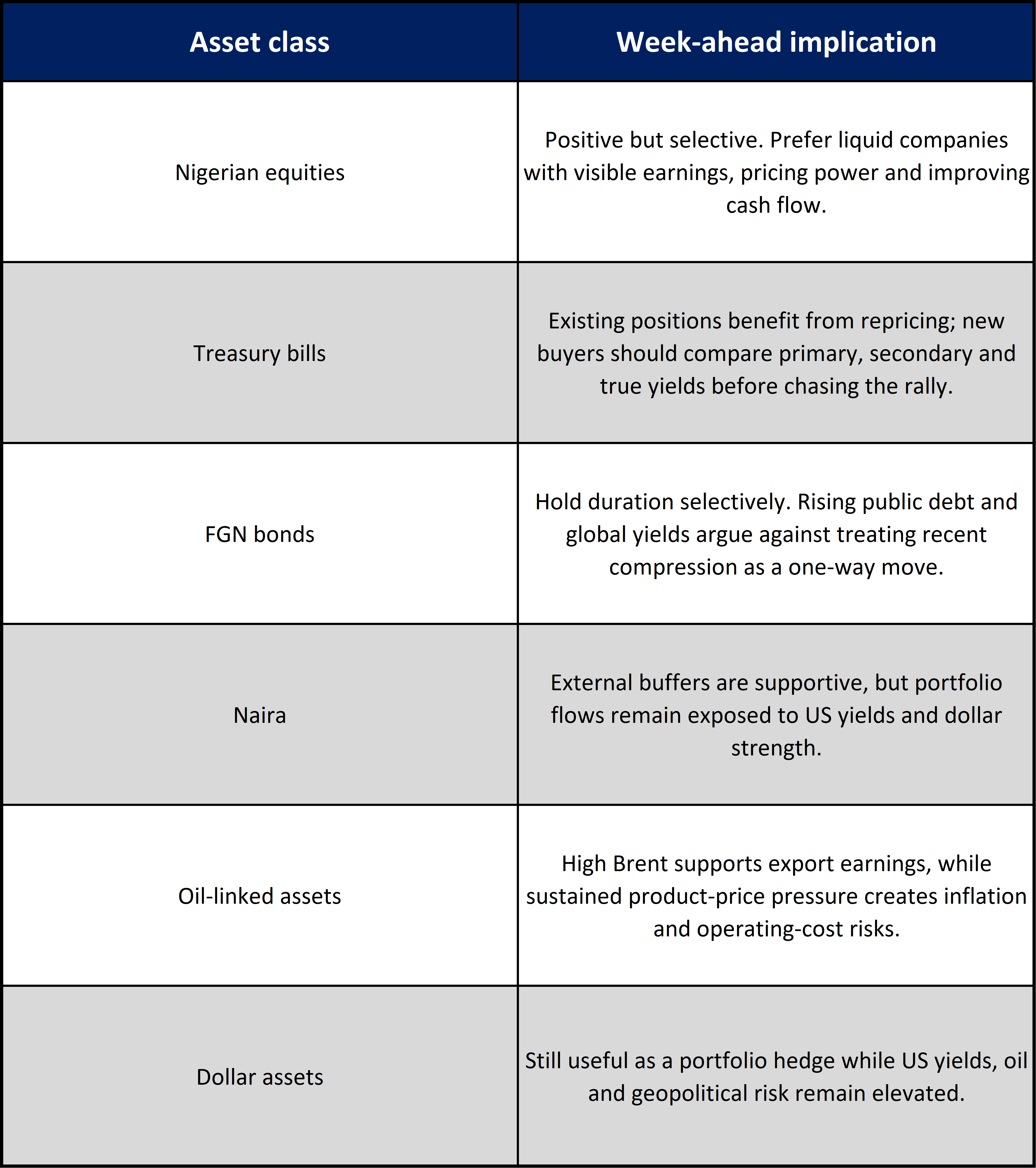
Ranora View:
The NGX rally has become broader, but breadth alone is not enough. The market’s next leg should be driven by evidence that private-sector activity and corporate earnings can grow into higher valuations.
We favour liquid Nigerian equities with credible earnings visibility over indiscriminate index exposure. Banks may benefit from stronger activity and trading opportunities, but lower yields could eventually narrow asset returns; industrial and consumer companies need volume growth to offset operating costs.
In fixed income, investors who locked in higher yields are well positioned. New capital should avoid chasing compressed auction rates without accounting for inflation, reinvestment risk and growing sovereign supply. The best near-term posture is selective equity exposure, measured duration and sufficient liquidity to exploit repricing after the Nigerian PMI and US payroll reports.
What to Watch Next:
September’s Nigerian private-sector PMI and whether growth remains broad across manufacturing, agriculture, services and trade.
NGX market breadth after Friday ended the sequence of record closes.
OMO issuance and whether liquidity remains near the CBN’s new 20% deposit-facility floor.
Friday’s US employment report and the response of the US 10-year Treasury yield.
Brent crude, Strait of Hormuz shipping flows and their effect on Nigerian inflation expectations.
Question of the day:
With Nigerian sovereign yields falling and the NGX already up more than 60% this year, which matters more for your next allocation: cheaper valuations, stronger earnings or continued naira stability?
Stay smart. Stay informed. Subscribe to Ranora Market Outlook for free and support independent market analysis.