


Opening View
Opening View:
Nigeria returns to FTSE Russell’s Frontier Market classification at today’s market open, three years after foreign-exchange shortages and repatriation delays pushed the country into unclassified status. This is an important repair to Nigeria’s investability, but it is not an automatic rerating of every Nigerian asset.
Two weeks ago, the question was whether investors would position ahead of re-entry. The NGX All-Share Index subsequently gained 2.78% last week, completing seven consecutive positive sessions and lifting its 2026 return to 60.53%. This week, the burden shifts from anticipation to evidence: actual foreign participation, turnover in eligible stocks, market breadth and the ability to repatriate capital efficiently.
The CBN’s policy decision on Tuesday will determine whether that evidence remains supportive. August inflation eased to 15.39%, the naira closed Friday near ₦1,331.20/$ at the official market, and external reserves stood around $54.69 billion. Those conditions create room to discuss lower rates. However, the Federal Reserve has just raised rates, the US 10-year Treasury yield is around 5%, and Brent remains above $100. The CBN must therefore balance domestic disinflation against the need to protect naira carry and foreign-investor confidence.
The key question is no longer whether Nigeria is visible to global funds. It is whether policy can make that visibility investable.
The Big Picture:
FTSE re-entry changes the permissible investment universe for benchmark-aware funds. Ten Nigerian large-cap stocks have been designated eligible for the broader Frontier Index Series, while Aradel Holdings, Dangote Cement, FirstHoldCo, GTCO, MTN Nigeria and Zenith Bank enter the narrower Frontier 50.
That should concentrate liquidity in internationally accessible, higher-free-float companies. It could also create a two-speed market in which eligible heavyweights receive stronger flows while less-liquid stocks depend mainly on domestic participation.
Tuesday’s MPC decision is therefore part of the index story. FTSE restored Nigeria after market participants reported that material FX and repatriation delays had been resolved. A poorly communicated easing decision, particularly one followed by weaker naira liquidity, would undermine the conditions behind the upgrade. A modest cut combined with continued liquidity sterilization would send a different message: support for domestic activity without abandoning currency discipline.
Nigeria Market Intelligence
FTSE implementation becomes a flow test
What happened: The NGX ASI closed Friday at 249,804.56 after gaining 2.78% during the week. Banking rose 4.43%, while MTN Nigeria, FirstHoldCo and Aradel were among the major contributors. This positioning means some inclusion demand may already be reflected in prices.
Investors should distinguish higher turnover from indiscriminate price appreciation. The most convincing outcome would be sustained value traded, positive breadth beyond the six Frontier 50 names and continued liquidity after the initial rebalance.
What to watch: Foreign transaction data, block trades, eligible-stock turnover and profit-taking after implementation.
The MPC must choose between visible disinflation and a harder global backdrop
What happened: The MPC concludes its meeting on Tuesday with the MPR currently at 26.5%. Headline inflation eased marginally to 15.39% in August, food inflation fell to 19.57%, and core inflation slowed to 13.29%.
Those figures support cautious easing, but the external environment argues against a large move. Ranora’s base case is a hold. If the committee cuts, a limited 25–50 basis-point reduction accompanied by continued OMO sterilisation would be more consistent with FX stability than the beginning of aggressive easing.
What to watch: The vote split, comments on oil-driven inflation, FX liquidity and whether the CBN separates the headline MPR from day-to-day liquidity management.
Wednesday’s bill auction will reveal the market’s real rate expectation
What happened: A ₦500 billion Treasury-bill auction is scheduled for Wednesday. At the previous auction, the 364-day bill attracted approximately ₦2.54 trillion of bids against a ₦500 billion offer, pushing its stop rate down to 16.62%.
Another decline would indicate that domestic investors expect further disinflation or eventual policy easing. A higher stop rate would suggest that the Fed hike, oil risk and the MPC decision have raised the return required to hold naira duration.
What to watch next: The 364-day bid-to-cover ratio, accepted amount and whether the stop rate diverges further from secondary-market yields near 19.8%.
FX stability is the metric that can validate the FTSE upgrade
What happened: The naira closed Friday at approximately ₦1,331.20/$ in the official market, while reserves were last reported at roughly $54.69 billion. The exchange rate has remained comparatively stable, but official-market turnover has varied sharply between sessions.
For foreign investors, the ability to execute and repatriate transactions matters more than a single closing rate. Stable pricing accompanied by deeper turnover would strengthen the case for persistent inflows. Stability dependent on thin demand or repeated intervention would be less convincing.
What to watch next: NFEM turnover, the official-parallel spread and any post-MPC change in dollar supply.
Global Market Intelligence:
The Fed has restarted tightening
What happened: US inflation rose 0.4% month-on-month in August and remained 3.4% year-on-year. With the US 10-year yield at approximately 4.98% on Monday morning, a hike or hawkish projection would increase the valuation hurdle for frontier-market assets. The Fed decides on Wednesday.
Global tightening is no longer only a US story.
What happened: The Federal Reserve raised its target range by 25 basis points to 3.75%–4.00% on 16 September, citing elevated inflation and resilient activity. More than ten scheduled Fed appearances this week may clarify whether the increase was a one-off adjustment or the start of a longer cycle.
For Nigeria, another Fed increase would raise the global opportunity cost of naira assets, even if Nigeria’s nominal rate differential remains wide.
A 5% US Treasury yield is becoming the global valuation hurdle
What happened: The US 10-year yield ended Friday around 5.00%. The S&P 500 lost 0.1% last week, while the Nasdaq gained 0.7%, showing that headline resilience remains concentrated rather than broad.
Higher risk-free yields reduce the relative appeal of frontier assets and increase refinancing costs for sovereign and corporate issuers. Nigerian equities must therefore offer both earnings growth and adequate liquidity, not merely index eligibility.
Oil remains both a Nigerian buffer and an inflation risk
What happened: Brent settled at $103.87 per barrel on Friday after approaching $110 earlier in the week. Elevated prices can support Nigeria’s export receipts and fiscal revenue, but the benefit depends on production volumes and the cost of domestic fuel supply.
Oil above $100 also complicates the CBN’s decision by increasing transport and production-cost risks. Gold futures settled near $4,425 an ounce, reflecting continued demand for geopolitical and inflation protection.
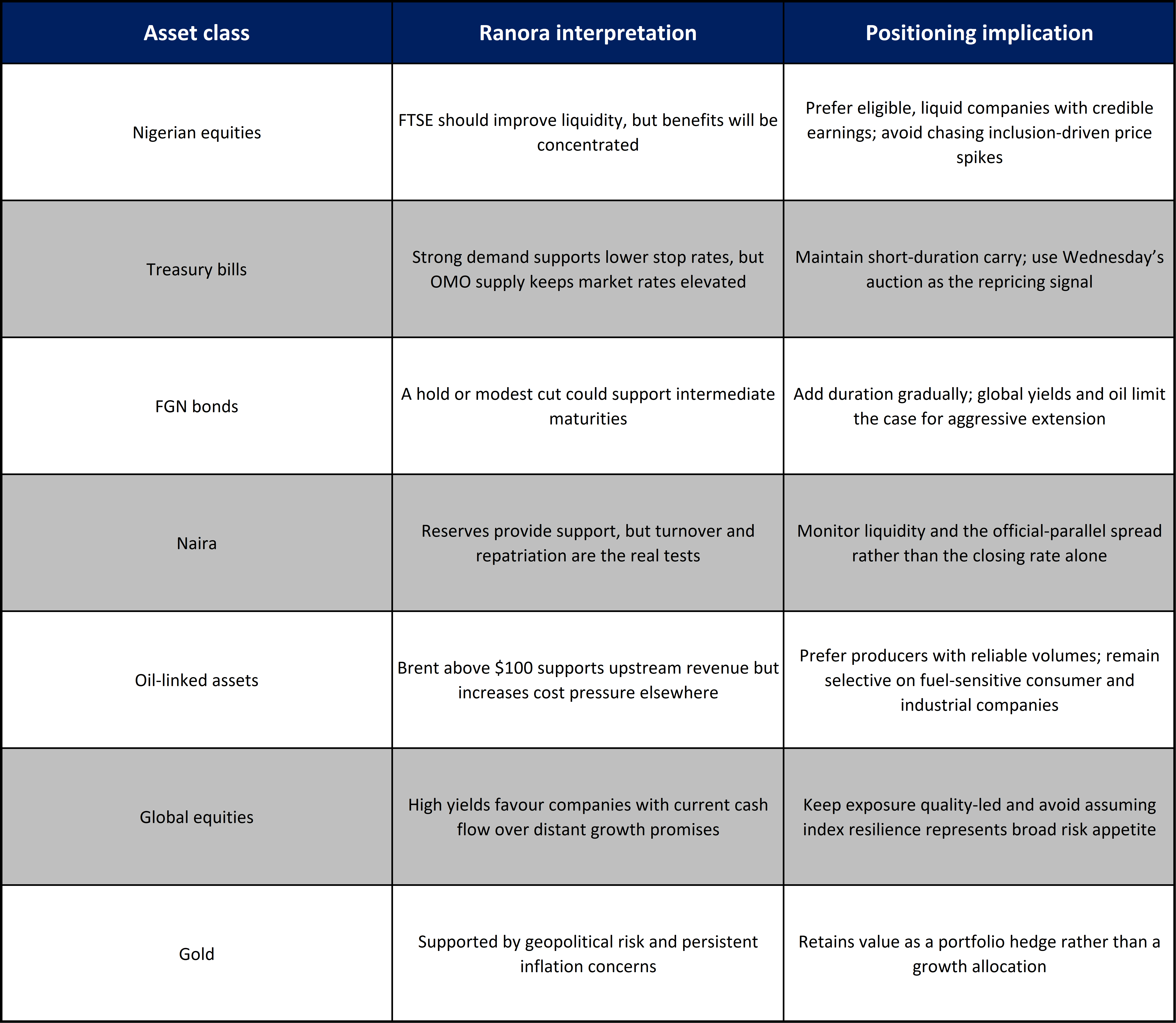
Asset Class Implications:
Ranora View:
Nigeria’s FTSE return is a credibility dividend, not a valuation waiver.
The strongest result this week would combine measurable foreign participation, stable FX execution and an MPC message that preserves positive naira carry. A small policy cut would not automatically weaken that framework if the CBN continues to manage excess liquidity through OMO operations. Its 16 September auction allotted approximately ₦3.29 trillion, demonstrating that effective monetary conditions can remain restrictive even when the headline rate moves.
Investors should therefore avoid treating Tuesday’s decision as a binary signal. The more important question is whether the combined policy package keeps the naira investable while allowing domestic yields to decline gradually. In equities, index eligibility can support liquidity, but earnings, free float and valuation will determine which inflows remain after the rebalance.
What to Watch Next:
Monday: Turnover and price action in the ten FTSE-eligible Nigerian large-cap stocks.
Tuesday: The CBN’s MPR decision, vote distribution and guidance on FX and liquidity.
Wednesday: The ₦500 billion NTB auction, particularly the 364-day stop rate and allotment.
Throughout the week: NFEM turnover, the naira’s official-parallel spread and evidence of foreign equity flows.
Globally: Fed commentary, the US 10-year yield around 5% and whether Brent remains above $100.
Question of the day:
Will FTSE re-entry create lasting foreign demand for Nigerian equities, or will high domestic and global yields keep capital concentrated in fixed income?
Stay smart. Stay informed. Subscribe to Ranora Market Outlook for free and support independent market analysis.