


Opening View
Nigeria enters this policy week with a more encouraging credit signal than bank balance sheets alone could provide. In the CBN’s third-quarter credit survey, lenders reported better availability and higher approval proportions. But inventory finance was a much stronger reported driver of corporate borrowing demand than capital investment. The distinction matters: financing stock can support today’s sales without establishing the case for tomorrow’s factory, warehouse or distribution network.
Earlier this month, we asked whether stronger bank funding was reaching borrowers. The survey provides evidence of improved reported access. The next test is what that access can finance, for how long, and at what cost. It does not establish a surge in actual loan volumes or a broad investment boom.
The CBN meets on Monday and Tuesday against renewed official-market naira weakness and faster monthly price increases, despite lower annual inflation. Abroad, last week’s sharp US equity losses add another constraint: external funding appetite can deteriorate even when Treasury yields fall.
Our reading is that the immediate business opportunity lies in making existing capacity work better. A durable expansion cycle needs credit terms and expected demand that justify committing capital beyond the next inventory turnover.
The Big Picture:
Credit availability, affordability and purpose are different signals. Better approvals can help a distributor replenish goods or a manufacturer complete orders. A capacity project needs something more: borrowing that lasts long enough for the asset to generate cash, and a return that clears financing, currency and execution costs.
The survey’s inventory-finance demand balance was 18.6, against 0.7 for capital investment. These are weighted lender-response measures, not shares of lending or growth rates. They cannot tell us whether businesses bought more physical stock or needed more money to replace the same stock at higher prices.
That limitation is economically important. If financing merely covers a larger replacement bill, sales can rise in naira without a comparable improvement in volumes or profitability. If goods sell slowly, interest accumulates before customers pay. For business owners, the relevant calculation is the margin left after funding the full cash-conversion cycle, including receivables.
For investors, improved access supports a recovery in utilisation more directly than it supports aggressive long-term earnings forecasts. The stronger expansion signal would be financed equipment orders and longer loan maturities alongside sustained customer demand. This week’s policy decision can influence those conditions, but cannot establish that they already exist.
Nigeria Market Intelligence
Credit access has improved, but pricing transmission remains incomplete.
The Q3 survey reports wider lending spreads relative to the policy rate in secured and corporate lending. That does not prove absolute loan rates rose, nor quantify an actual interest-rate spread. It does show why the MPC headline and the terms available to a borrower need separate assessment. Bank earnings will depend on funding costs and repayment quality as well as lending activity; wider reported spreads alone do not establish stronger margins. Watch renewed facilities, tenor and repayment terms after the decision.
Inflation and FX complicate working-capital planning
October annual inflation eased to 14.06% from 14.63%, while monthly inflation increased to 0.43% from 0.06%. Friday's reported NFEM reference was N1,389.73 per US dollar, weaker than Thursday's reference. This is not an executable bank quote. For import-dependent businesses, a larger naira procurement bill can absorb the benefit of easier loan access. Watch supplier replacement costs and actual FX settlement terms, not just the annual CPI headline.
Sovereign funding remains a separate pricing test.
Friday’s Open Repo rate was 20.00%, an interbank funding reference rather than a corporate lending rate. A reported additional Treasury-bill auction on Wednesday would test demand after the MPC meeting; final tender details still require confirmation. Its clearing rates and allotments will help distinguish policy signalling from actual market pricing. Gross issuance alone cannot establish a net liquidity withdrawal or prove that private borrowers have been crowded out.
The equity decline raises the earnings test.
The NGX All-Share Index ended Friday at 247,660.74, down 1.83% for the week. The fall does not identify which businesses face weaker demand and which are experiencing valuation or liquidity pressure. The useful distinction is whether an issuer can finance inventory and collect receivables without repeatedly refinancing at unfavourable terms. Watch operating disclosures and trading participation before interpreting an index rebound as a broad improvement in earnings prospects.
Global Market Intelligence:
The US sell-off can affect Nigeria through funding appetite.
The S&P 500 fell 8.6% and the Nasdaq Composite 10.0% in the week ended 20 November. Treasury yields also declined on Friday. For Nigerian sovereign and corporate borrowers, a lower US benchmark helps only if additional compensation demanded for credit and liquidity risk does not offset it. This is a transmission risk, not evidence that Nigerian capital outflows have already accelerated. Watch comparable sovereign spreads and issuance access.
Falling Treasury yields are not a Fed easing decision.
Minutes released last week showed that almost all participants at the October meeting considered further rate increases likely appropriate under their baseline outlooks. That assessment is conditional and predates the latest sell-off. Wednesday’s US inflation and spending data will test whether weaker asset prices are accompanied by softer underlying demand. Nigerian businesses with dollar liabilities should distinguish the interest-rate outlook from the availability and cost of refinancing.
Oil still has opposite effects across Nigerian balance sheets
Brent futures settled at US$92.57 a barrel on Friday. Higher crude prices can support export earnings while raising fuel and transport costs; lower prices reverse those pressures. Neither effect passes through immediately or uniformly. Producers’ realised receipts depend on volumes and costs, while non-oil businesses face local pricing, FX and inventory lags. Watch delivered energy costs alongside export-receipt conditions, rather than treating Brent alone as a corporate-margin forecast.
Asset Class Implications:
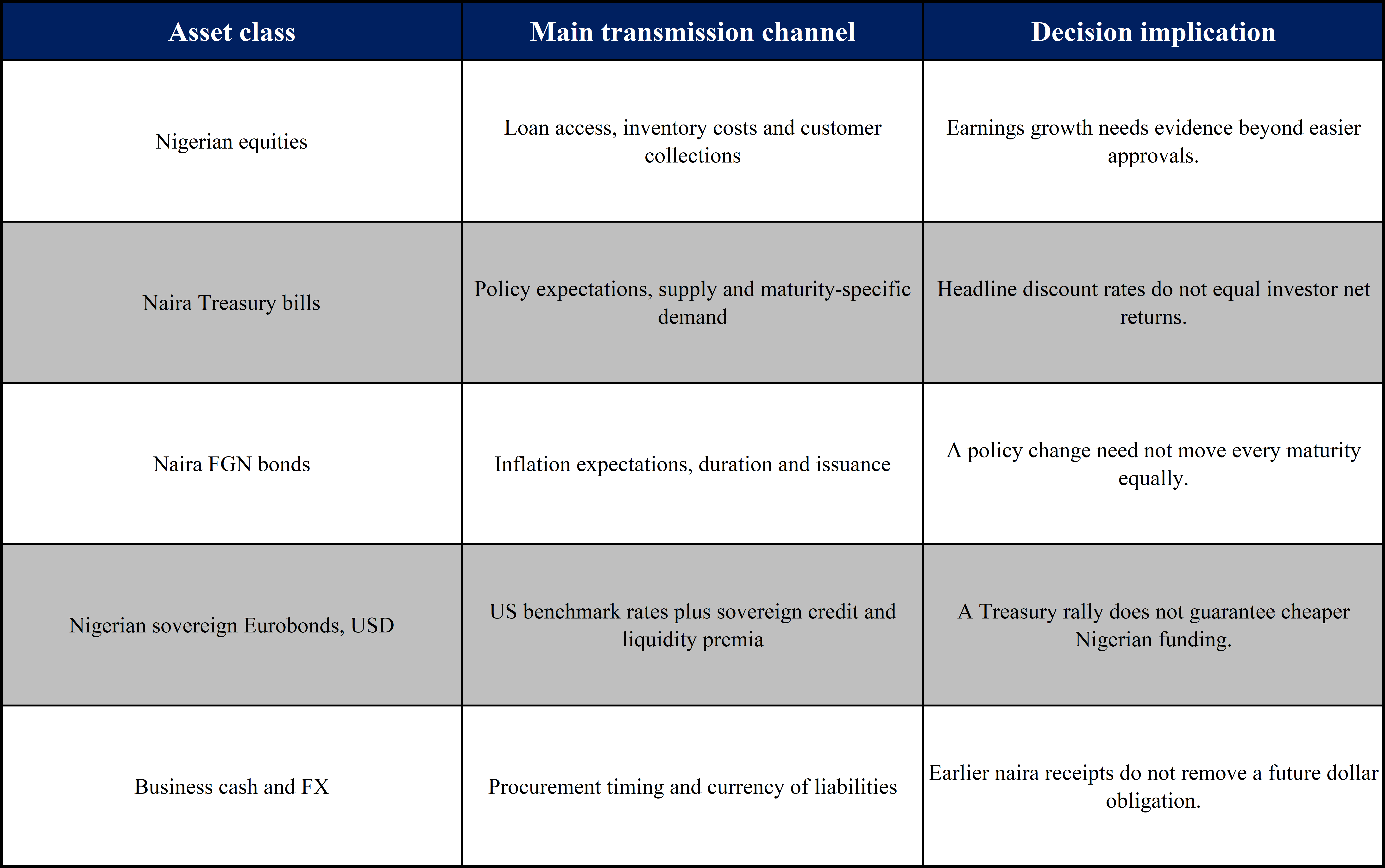
The same macro conditions affect assets through different channels.
Investment Ideas for the Week:
One new research candidate, with entry deferred: the Nigerian Treasury bill maturing 8 July 2027, denominated in NGN. Thesis ID: NG-NTB-20270708-CURVE-20261123. The prospective holding horizon is through that maturity, provided a later purchase qualifies on verified terms. This is a long-only, unleveraged comparison, not an allocation instruction.
The valuation question is specific. The 20 November indicative end-of-day secondary references displayed an annual yield of 18.61% for both the July bill and the bill maturing 4 November 2027. Their displayed discount rates were different: 16.66% and 15.80%, respectively. These are secondary-market references, not auction stop rates, guaranteed dealing offers or net returns. Equal annualised references also do not mean equal total cash earnings over different holding periods.
If comparable executable offers preserve that relationship after costs, the July maturity could provide earlier access to principal without sacrificing the quoted annual yield. That is a reason to investigate the shorter maturity, not proof that it is mispriced. The November bill offers longer income certainty and avoids the July reinvestment decision; that benefit could matter if available rates subsequently fall.
This week’s MPC communication and subsequent bill-market repricing are catalysts for reassessment. The case does not require a rate cut or a predicted capital gain. Before entry, both bills need same-day dealer offers for the same investment size and settlement date. The comparison must include purchase cash, maturity proceeds, broker and custody charges, applicable tax or withholding treatment, and the cost of an early exit. Those inputs have not been verified, so no after-tax yield or purchase price is presented.
Principal risks are inflation, sovereign repayment risk, adverse price changes before maturity and uncertain early-sale liquidity. For a reader ultimately funding dollar obligations, naira depreciation and conversion costs could outweigh the naira income. Holding to July also creates reinvestment risk that the later bill postpones.
What changes our view: a materially better net offer on the November comparator, a poor July offer, unclear settlement or tax treatment, or inadequate dealing depth would remove the apparent advantage. Conversely, verified comparable terms could turn this into a qualifying income opportunity. Until then, the decision is deferred entry. Earlier equity, bond and Eurobond candidates are not automatically renewed, and no transaction or realised return is implied.
Ranora View:
Better access to credit is useful progress, but its economic value depends on the assets and cash flows it finances. Our base interpretation is a working-capital recovery, with the prospect of better utilisation, rather than established evidence of a broad capacity-investment cycle.
That distinction changes the earnings question. Faster stock turnover and reliable collections can improve profitability before new capacity comes on stream. Borrowing more to carry expensive inventory can do the opposite. For banks, the same recovery creates lending opportunities but still requires repayment discipline and appropriate funding maturities.
The evidence that would change this view is sustained growth in financed capital projects on terms that match their payback periods. Until then, the policy decision should be judged by borrower terms and investment commitments, alongside FX stability. A lower headline rate alone would not settle the question.
What to Watch Next:
CBN meeting, 23-24 November: the policy decision and its liquidity framework, followed by actual borrower and interbank pricing.
Reported additional NTB auction, 25 November: confirmation of tender details, then clearing rates and allotments rather than the offer size alone.
US releases, 25 November: October PCE inflation and spending, alongside the second estimate of third-quarter GDP and corporate profits.
Nigerian FX and credit follow-through: procurement settlement costs, renewed loan terms and evidence of funded equipment or capacity projects.
US holiday trading, 26-27 November: NYSE cash-equity markets close for Thanksgiving on Thursday and finish early on Friday. Reduced participation could complicate price discovery.
Question of the day:
If access to credit improved for your business today, would you use it to carry more inventory or commit to new capacity, and what would need to change for the second choice to make sense?
Stay smart. Stay informed. Subscribe to Ranora Market Outlook for free and support independent market analysis.