


Opening View
Nigeria enters the week with a different borrowing proposition. The Debt Management Office is offering N2 trillion in bonds today, unchanged from the November amount in its original quarterly plan. What changed is the repayment schedule: bonds maturing in 2028, 2029, 2030 and 2033 replace the previously planned 2034, 2036 and 2038 offerings.
That distinction matters more than the headline amount. By our calculation, 85% of today’s offer matures by 2030. The offer asks investors to fund shorter maturities, while the government would need to repay or refinance the resulting borrowing sooner than under the earlier plan. Actual issuance still depends on the auction outcome.
Our reading is that this week’s market test is about where financing pressure lands. Additional shorter-dated government paper could compete more directly with medium-term corporate funding, while reduced planned supply of longer bonds could support their prices without making business credit cheaper.
For investors, a bond rally would therefore need interpretation, not automatic extrapolation. For businesses, the relevant question is whether obtainable funding terms improve over the life of an investment. Today’s expected inflation release and Wednesday’s settlement will help distinguish a change in market pricing from a genuine improvement in financing conditions.
The Big Picture:
The revised calendar redistributes supply; it does not reduce the planned November borrowing amount. That creates a potential divergence along the yield curve, the relationship between borrowing costs and maturity.
If demand is unchanged, less new long-dated paper could support existing long-bond prices. At the same time, more supply at earlier maturities could require higher yields there. Neither outcome is guaranteed: investor preferences, auction allotments and CBN liquidity operations can outweigh the calendar effect.
This also changes how the auction should be judged. A lower yield on a shorter bond is not a like-for-like improvement over October’s longer instruments. The useful comparison is with the same maturity in the secondary market, alongside the amount actually allotted.
For a company considering a factory expansion or distribution investment, a financing plan that matures before the project repays its cost still carries rollover risk. A lower initial interest bill does not remove that mismatch. The government’s revised offer illustrates the same trade-off at sovereign scale.
Nigeria Market Intelligence
The auction must pass a settlement test
The bond auction settles on 18 November. Last week’s 364-day Treasury-bill stop discount rate rose to 15.89% from 15.80%; strong demand should not be confused with guaranteed yield compression. That is a completed 11 November auction reference, not a rate available to buy today.
The practical test is whether lower accepted bond yields, if they emerge, are followed by softer post-settlement funding rates. A well-covered auction alone does not establish cheaper working capital or easier access to bank credit.
The equity recovery remains uneven
The NGX All-Share Index gained 1.36% in the week ended 13 November, closing at 252,269.16 points. Industrial Goods rose 6.11%, while Banking and Consumer Goods declined 0.21% and 0.55%, respectively. These are price-index changes, not dividend-inclusive portfolio returns.
The divergence matters: the headline recovery does not establish an economy-wide earnings upgrade. This week, broader sector participation and company-specific margins will be more informative than another rise in the aggregate index.
Inflation relief must reach operating costs
Nigeria’s October inflation report is expected today; no released October figure is included at this edition’s cutoff. Proshare’s completed-week review also reported naira weakness in both the official and parallel markets, so domestic disinflation cannot be treated as automatic import-cost relief.
For manufacturers and distributors, the decision-relevant combination is monthly input-price movement, obtainable FX and the cost of financing replacement inventory. A lower annual inflation rate can coexist with rising prices and continued pressure on cash margins.
Global Market Intelligence:
The US equity rebound is not a funding signal
The S&P 500 gained 2.5% last week, but the US ten-year Treasury yield stood at 5.15% late Friday. October US producer prices rose 0.3% month on month; the measure excluding foods, energy and trade services increased 0.5%, both seasonally adjusted.
That combination does not establish an easing backdrop. Nigerian dollar borrowers face a benchmark-rate cost as well as their own credit premium. Wednesday’s Fed minutes may clarify the earlier policy debate, but they cover the October meeting and predate these November inflation releases.
China’s new data weaken the broad demand-recovery case
Data released this morning show October Chinese retail sales rose just 0.4% year on year in nominal terms, while industrial value added increased 4.8% in real terms. These measures have different price bases, but together they show that positive production growth is not equivalent to strong household spending.
For Nigeria, weak Chinese consumption complicates the case for a broad commodity-demand upswing. For import-facing businesses, supplier pricing and delivery terms remain more useful than assuming that either Chinese output growth or weak retail demand guarantees cheaper inputs.
Oil affects receipts and costs differently
Brent futures settled at US$95.84 a barrel on Friday. ICE’s delayed January-contract observation was US$95.35 at 05:09 WAT today, an early-session reference rather than a Monday settlement or executable quote.
Lower crude prices can ease some energy-cost pressure but also reduce Nigerian export receipts, other things equal. The business outcome depends on the naira, delivered fuel prices and inventory timing. This week, shipping developments and actual local fuel repricing matter more for cash-flow forecasts than crude’s direction alone.
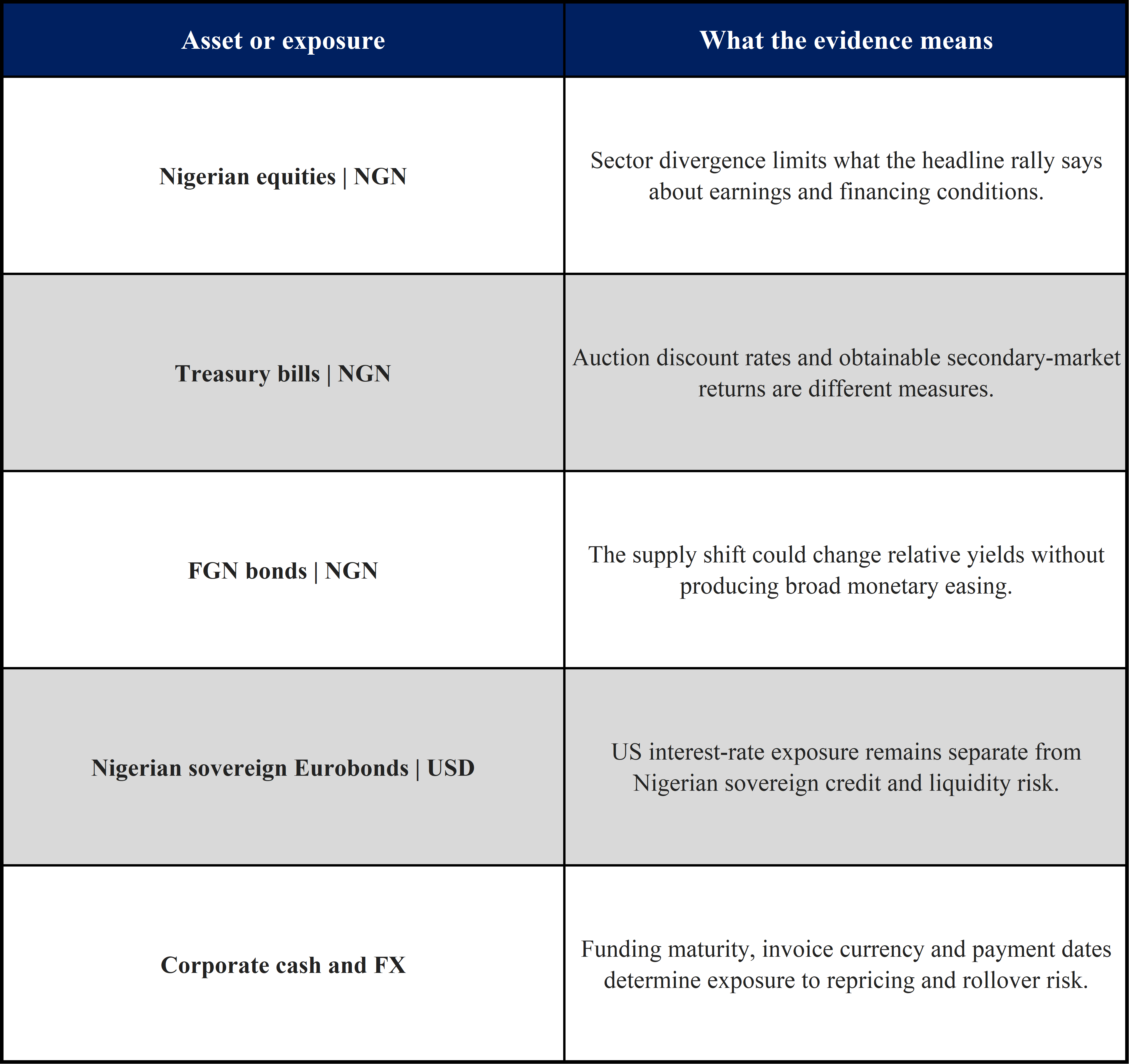
Asset Class Implications:
How the week’s developments could transmit into portfolios and business finances.
Investment Ideas for the Week:
No new purchase recommendation this week
The research for this edition has not established a new Nigerian opportunity with sufficiently verified entry economics. We are introducing no new thesis identifier and are not automatically renewing earlier ideas. This is a decision about the evidence available for an entry, not a claim that the market contains no attractive assets. The framework remains long-only and unleveraged.
Naira bonds and Treasury bills
Defer a new entry based solely on today’s supply change. A potentially supportive technical backdrop for longer bonds is not proof that their current prices offer enough compensation for interest-rate and inflation risk. The next catalyst is the auction result, followed by secondary-market pricing after settlement.
Before selecting an exact maturity, compare its obtainable yield to maturity with shorter sovereign alternatives after the bid-offer spread, fees, applicable tax treatment and the full settlement amount, including accrued interest. The advertised coupon is not the purchase yield. The circular’s primary subscription minimum is N50,001,000; access through a particular intermediary and any secondary-market minimum must be checked separately.
For bills, the last auction’s discount rate is not an annualised return on the cash invested, nor a current dealing offer. The missing inputs are an identified maturity, executable size and price, verified costs and applicable tax treatment. An acceptable comparison would also show the cost of selling early and the reinvestment exposure if the bill matures before the cash is needed.
Nigerian equities and sovereign USD Eurobonds
A sector rally does not establish an equity valuation case. No stock is promoted here without current issuer evidence, a price-based valuation, corporate-action checks and obtainable dealing depth. Where cash conversion drives the thesis, comparable operating cash flow and working-capital effects must support it; reported profit alone is insufficient.
For Nigerian sovereign Eurobonds, the DMO’s published closing references dated 12 November are useful starting points, not executable offers. A qualifying USD idea needs a maturity-matched US Treasury comparison, credit compensation, accrued interest, bid-offer costs, access and liquidity checks. Currency-conversion costs matter for a naira-funded buyer; holding a Nigerian bond in dollars does not remove Nigerian sovereign risk.
No target, allocation, assumed holding return or transaction is implied. A new entry view would require fresh evidence and verified net terms; older thesis identifiers and their histories remain unchanged rather than being repackaged as new opportunities.
Ranora View:
Our base interpretation is that the revised borrowing plan redistributes interest-rate exposure between investors and the sovereign; it does not yet demonstrate cheaper capital. The immediate portfolio implication is that bond-price strength and business-financing relief could diverge.
That distinction will matter for equity valuations and capital spending. If shorter-maturity yields remain firm while longer bonds strengthen, companies refinancing sooner may see little benefit. If matched-maturity yields, funding rates and obtainable borrower terms improve together after settlement, the case for a broader financing recovery becomes stronger. Today’s auction result should be read through that comparison, not through the lowest quoted yield.
What to Watch Next:
Monday’s bond auction: accepted yields against comparable secondary maturities, actual allotment and demand across the offered bonds.
Nigeria’s October CPI, expected today: monthly food and non-food pressures, not just the annual headline.
Wednesday’s settlement: overnight funding conditions, secondary bond pricing and any offsetting CBN liquidity operations.
Fed minutes on Wednesday 18 November: the October policy discussion, assessed alongside the subsequently released inflation evidence.
Market transmission through the week: NGX sector breadth, obtainable FX and delivered fuel costs. These will test whether asset-price changes reach earnings and cash flow.
Question of the day:
What would change your assessment of Nigerian financing conditions more: lower government bond yields, or better borrowing and FX terms actually available to businesses?
Stay smart. Stay informed. Subscribe to Ranora Market Outlook for free and support independent market analysis.