


Opening View
Nigeria enters the week with a stronger sovereign credit signal. Fitch affirmed the country’s B rating and changed its outlook to Positive on Friday. This is an improvement in the assessment of its direction, not a completed rating upgrade. The announcement came after Nigerian trading, so last week’s market moves cannot be treated as a response.
The investment opportunity is more specific than a broad “buy Nigeria” call. Improving creditworthiness can reduce the extra return investors demand for lending to Nigeria. But the US interest-rate component remains substantial: the US Treasury’s ten-year par yield was 5.24% on 9 October.
Our interpretation: reassess Nigerian credit risk without automatically adding long-maturity dollar bonds. Their prices could still fall if rising US yields outweigh any reduction in Nigeria’s risk premium. For businesses, improved sovereign sentiment is not evidence that refinancing quotes have become cheaper.
This week’s test is whether the better credit assessment translates into better relative pricing, and whether that improvement survives the next inflation readings.
The Big Picture:
A Nigerian Eurobond contains two distinct exposures: the country’s ability to repay and the level of dollar interest rates. A narrower credit spread, meaning a smaller yield premium over comparable US debt, can coexist with an unchanged or higher total borrowing cost. That is the distinction investors and corporate treasurers should monitor.
Fitch’s action strengthens the argument for reassessing country risk; it does not establish that bonds are undervalued. The evidence needed next is bond-by-bond pricing against maturity-matched Treasuries, not a comparison between an average Nigerian Eurobond yield and a single US benchmark. This is Ranora’s interpretation of the sourced credit and rate evidence above, not a claim that spreads have already narrowed.
Nigeria Market Intelligence
Equities: recovery needs broader participation.
The NGX All-Share Index fell 0.97% last week to 248,363.55 points. Banking lost 2.64% and Oil/Gas 3.85%; 24 equities advanced against 54 decliners. That leaves a clear test for this week: does improved sovereign sentiment bring broader buying, or only a lift in a few large stocks? For banks, require evidence of funding-cost relief and sound loan performance before assuming an earnings benefit.
Fixed income: compare the return actually available.
Friday report put its indicative 365-day secondary Treasury-bill yield at 18.64% and its ten-year FGN bond benchmark yield at 16.43%. These are secondary-market references, not auction stop rates or guaranteed dealing quotes. They favour checking available bill income before extending naira duration simply on improving sovereign headlines. Watch whether inflation and executable bond prices justify taking more maturity risk.
FX: plan around access, not just the screen rate.
AIICO reported an official-market reference of N1,331.19 per US dollar on Friday. For importers and dollar borrowers, the useful test is the rate and settlement timing available for their transaction. A favourable credit assessment does not eliminate currency mismatches. Watch executable FX and forward quotes against upcoming payments.
Inflation: examine the monthly detail.
Trading Economics lists September’s Nigerian CPI release for Thursday, 15 October, following August’s 15.39% annual inflation rate. Treat the date as provisional pending NBS confirmation. The portfolio question is whether monthly food and transport pressures support further bond-yield declines, not merely whether the annual headline falls.
Global Market Intelligence:
US equities have not removed the funding hurdle.
The S&P 500 gained 1.2% last week and the Nasdaq Composite 0.6%. That strength does not make dollar funding cheaper for Nigerian issuers. September US CPI is scheduled for Wednesday, 14 October, and PPI for Thursday, 15 October, both at 1:30 p.m. WAT. Watch the Treasury-market response: softer data would help the duration case, but the reaction matters more than the headline alone.
Oil supports the sovereign differently from companies.
Brent futures settled at US$104.72 a barrel on Friday. The World Bank’s October Nigeria update says higher oil strengthened external balances, while existing oil commitments moderated fiscal gains. Our implication: avoid treating expensive crude as uniformly positive for Nigerian assets. Fuel-intensive businesses can face margin pressure even when the external accounts improve. Watch realised export receipts, production and domestic fuel-cost pass-through.
Bangkok is a financing test, not an inflow forecast.
The IMF-World Bank Annual Meetings run from 12–18 October in Bangkok. For Nigerian investors, assess any financing announcements by their terms, conditions and disbursement timetable. A meeting or expression of interest is not funded capital. Watch concrete commitments and changes to growth or debt-service assumptions.
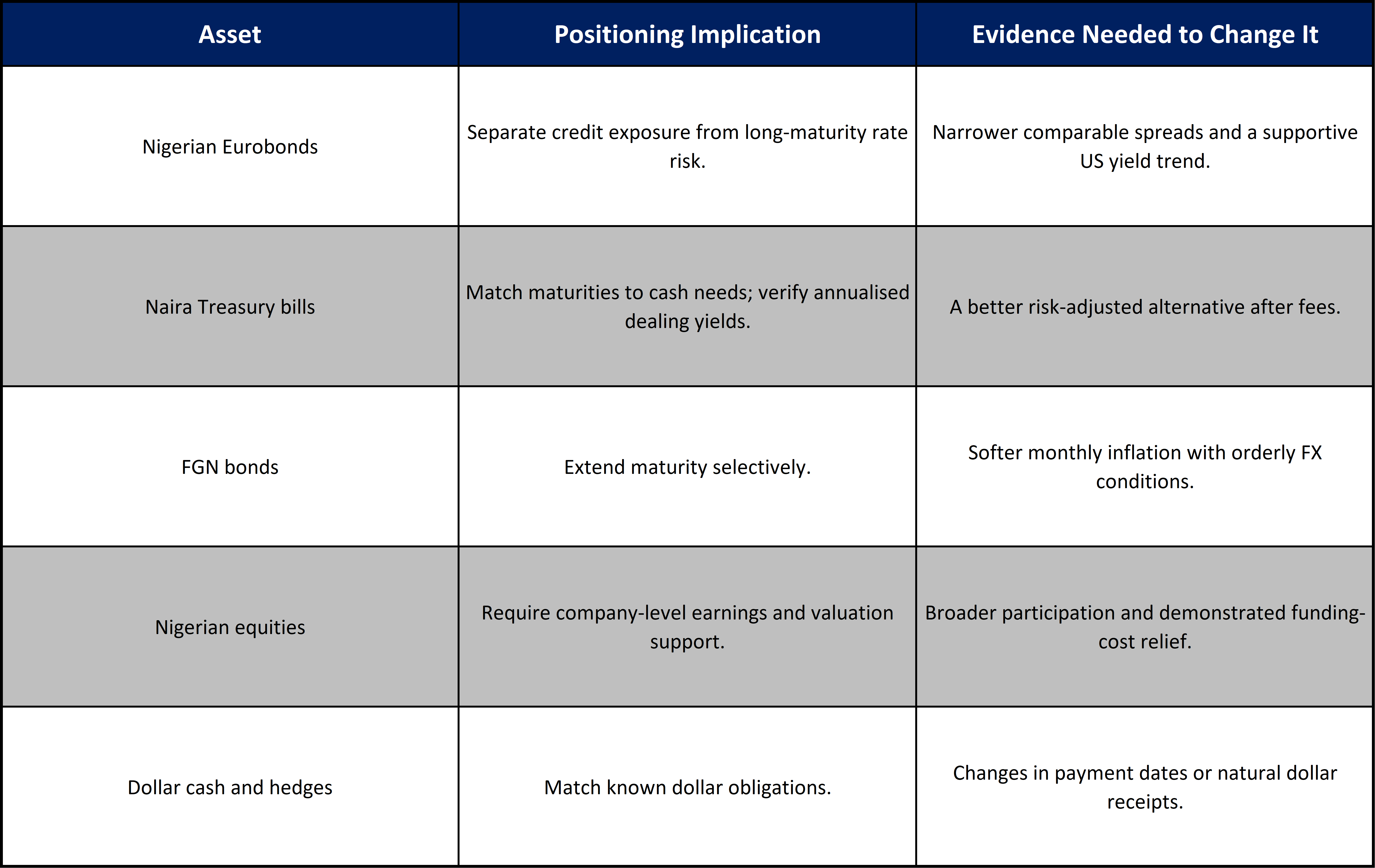
Asset Class Implications:
Ranora View:
The fresh opportunity is to reassess Nigeria’s credit premium, not to assume that its longest dollar bonds offer the best trade. Our preference is selective short-to-intermediate maturity exposure where actual spreads compensate for credit and liquidity risk. That generally limits interest-rate sensitivity; it does not eliminate credit losses or prove that today’s prices are attractive.
For businesses, compare the full refinancing quote, including fees, with the existing liability before treating sovereign progress as financing relief. We would become more willing to extend dollar duration if US yields eased alongside firmer Nigerian credit pricing. Renewed FX stress or fiscal slippage would weaken the credit case. This is a conditional house view based on the credit, rate and market evidence cited above.
What to Watch Next:
Monday–Tuesday: Assess post-announcement Eurobond quotes carefully. SIFMA recommends a US fixed-income holiday on Monday, 12 October; Tuesday should provide a fuller pricing test.
Wednesday–Thursday: Track US CPI and PPI, then the response in Treasury yields and Nigerian dollar bonds.
Thursday, provisionally: Read Nigeria’s CPI components for evidence supporting or challenging additional naira duration. The Trading Economics schedule remains subject to NBS confirmation.
Throughout the week: Look for broader NGX participation and workable FX quotes. These are practical tests of whether stronger sovereign sentiment is reaching portfolios and business funding.
Question of the day:
What would make you add Nigerian dollar debt this week: a wider credit premium, a shorter maturity, or evidence that US yields are turning lower?
Stay smart. Stay informed. Subscribe to Ranora Market Outlook for free and support independent market analysis.