


Opening View
Opening View:
Nigeria’s Q2 GDP report is the domestic market’s most important release this week, but the headline growth rate will not be enough. The stronger signal will come from the composition of growth: whether manufacturing, trade and other consumer-facing sectors are gaining momentum, or whether expansion remains concentrated in areas with limited read-through to listed-company earnings.
The timing raises the stakes. Investors have today to process the report before Tuesday’s Eid ul Mawlid public holiday. Trading resumes on Wednesday alongside a scheduled ₦700 billion Treasury-bill auction, while approximately ₦2.32 trillion in OMO maturities and ₦166 billion in bond coupons are expected to add liquidity to the financial system.
That combination should keep demand for government securities firm. The more difficult question is whether improving inflation, currency and growth data can persuade investors to rebuild equity positions after the NGX All-Share Index declined 1.35% last week.
Globally, Wednesday’s US inflation release and Nvidia results will test both the rates outlook and the earnings assumptions behind technology valuations. Jackson Hole and oil-market risks then take over later in the week. For Nigerian investors, the transmission channels are clear: US yields influence frontier-market flows, while Brent affects fiscal revenue, FX supply and domestic inflation expectations.
The Big Picture:
The Nigerian macro narrative is improving faster than the equity market’s earnings narrative.
Headline inflation slowed to 15.43% in July and the naira strengthened across official and parallel markets last week. However, monthly food inflation accelerated to 5.56%, suggesting that household purchasing power remains under pressure. GDP growth therefore needs to be examined for breadth, not merely direction.
If Q2 growth strengthens across manufacturing, trade and services, the case for selective exposure to banks, industrial companies and consumer names becomes more credible. If growth remains narrow, the current preference for government securities will remain rational despite lower annual inflation.
This is the week when macro stability must begin to demonstrate an earnings transmission mechanism.
Nigeria Market Intelligence
Q2 GDP is an earnings-quality test
What happened: Nigeria’s economy expanded by 3.89% year-on-year in Q1 2026, compared with 3.13% in Q1 2025. Manufacturing grew by 3.29%, trade by 2.08%, and the non-oil economy accounted for 96.08% of real GDP. The Q2 report is scheduled for release today.
Why it matters: A stronger headline driven by broad improvements in manufacturing, trade and services would suggest that easing core inflation and greater FX stability are reaching the operating economy. Growth dominated by a small number of sectors would provide less support for a broad equity rerating.
What to watch: Sector growth, the oil/non-oil split, manufacturing momentum and evidence that trade or consumer activity is improving.
A shortened week may concentrate price discovery
What happened: The Federal Government declared Tuesday, 25 August, a public holiday for Eid ul Mawlid. Nigerian markets consequently have a shortened trading week immediately after the GDP release.
Why it matters: Investors will have a narrow window to interpret GDP before the holiday and Wednesday’s bill auction. This can concentrate order flow and exaggerate movements in liquid bellwether equities when trading resumes.
What to watch: Monday’s closing breadth and volume, followed by whether Wednesday’s market reaction confirms or reverses the initial GDP interpretation.
The liquidity test moves to Treasury bills
What happened: Approximately ₦2.32 trillion in OMO maturities and ₦166 billion in bond coupons are expected this week. This comes ahead of a ₦700 billion Treasury-bill auction across the 91-day, 182-day and 364-day tenors.At the 12 August auction, subscriptions reached ₦4.41 trillion against ₦700 billion offered. The 364-day bill attracted ₦4.19 trillion of bids and cleared at a 17.59% stop rate.
Why it matters: Abundant liquidity should sustain demand, but investors should not assume that oversubscription automatically means lower stop rates. The previous auction demonstrated that the government can increase allotments or maintain pricing discipline when demand is unusually strong.
What to watch next: The amount allotted, not only the amount offered; the 364-day bid range; and whether the 182-day tenor remains comparatively weak.
Equities now need earnings evidence
What happened: The NGX All-Share Index declined 1.35% last week to 239,351.16. Fifty-nine stocks fell against 18 gainers, while trading volume dropped by 48.6%. The naira strengthened to ₦1,346.49/$ at NFEM and ₦1,405/$ in the parallel market.
Why it matters: Weak breadth suggests more than isolated profit-taking. After a strong year-to-date advance, investors are raising the valuation threshold for additional exposure. A firmer naira supports companies with imported inputs, but that benefit will not translate uniformly while food costs continue to constrain consumers.
What to watch: Banks with strong interest and fee income, industrial businesses benefiting from lower FX volatility, and consumer companies with genuine pricing power rather than nominal revenue growth alone.
Global Market Intelligence:
US PCE will determine whether yields remain a headwind
What happened: US July personal income and expenditure data are due Wednesday. In June, headline PCE inflation was 3.7% year-on-year and core PCE was 3.3%.
Why it matters: Another firm inflation reading could keep Treasury yields elevated and reduce the relative appeal of frontier-market assets. A softer result would ease global duration pressure and could support emerging-market currencies and Eurobonds.
What to watch: Core monthly inflation, consumer spending and the US 10-year yield’s reaction.
Nvidia tests the earnings support beneath global equities
What happened: Nvidia will report fiscal Q2 2027 results on Wednesday after the US market closes.
Why it matters: With global technology performance increasingly dependent on AI-related capital expenditure, Nvidia’s guidance may matter more than its reported quarter. Weak forward demand could trigger broader valuation compression rather than an isolated company reaction.
What to watch: Data-centre revenue, customer capital-spending signals and management’s forward commentary.
Jackson Hole arrives during bond-market stress
What happened: The Kansas City Fed’s Jackson Hole symposium runs from 27–29 August under the theme “Financial Innovation: Implications for Payments and Policy.”
Why it matters: Markets will assess how the Fed interprets persistent inflation and volatile government-bond yields. A message that validates tighter-for-longer conditions could strengthen the dollar and tighten financing conditions for emerging and frontier markets.
What to watch: Language on inflation persistence, financial conditions and the role of market pricing in policy transmission.
Oil is becoming both support and risk for Nigeria
What happened: Brent futures gained 6.39% last week as concerns about Iran and supply conditions intensified. The S&P 500 fell 1.43%, while the Nasdaq declined 2.05%.
Why it matters: Higher Brent can improve Nigeria’s export receipts and fiscal arithmetic. However, an oil-driven increase in US inflation expectations can lift global yields, weaken risk appetite and raise Nigeria’s domestic energy and transport costs. The net benefit depends on production volumes, realized export receipts and the duration of the price move.
What to watch: Brent’s ability to hold its recent gains, developments affecting Iranian supply, and the response of global bond yields.
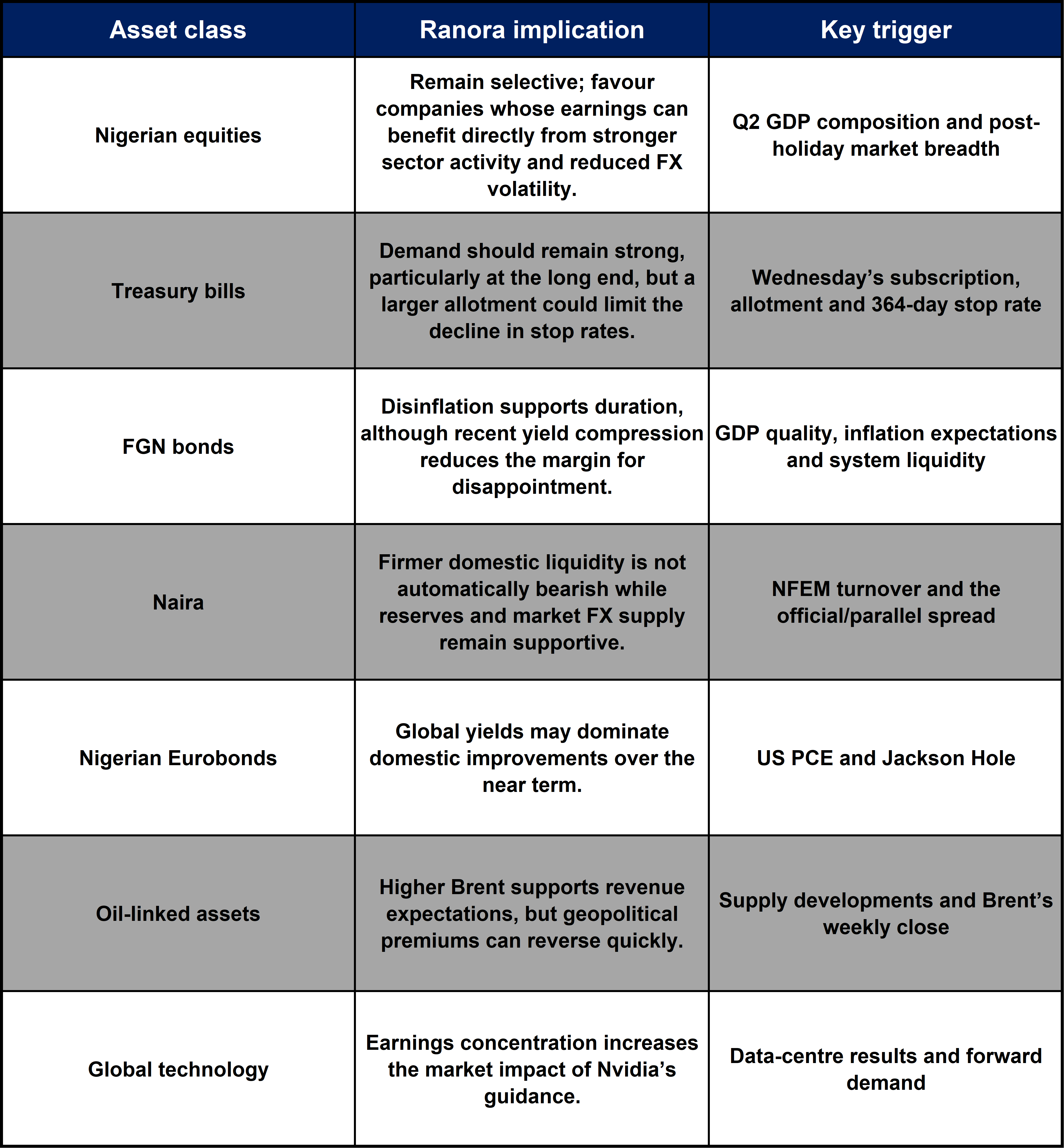
Asset Class Implications:
Ranora View:
Nigeria’s investment case this week is not simply that growth may be improving. The relevant question is whether macro stabilisation is becoming broad enough to support corporate volumes, margins and cash generation.
The base positioning still favours sovereign fixed income because liquidity is strong, nominal yields remain attractive and annual inflation is easing. However, the next stage of opportunity may become more selective. Evidence of stronger manufacturing, trade and consumer activity would justify measured additions to quality equities with defensible valuations and identifiable earnings leverage.
A weak or narrowly based GDP report would reinforce the opposite conclusion: retain yield exposure, avoid treating naira stability as a universal earnings catalyst, and demand a larger valuation discount before increasing equity risk.
Globally, exposure should remain protected against higher US yields. The combination of PCE, Nvidia, Jackson Hole and oil risk leaves little room for portfolios that depend on only one benign outcome.
What to Watch Next:
Nigeria’s Q2 GDP growth composition, particularly manufacturing, trade and non-oil activity.
NGX breadth and volume when trading resumes after Tuesday’s holiday.
Wednesday’s Treasury-bill subscriptions, allotments and stop rates.
US core PCE and the reaction of the dollar and 10-year Treasury yield.
Nvidia’s guidance, Jackson Hole communication and the persistence of the Brent risk premium.
Question of the day:
Would broad-based Q2 growth be enough to bring investors back into Nigerian equities, or do current Treasury yields still set too high a hurdle?
Stay smart. Stay informed. Subscribe to Ranora Market Outlook for free and support independent market analysis.