


Opening View
Opening View:
Nigeria begins the week with two events capable of changing market direction: the July inflation release and a scheduled FGN bond auction offering between ₦1.2 trillion and ₦1.6 trillion across two maturities.
The inflation headline will attract attention, but investors should look beyond it. Headline inflation eased only marginally to 15.91% in June, while food inflation accelerated to 17.52% year on year and 3.75% month on month. A renewed increase in July food prices would weaken the case for near-term monetary easing, even if the headline rate remains broadly stable.
The bond auction will provide the market’s immediate verdict. Recent Treasury bill auctions have attracted strong demand for one-year paper, but today’s offer asks investors to accept materially longer duration. Strong subscriptions and lower clearing yields would indicate that domestic institutions are becoming more comfortable extending maturity. Weak demand or elevated marginal yields would show that investors still require a substantial term premium.
Globally, softer US consumer inflation and weaker retail sales have reduced some pressure for higher rates. However, the Federal Reserve’s July decision contained three votes for an increase. Wednesday’s minutes may therefore keep US yields, the dollar and frontier-market positioning volatile.
The Big Picture:
This week is about whether improving headline inflation is strong enough to change asset allocation.
Nigeria’s nominal policy rate remains 26.5%, while the latest available Treasury bill stop rates are below 18%. If July inflation moderates without another acceleration in food prices, investors may become more willing to lock in longer-dated government yields before any eventual monetary easing.
The alternative is less favourable. Persistent food inflation, combined with elevated oil-related transport costs, would keep real returns under scrutiny and preserve demand for shorter-duration instruments. It could also limit the valuation support available to equities, particularly highly leveraged consumer and industrial companies.
The global backdrop adds another layer. US inflation eased in July, but oil remains expensive and US Treasury yields remain elevated. Nigerian assets therefore need more than a softer US inflation print they need stable dollar liquidity, credible domestic disinflation and auction pricing that compensates investors for duration risk.
Nigeria Market Intelligence
July inflation is the week’s first decision point
What happened: Nigeria’s latest published CPI report showed headline inflation easing from 15.93% in May to 15.91% in June. However, food inflation rose from 16.96% to 17.52%, while monthly food inflation accelerated to 3.75%.
Why it matters: The food component is a better guide to household purchasing power and consumer-sector margins than the small change in the headline rate. Another food-price acceleration would strengthen the case for the CBN to keep monetary conditions tight.
What to watch: July’s month-on-month headline and food readings, rather than the annual headline alone. Investors should also examine whether inflation is broadening into transport and services.
The bond auction will reveal the market’s duration appetite
What happened: The DMO’s provisional calendar schedules reopenings of the 22.60% FGN January 2035 and 15.45% FGN June 2038 bonds for today. The indicated offer range is ₦600 billion to ₦800 billion per instrument.
Why it matters: The potential ₦1.6 trillion combined offer is a meaningful supply test. Strong demand would suggest that pension funds, banks and asset managers are prepared to move beyond Treasury bills. Elevated marginal yields would indicate that investors still see inflation and liquidity risks as too high to accept current longer-term pricing.
What to watch: Subscription levels, marginal yields, the amount allotted and post-auction secondary-market trading.
Nigerian equities enter the week under profit-taking pressure
What happened: NGX-sourced daily data show the All-Share Index closing at 242,619.20 on 14 August, about 1.2% below its 7 August close. The market declined in four consecutive sessions after Monday’s advance.
Why it matters: This looks less like a rejection of Nigerian equities and more like a shift toward selectivity after a strong year-to-date run. With fixed income yields still attractive, equity valuations increasingly need earnings delivery rather than liquidity alone.
What to watch next: Banks with credible recapitalization plans, oil producers supported by high crude prices, and consumer companies capable of defending margins if food and transport inflation remain firm.
Naira stability still depends on dollar liquidity
What happened: CBN-sourced market data placed the official USD/NGN rate at approximately ₦1,357.11 on 14 August.
Why it matters: A stable naira reduces imported inflation and improves earnings visibility for manufacturers, telecom operators and consumer businesses. However, the quality of that stability depends on sustained market turnover and autonomous inflows, not only official supply.
What to watch: Daily NFEM turnover, the range between intraday highs and lows, external-reserve direction and any post-auction pressure on banking-system liquidity.
Global Market Intelligence:
Federal Reserve minutes could revive the rates debate
What happened: The Fed held its target range at 3.50%–3.75% in July, but three policymakers voted for a 25-basis-point increase. Wednesday’s minutes will be examined for evidence that the hawkish camp extends beyond those dissenters. A more restrictive message could lift US yields and the dollar, reducing appetite for frontier-market duration.
US inflation cooled, but the growth signal weakened
What happened: US headline CPI rose 0.1% in July and 3.4% year on year, while core inflation eased to 2.5%. Producer prices were unchanged during the month, but retail sales fell 0.6%. The combination reduces immediate inflation pressure but also raises questions about consumer momentum.
For Nigeria, the best outcome would be lower US yields without a sharp deterioration in global growth. That would improve the relative appeal of naira fixed income while preserving commodity demand.
Oil remains supportive for revenue but dangerous for inflation
What happened: Brent ended Friday around $88.52 per barrel as uncertainty around Persian Gulf shipments persisted. OPEC+ has approved a further 188,000-barrel-per-day production adjustment for September.
Elevated Brent can support Nigeria’s export receipts and fiscal revenue if domestic production is sustained. The offset is higher fuel, freight and imported-input costs, which could slow disinflation and squeeze non-oil corporate margins.
China’s slowdown remains a commodity-demand risk
What happened: China’s official manufacturing PMI fell to 49.2 in July from 50.3 in June, returning below the 50-point expansion threshold. Second-quarter GDP growth also slowed to 4.3% year on year.
This matters for Nigeria through oil and broader commodity demand. A deeper Chinese slowdown could eventually offset some of the geopolitical premium supporting crude prices.
Asset Class Implications:
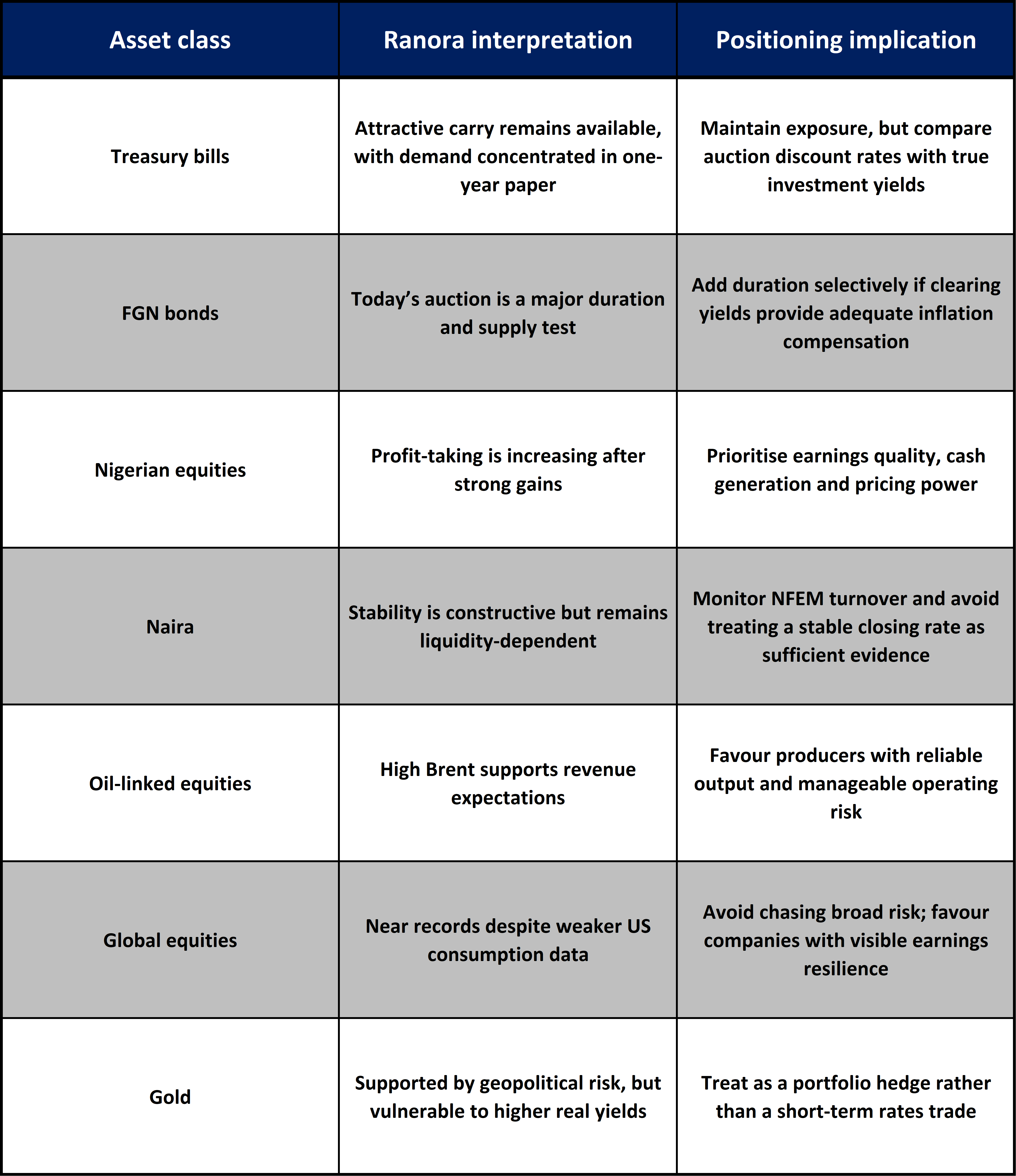
Ranora View:
The most important signal this week will not be the inflation headline in isolation. It will be the interaction between inflation, bond-auction pricing and the naira.
A softer inflation print combined with strong demand at today’s auction would support a gradual extension from Treasury bills into selected FGN bonds. It could also improve the relative appeal of dividend-paying equities as investors begin to anticipate lower reinvestment rates.
If food inflation remains elevated and the auction clears at higher yields, short duration should retain the advantage. In equities, that outcome would favour banks with strong liquidity franchises, oil producers benefiting from elevated Brent, and businesses with demonstrated pricing power. Highly leveraged consumer and industrial companies would remain more exposed.
Globally, softer US inflation is helpful, but the Fed’s internal split and the 4.69% US 10-year yield at Friday’s close show that the cost of capital has not normalised. Nigerian assets must therefore compete for capital on yield, currency stability and earnings quality, not optimism alone.
What to Watch Next:
Nigeria’s July headline, food and month-on-month inflation readings.
Subscription, allotment and marginal yields from today’s FGN bond auction.
NFEM turnover and naira trading ranges following domestic liquidity settlements.
Wednesday’s Federal Reserve minutes and the reaction in US yields and the dollar.
Friday’s flash PMIs, Brent crude volatility and developments affecting the Strait of Hormuz.
Question of the day:
If July inflation moderates but food prices remain elevated, would you prefer to lock in longer-dated FGN bond yields or remain in Treasury bills until the disinflation trend becomes broader??
Stay smart. Stay informed. Subscribe to Ranora Market Outlook for free and support independent market analysis.