


Opening View
Opening View:
The week opens with an uncomfortable combination for investors: weaker US employment, record-high US equities, falling Treasury yields and Brent crude trading above $84 per barrel.
US employers unexpectedly cut 23,000 jobs in July, while May and June payrolls were revised down by a combined 103,000. The immediate market response was supportive: the S&P 500 reached a record 7,757.64 and the US 10-year yield declined to 4.64%. But Wednesday’s US inflation report will determine whether that reaction holds. July inflation is expected to ease only slightly to 3.4%, leaving the Federal Reserve caught between a weakening labour market and persistent price pressure.
For Nigeria, higher oil prices are not an unqualified positive. They can improve export receipts and reinforce external reserves, but prolonged disruption around the Strait of Hormuz could also raise fuel, freight and imported input costs. That would complicate Nigeria’s fragile disinflation trend and reinforce the CBN’s case for keeping monetary conditions tight.
The implication is clear: this is a week for selective positioning. Short-duration fixed income remains attractive, while equities must increasingly be justified by earnings quality rather than market momentum.
The Big Picture:
The central market question is whether weaker US growth will bring global yields lower before higher oil prices push inflation expectations back up.
A benign US CPI print would likely support Treasury prices, global equities and selected emerging-market assets. A hotter reading would challenge record US equity valuations, lift the dollar and make frontier-market positioning more difficult.
Nigeria enters this test with meaningful buffers. The CBN retained the Monetary Policy Rate at 26.5% in July, while gross external reserves reached $52.03 billion on 7 August. However, June headline inflation eased by only two basis points to 15.91%. Monetary easing therefore remains dependent on clearer disinflation and continued FX stability, not simply a stronger reserve headline.
Nigeria Market Intelligence
Tight monetary policy remains the base case
What happened: The CBN retained the MPR at 26.5%, with the commercial-bank CRR unchanged at 45%. June inflation eased marginally from 15.93% to 15.91%.
Why it matters: The inflation improvement is too small to establish a convincing easing trend, particularly with oil and shipping costs elevated.
What to watch: Liquidity-management operations, short-term market rates and the next inflation release.
Higher oil improves the buffer but raises the inflation bill
What happened: Brent traded around $84.04 early Monday as geopolitical and shipping risks persisted. The CBN reported gross reserves of $52.03 billion as of 7 August.
Why it matters: Higher export receipts can support fiscal revenue and dollar liquidity, but costlier refined products, freight and imported inputs can weaken the naira’s purchasing power and slow disinflation.
What to watch: Whether Brent remains above $80, physical shipping conditions around Hormuz and the translation from export prices into actual FX inflows.
Sovereign bond supply is already shaping positioning
What happened: The DMO’s provisional calendar schedules a 17 August auction of the January 2035 and June 2038 bonds, with ₦600 billion to ₦800 billion indicated for each reopening...
Why it matters: A potential ₦1.2 trillion to ₦1.6 trillion offer is large enough to influence liquidity, secondary-market yields and institutional demand before the auction date.
What to watch next: The final offer circular, bid-to-cover ratios and whether investors require higher yields to absorb the supply.
Nigerian equities face an earnings-quality test
What happened: The NGX rebounded strongly after June’s 8.4% correction, but index performance remains heavily influenced by large-cap banking, telecoms, energy and industrial counters.
Why it matters: With government securities still offering high nominal returns, equity investors require stronger earnings visibility and dividends to justify additional risk.
What to watch: Half-year results, banking recapitalization progress, market breadth and the end-August update on Nigeria’s FTSE Frontier Market review.
Global Market Intelligence:
US inflation is the week’s main risk event
What happened: July US CPI is due Wednesday, followed by PPI on Thursday and retail sales on Friday. Consensus expects annual CPI to ease from 3.5% to 3.4%.
Why it matters: A soft print would validate lower Treasury yields; an upside surprise could restore expectations of further Fed tightening.
What to watch: Core inflation, shelter and energy components, the two-year Treasury yield and the dollar.
Weak payrolls have complicated the Fed’s decision
What happened: US payrolls declined by 23,000 in July, with the prior two months revised down by 103,000.
Why it matters: The labour market now argues against higher rates, while oil and inflation argue for restraint. That tension should keep bond and currency volatility elevated.
What to watch: Whether CPI reinforces the labour-market signal or overturns it
Record equities are increasingly dependent on lower yields
What happened: The S&P 500 closed at a record 7,757.64, while the Nasdaq gained 1.3% on Friday and the US 10-year yield fell to 4.64%.
Why it matters: Record valuations leave less room for an inflation or earnings disappointment. A renewed rise in yields would pressure long-duration growth stocks first.
What to watch: Market breadth and whether gains broaden beyond mega-cap technology.
China’s trade strength masks softer commodity demand
What happened: China’s July exports rose nearly 24% year-on-year and imports increased 27.5%, but crude-import volumes fell 13.2% during January to July.
Why it matters: Strong manufactured exports support global industrial activity, but weaker crude volumes limit the demand-side support for oil.
What to watch: Whether Chinese domestic demand strengthens enough to offset geopolitical supply risk.
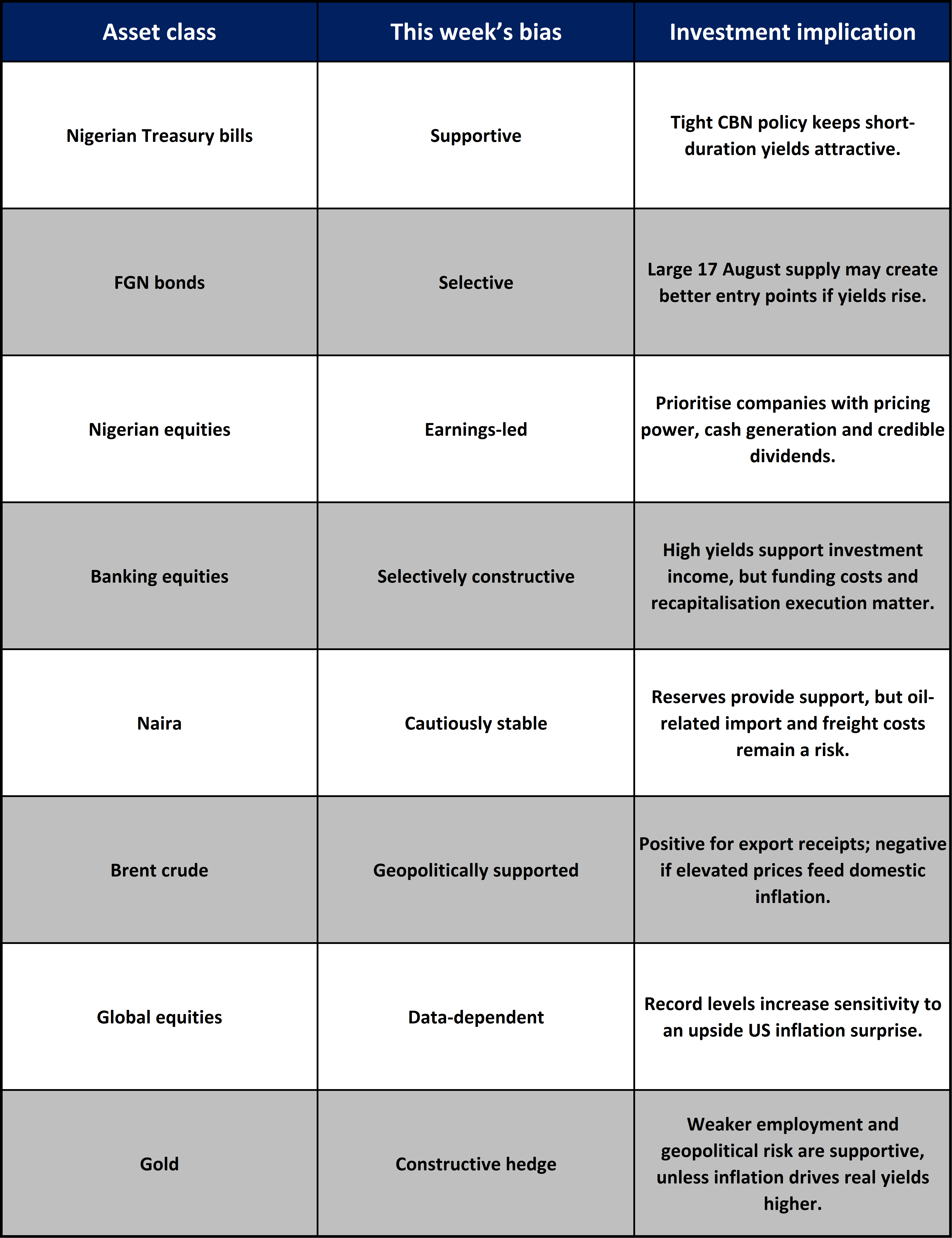
Asset Class Implications:
Ranora View:
The strongest positioning this week is not a broad risk-on trade. It is a barbell between short-duration Nigerian fixed income and carefully selected equities with visible earnings and pricing power.
Investors should avoid adding long bond duration solely because US payrolls weakened. Nigeria’s upcoming sovereign supply and the risk of oil-driven inflation could still push yields higher. Duration becomes more attractive if US CPI is benign, Brent stabilises and the 17 August bond offer is absorbed without a large concession.
Within equities, the burden of proof has shifted from momentum to fundamentals. Banks with credible recapitalization plans, energy companies with export-linked revenues and consumer businesses able to defend margins should command more attention than high-beta names whose valuations depend on continuing liquidity.
What to Watch Next:
US July CPI on Wednesday, 12 August.
US PPI on Thursday and retail sales on Friday.
Brent crude and access to the Strait of Hormuz.
The DMO’s final offer circular ahead of the 17 August bond auction.
NGX half-year earnings, market breadth and positioning ahead of FTSE Russell’s end-August review.
Question of the day:
Would a softer US inflation print make you extend duration in Nigerian bonds, or do domestic supply and oil-related inflation risks still favour Treasury bills?
Stay smart. Stay informed. Subscribe to Ranora Market Outlook for free and support independent market analysis.