


Opening View
Opening View:
The main question for Nigerian markets this week is not whether policy is tight. It is whether tight policy is now tight enough to keep inflation expectations, naira liquidity, and portfolio flows stable at the same time.
The CBN held the Monetary Policy Rate at 26.5% at its July 20-21 meeting, while keeping the CRR for deposit money banks at 45% and maintaining the standing facilities corridor at +50/-450 basis points. That confirms the direction of policy: the central bank is not ready to ease just because headline inflation has edged lower. Nigeria’s latest NBS data shows headline inflation at 15.91% in June, only slightly below May’s 15.93%, while food inflation remains higher at 17.52%.
For investors, this keeps the front end of the fixed income curve important. Treasury bills and short-duration instruments should remain attractive as long as real policy credibility matters more than early easing hopes. Equities can still benefit from domestic liquidity and earnings expectations, but valuations will face a higher hurdle where yields remain compelling. Globally, the Fed’s July 28-29 meeting, US GDP, June PCE inflation, oil prices, and major technology earnings will shape risk appetite for emerging and frontier markets.
The Big Picture:
Nigeria enters the week with a familiar but important tension: disinflation is visible, but not yet decisive. The CBN’s hold suggests policymakers want more evidence before shifting from inflation control to growth support. That matters for asset allocation because it keeps liquidity pricing firm and reduces the odds of an immediate broad-based rally in long-duration bonds.
The naira also remains central. CBN data showed the official USD/NGN rate around ₦1,362.09 on July 24, while reported external reserves have strengthened to 52 billion dollars compared with earlier in the year. This gives the FX market more support than it had during periods of weak dollar liquidity, but the position is still exposed to oil prices, portfolio flows, and import demand.
Globally, the week is heavy. The Federal Reserve meeting ends Wednesday, July 29, and the BEA is scheduled to release US Q2 GDP and June personal income and outlays data on July 30. US PCE inflation was 4.1% year-on-year in May, so the next print will matter for Treasury yields, the dollar, and frontier-market risk appetite.
Nigeria Market Intelligence
CBN policy is still doing the heavy lifting
What happened: The CBN retained the MPR at 26.5% at the 306th MPC meeting held July 20-21, 2026. It also retained the standing facilities corridor at +50/-450 basis points and kept CRR at 45% for deposit money banks, 16% for merchant banks, and 75% for non-TSA public sector deposits.
Why it matters: The hold tells the market that the CBN is not treating one soft inflation reading as enough evidence to begin easing. This supports elevated money-market rates and reinforces the appeal of short-duration fixed income.
What to watch: Watch whether upcoming liquidity conditions force more aggressive OMO or T-bill activity. If liquidity stays abundant, the CBN may keep using securities operations to preserve policy transmission.
Inflation is easing, but the food component still limits policy comfort
What happened: NBS data shows headline inflation at 15.91% in June 2026, down marginally from 15.93% in May. Food inflation was 17.52%.
Why it matters: The headline number helps sentiment, but the food print matters more for household purchasing power, wage pressure, and political sensitivity. A shallow decline in headline inflation is unlikely to trigger a policy pivot if food prices remain sticky.
What to watch: The next inflation print should be read less as a single headline number and more as a test of breadth: food, core inflation, and month-on-month pressure will matter for fixed income pricing.
Fixed income supply remains a market anchor
What happened: The DMO revised its Q3 2026 FGN bond issuance calendar, with reported planned issuance reduced to a range of ₦3.4 trillion to ₦4.6 trillion from ₦4.2 trillion to ₦5.1 trillion. The revised calendar still points to sizable August and September bond supply, including longer-dated paper..
Why it matters: Even with a lower issuance range, supply remains large enough to keep investors selective. Pension funds, banks, and asset managers will need yield compensation to absorb duration, especially while the CBN keeps policy restrictive.
What to watch next: Demand at the August bond auction will be important. Strong demand at stable yields would suggest liquidity is still supportive; weak demand or higher stop rates would signal investors are demanding more compensation for duration.
The naira has support, but the test is durability
What happened: CBN exchange-rate data showed the official USD/NGN rate at about ₦1,362.09 on July 24. CBN-linked reserve data and market reports also point to stronger external reserves at 52 billion dollars compared with earlier in the year.
Why it matters: A firmer reserve position helps confidence, but FX stability still depends on dollar supply, oil receipts, portfolio inflows, and import demand. If global risk appetite weakens after the Fed meeting, the naira could face renewed pressure even with better reserves.
What to watch: Watch official-market turnover, the gap between official and parallel-market pricing, and whether foreign portfolio investors continue to find naira yields attractive after adjusting for currency risk.
Nigerian equities are still strong, but selectivity matters more
What happened: The NGX All-Share Index closed at about 247,357.41 on July 24, down 0.19% on the session, after a strong prior run to close the week up by 1.60% .
Why it matters: The equity market can still benefit from domestic liquidity, bank earnings expectations, and inflation-linked revenue growth in selected sectors. But high fixed-income yields mean equities need credible earnings delivery to keep attracting incremental capital.
What to watch: Banks, consumer names, industrials, and telecoms should be watched for margin resilience, funding-cost pressure, and pricing power. Where earnings cannot justify valuation expansion, investors may prefer yield assets.
Global Market Intelligence:
The Fed is the week’s global risk anchor
The FOMC meets July 28-29, with the policy statement due Wednesday. The key issue is not just the rate decision; it is how the Fed frames inflation risk after higher energy-price volatility and persistent PCE inflation. If US yields rise after the meeting, frontier-market assets may face pressure as dollar returns become more competitive.
US inflation and GDP data arrive immediately after the Fed
The BEA is scheduled to release US Q2 GDP and June personal income and outlays on July 30. May PCE inflation was 4.1% year-on-year. A hotter June print would support higher-for-longer US yields, which could reduce appetite for emerging and frontier-market duration.
Oil remains a two-sided Nigerian story
Brent crude fell to about $96.78 on July 24 after briefly moving above $100, according to AP. For Nigeria, higher oil prices can improve revenue expectations and FX supply potential, but sustained geopolitical risk can also lift imported inflation and complicate global rate expectations.
US equities are watching earnings quality, not just earnings beats
What happened: Major US technology companies, including Meta, Microsoft, Amazon, and Apple, are reporting this week. The market focus is shifting toward AI capital expenditure, margins, and whether investment spending can convert into durable cash flow.
Why it matters: If US tech earnings disappoint and global risk appetite weakens, frontier-market flows may become more selective. Nigeria’s high yields may still attract capital, but equity risk appetite could become more cautious.
Asset Class Implications:
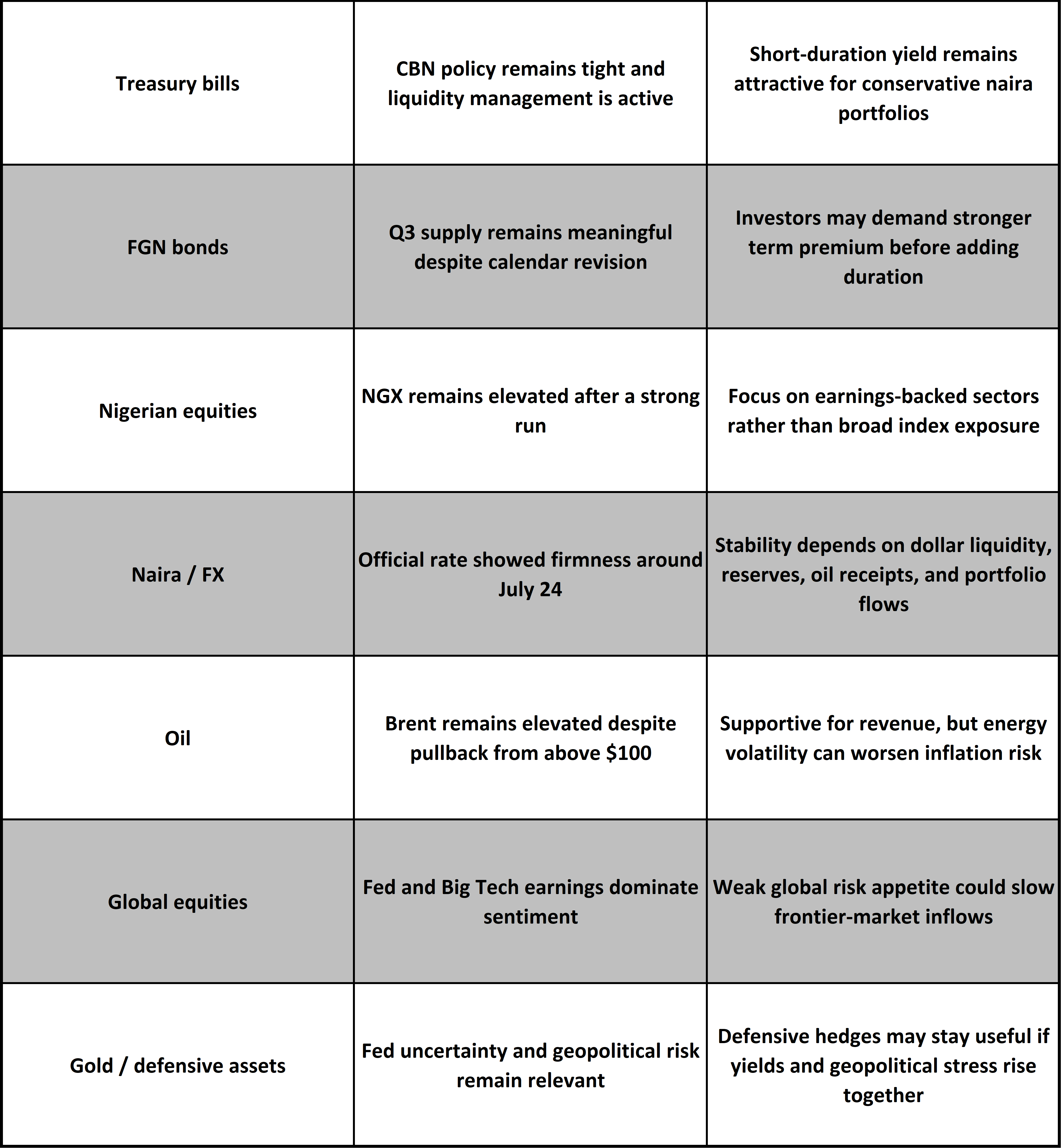
Ranora View:
The week ahead favours disciplined income positioning over aggressive duration or broad equity risk. Nigeria’s macro setup is improving at the margin, but not enough to justify assuming that policy easing is close. The CBN hold, sticky food inflation, and continued government borrowing needs all point to a market where yield remains the first filter for capital allocation.
For naira investors, short-duration fixed income remains compelling while policy rates stay high and inflation is only gradually moderating. For equity investors, the better opportunity is likely in companies with pricing power, strong cash generation, and earnings visibility rather than in chasing the index after a strong move. For businesses, the signal is clear: financing costs are unlikely to ease quickly, so balance-sheet management and working-capital discipline still matter.
The main risk to this view is external. A hawkish Fed, stronger dollar, or renewed oil shock could tighten financial conditions for frontier markets. The main upside risk is stronger FX liquidity combined with sustained disinflation, which could eventually support a cleaner re-rating of Nigerian assets.
What to Watch Next:
Fed decision on July 29 and the tone of the press conference.
US Q2 GDP and June PCE inflation on July 30.
Naira official-market turnover and the official-parallel spread.
Demand and pricing expectations ahead of the next FGN bond auction.
Whether Nigeria’s next inflation data confirms a broader disinflation trend beyond the headline rate.
Question of the day:
If Nigerian yields remain elevated while inflation eases only slowly, should investors prioritise short-term income or begin positioning early for a future bond-market rally?
Stay smart. Stay informed. Subscribe to Ranora Market Outlook for free and support independent market analysis.