


Opening View
Opening View:
Nigeria’s market week starts with one question: how much room does the Central Bank of Nigeria have to sound easier when inflation is no longer falling quickly and global oil risk is back on the screen?
The CBN’s Monetary Policy Committee meets on 20-21 July 2026. At its last meeting in May, the committee retained the MPR at 26.5%, kept banks’ CRR at 45%, merchant banks’ CRR at 16%, and held the 75% CRR on non-TSA public-sector deposits. That means investors will be watching less for a dramatic rate move and more for the tone: whether the CBN prioritizes disinflation, naira stability, liquidity control, or growth support.
The inflation backdrop is not weak enough to make policy easy. NBS data shows headline inflation at 15.91% in June, barely below May’s 15.93%, while food inflation rose to 17.52%.
The global overlay is oil. Brent crude moved above $90 as US-Iran tensions intensified, which helps Nigeria’s oil revenue narrative but can also feed imported inflation and fuel-cost expectations if sustained.
The Big Picture:
This week is about the balance between yield, inflation, and FX credibility.
Nigeria’s disinflation story is still intact on the surface, but it is no longer one-way. A 15.91% headline print gives the CBN some evidence that prior tightening is working, yet rising food inflation limits the case for aggressive easing. For investors, that keeps short-duration fixed income relevant, especially if the CBN signals that liquidity control will remain tight.
Equities enter the week after heavy activity but with a more demanding valuation backdrop. NGX weekly turnover for the week ended 17 July fell to 2.819 billion shares worth ₦182.499 billion, from 3.648 billion shares worth ₦220.568 billion the prior week. That does not automatically imply weak sentiment, but it does suggest that investors may be more selective after a strong run.
Globally, US inflation cooled in June, with CPI at 3.5% year-on-year and core CPI at 2.6%, but oil above $90 can complicate the Fed’s next meeting on 28-29 July.
Nigeria Market Intelligence
CBN MPC is the week’s main domestic event
What happened: The MPC begins its 306th meeting today, 20 July, and concludes on 21 July.
Why it matters: The market is not just pricing the level of the MPR. It is pricing the CBN’s reaction function. If the committee keeps policy tight, treasury bills and short-duration money-market instruments may remain attractive. If the tone turns dovish, the first reaction could be positive for equities but less supportive for the naira unless dollar supply remains firm.
What to watch: The decision, the vote split if disclosed, and language around food inflation, FX liquidity, and banking-system liquidity.
Inflation is lower, but food prices are the constraint
What happened: Headline inflation eased slightly to 15.91% in June from 15.93% in May. Food inflation rose to 17.52%.
Why it matters: The headline number supports the argument that inflation is stabilising, but the food component weakens the case for a fast easing cycle. For households and consumer-facing companies, food inflation still affects disposable income, pricing power, and volume growth.
What to watch: Whether July food inflation cools after the MPC meeting, and whether the CBN treats June as progress or as a warning that disinflation is losing speed.
Naira stability remains a portfolio driver
What happened: CBN data lists the NFEM rate at about ₦1,380.18/$ on 17 July 2026, with the NFEM rate defined as the official volume-weighted average rate.
Why it matters: A more stable naira helps foreign-currency planning, imported-input costs, and investor confidence. But stability has to be backed by turnover and supply, not just headline rates. If oil revenue expectations improve while reserves remain firm, naira risk may become more manageable. If dollar demand rises after the MPC, pressure can return quickly.
What to watch next: NFEM turnover, reserve movement, and the spread between official and parallel-market pricing.
Nigerian equities may become more selective
What happened: Weekly NGX turnover declined in volume and value during the week ended 17 July, though activity stayed sizeable.
Why it matters: After a strong equity market run, the next leg will likely depend more on earnings quality, dividend expectations, banks’ recapitalisation positioning, and sector rotation than on broad market momentum alone. Banks can still attract interest if high rates support earnings, but profit-taking risk rises where price gains have moved ahead of fundamentals.
What to watch: Banking sector flows, consumer goods margin updates, industrial names with FX exposure, and corporate earnings guidance.
Global Market Intelligence:
Oil is the global macro risk Nigeria cannot ignore
What happened: Brent crude moved above $90 as US-Iran tensions escalated.
What it means for Nigerian investors: For Nigeria, higher Brent can support fiscal and external-account expectations if production and export receipts hold up. The risk is that higher oil also feeds global inflation, transport costs, and imported price pressures. That is not a simple positive for Nigerian assets.
What to watch next: Brent above $90, Strait of Hormuz headlines, and whether oil strength improves Nigeria’s dollar inflows.
Nigeria’s oil-output story has improved
What happened: IEA data shows Nigeria’s OPEC+ crude supply at 1.51mb/d in June, up from 1.47mb/d in May and slightly above its implied target of 1.50mb/d.
Why it matters: Higher output strengthens the case for improved fiscal receipts and FX supply. It also gives the market a reason to treat higher Brent as more meaningful for Nigeria, provided production reliability is sustained.
What to watch next: NNPCL/export data, pipeline security, and whether June’s production level is repeated.
US inflation cooled, but the Fed is not finished
What happened: US CPI rose 3.5% year-on-year in June, down from 4.2% in May. Core CPI eased to 2.6% from 2.9%.
Why it matters: Lower US inflation can support risk assets and emerging-market flows, but oil above $90 may slow the decline in inflation expectations. For Nigeria, the Fed path matters because US yields influence frontier-market risk appetite and dollar strength.
What to watch next: US jobless claims, PMIs, and the 28-29 July FOMC meeting.
Global equities face an earnings test
What happened: US equities fell on Friday, 17 July, with the S&P 500 down 1.0%, the Nasdaq down 1.4%, and the Nasdaq down 2.9% for the week.
Why it matters: If US tech weakness deepens, global risk appetite may soften. That can reduce foreign appetite for frontier-market risk even when Nigeria’s local story looks better. If earnings stabilize sentiment, Nigerian equities may benefit from broader risk-on positioning.
What to watch next: US mega-cap earnings, semiconductor sentiment, and whether investors rotate into defensive sectors.
Asset Class Implications:
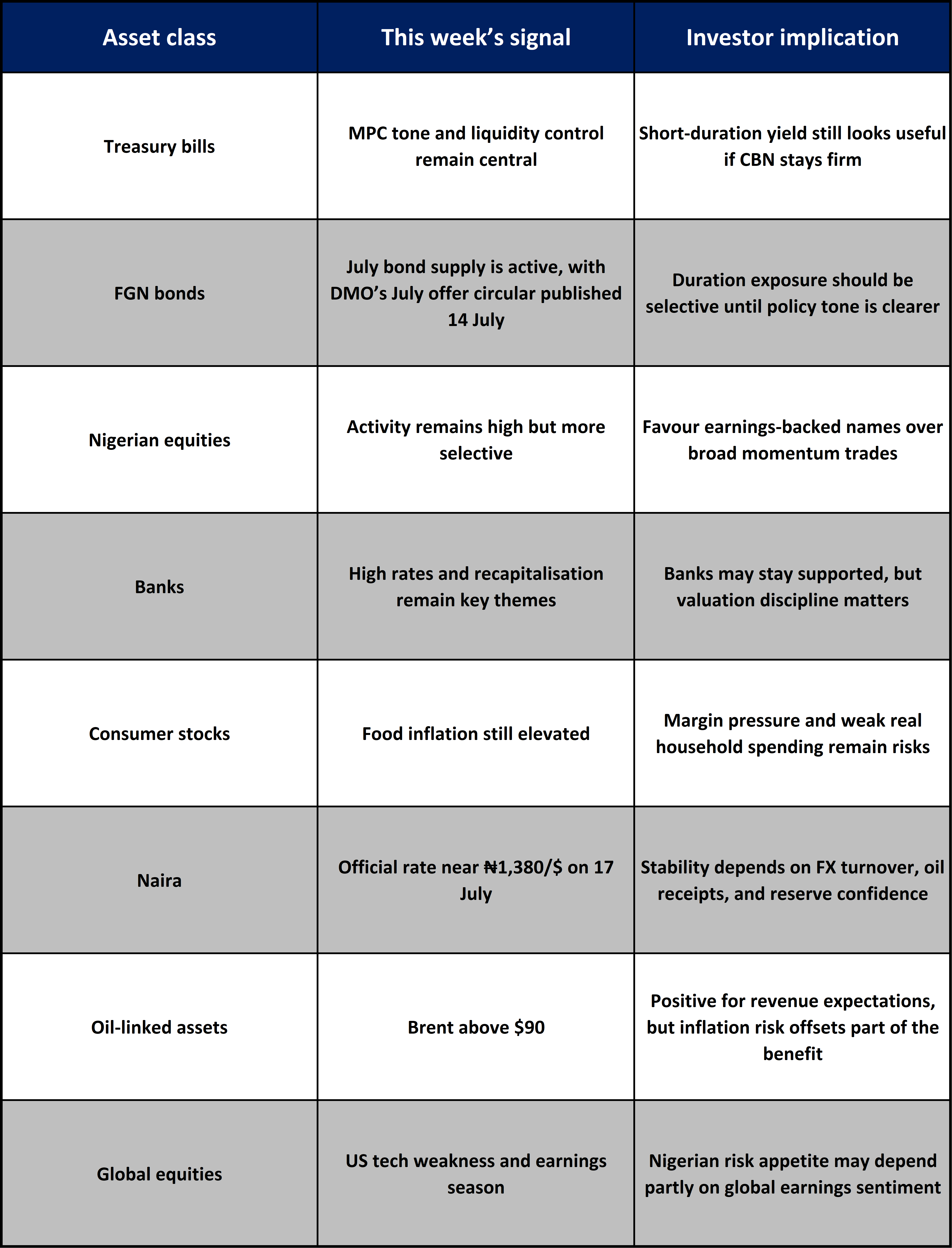
Ranora View:
The strongest investment message this week is that Nigeria’s macro story is improving, but not enough to justify ignoring yield and FX discipline.
A slightly lower headline inflation rate, firmer reserves narrative, better oil-production data, and higher Brent prices all support confidence in Nigerian assets. But food inflation, policy uncertainty, and global oil-driven inflation risk mean the market still needs a risk premium. In practical terms, this supports a barbell approach: keep exposure to short-duration fixed income for income and liquidity, while using equities selectively in sectors with visible earnings, pricing power, and balance-sheet strength.
The MPC decision matters because it will tell investors whether the CBN is prepared to protect disinflation before chasing growth. A patient CBN would support naira credibility and fixed-income demand. A softer tone may help equities in the short term, but only if FX supply remains convincing.
What to Watch Next:
CBN MPC decision on 21 July, especially language on inflation, FX, and liquidity.
NFEM turnover and whether the naira holds near recent official-market levels.
Brent crude direction after the move above $90.
NGX sector rotation, especially banks, consumer goods, oil and gas, and industrials.
US data and earnings ahead of the 28-29 July FOMC meeting.
Question of the day:
If the CBN holds rates steady this week, would you rather increase exposure to treasury bills, Nigerian equities, or stay liquid until the naira signal becomes clearer?
Stay smart. Stay informed. Subscribe to Ranora Market Outlook for free and support independent market analysis.