


Opening View
The most useful question for Nigerian equity investors this week is not whether earnings are growing. It is where that growth is coming from, and how much of it a share price already assumes.
Unilever Nigeria’s new nine-month results provide a clear example. Revenue rose 18% and net profit increased 20%. Those headlines support a recovery narrative. The product breakdown makes the investment conclusion more selective: food sales expanded strongly, while personal-care revenue declined. A company can deliver a good result without every part of its portfolio participating.
Our interpretation is that investors should underwrite consumer businesses by category, rather than attach the same recovery premium to the whole sector. These are nominal sales figures, not proof of stronger sales volumes or a nationwide improvement in household purchasing power.
That distinction matters ahead of another earnings-heavy week. Nigeria’s scheduled Treasury-bill auction will provide a fresh income benchmark, while the Federal Reserve meeting and major US technology results could alter the appetite for risk. The opportunity is to identify businesses whose operating progress survives those competing demands on capital. A stronger reported profit, or an approaching dividend date, does not establish an attractive entry price.
The Big Picture:
Calculations from Unilever’s filing show Foods revenue grew 29.8% in the nine months to September, compared with a 3.5% decline in Personal Care and 11.5% growth in Beauty and Wellbeing, against the same period of 2025.
The implication is not simply that food is defensive. It is that company-wide growth can conceal very different category trajectories. Before extending a valuation premium, investors need to know whether sales reflect higher prices, stronger volumes, a changing product mix or a durable competitive advantage. The reported category totals alone do not answer those questions.
For businesses, the practical lesson is equally specific: distribution spending and inventory commitments should follow evidence at product level. Expanding every category on the strength of an aggregate sales target risks tying up cash where demand is less convincing.
The next test is whether growth broadens while margins hold. If it does, the case for a more diversified earnings base improves. If it does not, the valuation should remain dependent on the categories actually delivering.
Nigeria Market Intelligence
Equities: the index understates the dispersion
The NGX All-Share Index ended the week to 23 October at 247,222.27, down 0.13%. Beneath that small decline, 55 shares fell and only 20 advanced. Industrial goods gained 1.95%, while banking and consumer goods lost 0.67% and 0.55%, respectively. This is a stock-selection market, not evidence of uniform buying. Watch whether earnings-driven gains spread beyond a handful of heavyweights.
Banks: separate profit growth from the interest franchise
First HoldCo's nine-month group profit rose 65.1% to NGN744.45 billion, but net interest income fell 16.0%, calculated from its filing. Stronger fees, trading gains and lower impairment charges supported the result. The valuation question is how much of that improvement can recur. Watch deposit costs, interest margins and credit performance before extrapolating the headline profit growth.
Fixed income: a new bidding test, not a promised yield.
The Treasury-bill auction scheduled for Wednesday, 28 October, carries a reported NGN800 billion offer. Compare the actual clearing rates and allocations across tenors when results arrive. A large bid book would not, by itself, justify buying longer maturities: the relevant comparison is the net annualised return available for the investor's required holding period. Auction discount rates and secondary-market yields are different measures
Global Market Intelligence:
The Fed decision comes before another inflation test
The Fed meets on 27-28 October. A pause is widely expected in market reporting, but it would not establish that further tightening is off the table. US third-quarter advance GDP and September personal income and outlays, including PCE inflation, are scheduled for 29 October. Last Thursday's Treasury rally alongside weaker equities was not proof of an easing cycle. For Nigerian dollar borrowers, the test is the actual refinancing cost after the decision and data.
Technology earnings must justify the spending
Alphabet and Microsoft are scheduled to report on Wednesday, followed by Amazon on Thursday, after last week’s technology weakness. Focus on the revenue and cash returns associated with AI investment, not capital spending alone. A further reassessment could reduce global investors’ willingness to take less-liquid market exposure. That is a risk channel for Nigeria, not evidence that foreign money has already left the NGX.
Higher oil can help receipts and hurt margins
Brent crude strengthened late last week amid Middle East supply concerns. For Nigeria, higher realised export prices could support receipts if production and collections hold up. The same environment can raise fuel, freight and replacement costs for businesses. Do not treat an oil-price rise as an automatic improvement in consumer-company earnings or the naira; watch delivered costs and actual dollar supply
Asset Class Implications:
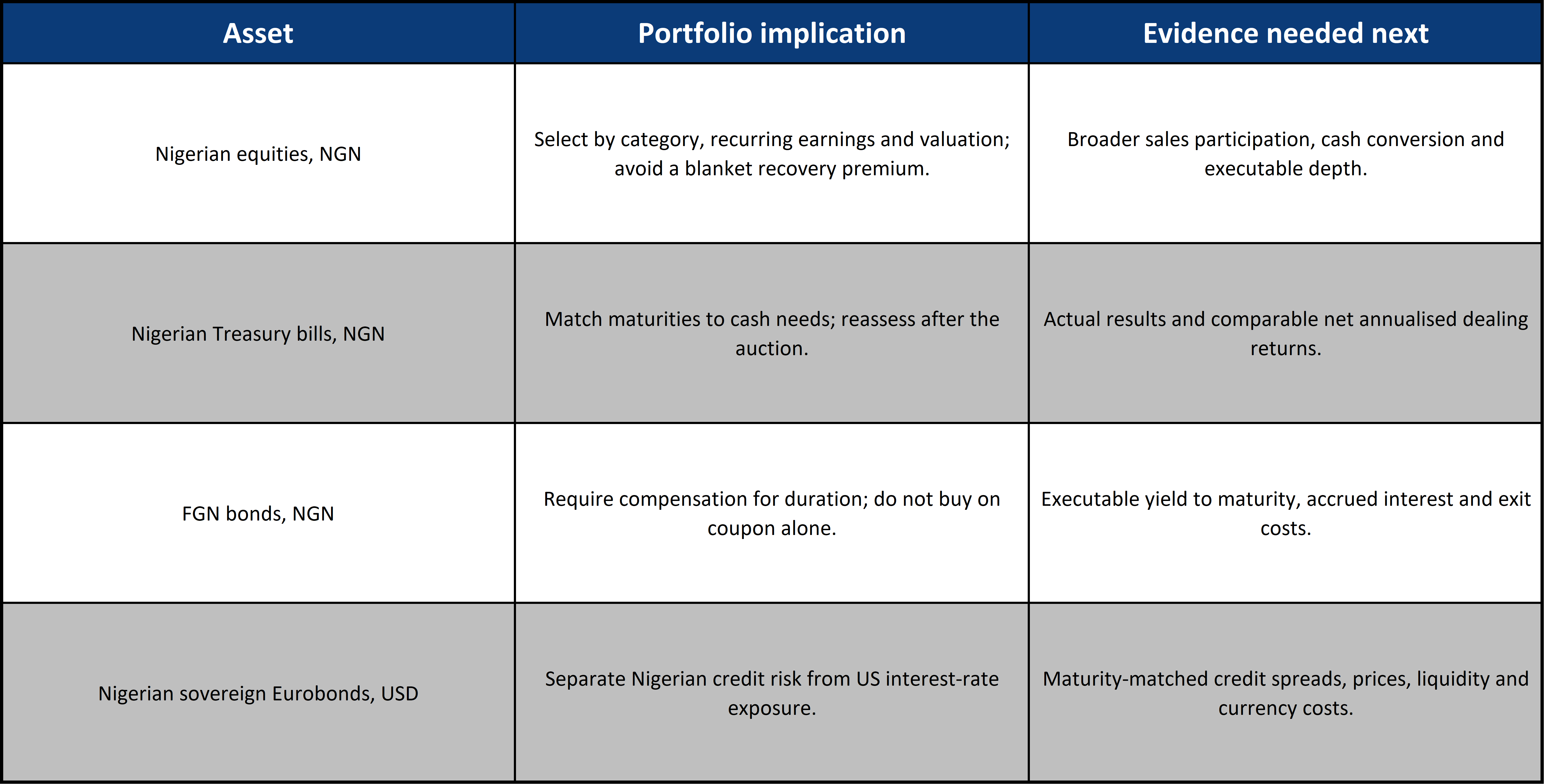
Investment Ideas for the Week:
Unilever Nigeria ordinary shares: defer entry
Instrument: Unilever Nigeria Plc ordinary shares, NGX: UNILEVER. Currency: NGN. Thesis ID: NG-EQ-UNILEVER-MIX-20261026. Prospective holding horizon: 12-24 months, if the entry tests are met. Status: pending; no purchase recommendation this week.
The new nine-month filing earns Unilever a place on the research list because its category mix provides a specific thesis to test. The potential catalyst is sustained food growth with improved participation elsewhere, rather than an assumed recovery across every consumer business. Subsequent results should show whether that combination can support repeatable earnings without requiring disproportionate investment in working capital.
The price reference is NGN109 at the 23 October close, a delayed end-of-day observation, not an executable offer. Against it, the declared NGN2 interim dividend represents a calculated 1.83% gross single distribution. That is neither an annualised yield nor a promised total return. It cannot be compared directly with an annual Treasury-bill yield, and it does not establish that the shares are cheap.
The qualification date is 30 October and payment is scheduled for 18 November, subject to withholding tax. Investors must confirm settlement and register eligibility; buying on the qualification date should not be assumed to secure the dividend. A distribution also does not remove the possibility of an ex-dividend price adjustment or subsequent capital loss.
Cash generation sets an additional hurdle. Nine-month net operating cash was NGN10.26 billion, against NGN32.83 billion a year earlier, with higher tax payments and working-capital absorption. Separately, purchases of property, plant and equipment rose to NGN8.95 billion from NGN1.09 billion. That investment outlay is separate from operating cash flow. With NGN91.34 billion in cash and cash equivalents at September-end, this is a conversion and valuation question, not a claim of immediate funding distress.
Entry remains deferred because no verified live spread, executable depth or complete broker and statutory charge schedule is available here. Investor-specific tax and, where relevant, FX conversion costs also remain unresolved. Before a positive recommendation, compare a defensible earnings valuation and expected net return with alternatives over the same horizon, allowing for equity losses and sale liquidity.
The view would strengthen with broader category progress, better cash conversion and an entry valuation that compensates for the remaining risks. It would weaken if food growth slows, personal-care weakness persists or margins reverse. No target, stop, allocation or hypothetical execution is implied. Last week’s candidates are not automatically renewed; this is the sole new thesis for this Monday.
Ranora View:
Do not pay a sector-wide recovery multiple for company-specific progress. Unilever’s result makes the case for examining where sales growth originates, while its cash-flow statement makes the purchase decision more demanding than the dividend headline suggests.
Our stance is selective equity research with entry deferred on the new candidate, alongside liability-matched income exposure assessed at actual dealing terms. This week’s bill auction and global policy events should update those comparisons, not substitute for them. Broader category growth, improving cash conversion and a defensible valuation would justify a more constructive conclusion. Until then, a successful company result and an attractive investment remain separate judgements.
What to Watch Next:
1. Wednesday, 28 October: Nigeria’s scheduled Treasury-bill auction. Compare tenor-level clearing rates and allocations, then secondary-market pricing.
2. Wednesday, 28 October: the Fed decision and scheduled Alphabet and Microsoft results. Watch the implications for dollar funding and required equity returns.
3. Thursday, 29 October: US GDP and PCE-related data, plus scheduled Amazon results. Test whether growth and spending are supported by earnings and contained inflation.
4. Friday, 30 October: Airtel Africa’s scheduled half-year results and Unilever’s dividend qualification date. Keep the earnings assessment separate from settlement eligibility.
5. Throughout the week: breadth of Nigerian earnings-driven gains, bank FX dealing terms and delivered fuel costs. These will help test whether operating improvements can survive current funding and input costs.
Question of the day:
What would make you pay more for a Nigerian consumer stock today: broader sales growth, stronger margins or better cash conversion, and what evidence would change your answer?
Stay smart. Stay informed. Subscribe to Ranora Market Outlook for free and support independent market analysis.