


Market Overview
Nigeria’s financial landscape is strengthening as banks surpass recapitalisation targets, signalling stronger investor confidence and improved system resilience. At the same time, developments in broadband expansion, trade digitisation, and energy supply constraints highlight an economy balancing reform with structural challenges. Globally, geopolitical tensions particularly around energy markets alongside shifting inflation expectations continue to influence market sentiment and capital flows.
Nigerian News & Market Update
Nigerian banks raise N4.6 Trillion to meet CBN’s capital rules:
Nigerian banks have raised ₦4.61 trillion ahead of the March 31, 2026 recapitalisation deadline, with 27% from foreign investors signalling improved market confidence. Most lenders (34 banks) have met the CBN’s higher capital thresholds, aimed at strengthening resilience, supporting growth, and enhancing financial stability. The CBN also reinforced stricter governance, credit discipline, and regulatory oversight, while maintaining orthodox monetary policy to stabilise prices and the financial system. - Businessday
Legend, Spectranet Merge to Transform Nigeria’s Broadband Market:
Legend Internet Plc and Spectranet are in advanced merger talks, targeting completion in Q2 2026, subject to regulatory approvals. The combined entity is expected to reach ₦80 Billion market cap, creating Nigeria’s largest ISP with enhanced scale, infrastructure, and broadband capacity. The deal aims to unlock synergies, improve profitability, and position the company for growth. - Thisday
Dangote-NNPC deal hits turbulence over crude shortfall:
Dangote Refinery’s supply deal with NNPC is under strain after receiving only 27% of required crude, creating a 79.5m barrel shortfall valued at $5.4 Billion. The shortage amid continued crude exports and global price pressures has forced reliance on costlier imports, contributing to rising domestic fuel prices. NNPC, is sourcing third-party crude, underscoring structural challenges in Nigeria’s push for energy self-sufficiency. - Punch
FG unveils National Single Window to boost trade:
Nigeria launched a National Single Window to digitise trade, streamline documentation, and cut import/export costs and delays. The platform, going live March 27 in phases, aims to reduce cargo clearance time by up to 50% and improve transparency and revenue collection. Success will depend on port infrastructure upgrades and effective coordination across agencies and stakeholders. - Punch
Nigeria Sectoral Indices Performance
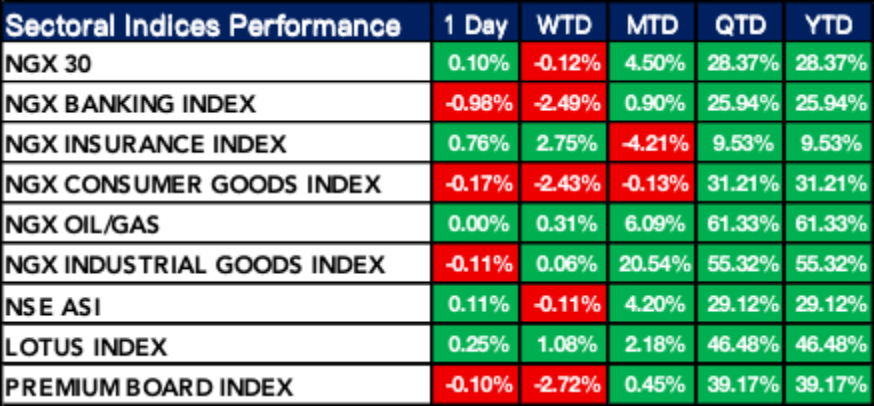
The latest sectoral indices show a mixed but mostly positive market outlook. The NGX Oil/Gas and Industrial Goods indices lead with strong year-to-date gains above 55%, supported by solid monthly and quarterly growth. Meanwhile, the Banking and Consumer Goods sectors face short-term declines despite healthy longer-term performance. The Insurance index shows gains in the short term but a recent dip month-to-date, highlighting ongoing market volatility. Overall, some sectors are thriving while others navigate challenges in today’s dynamic market.
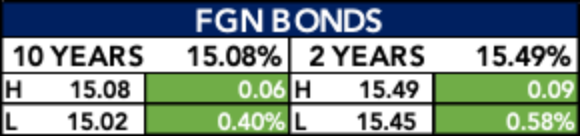
Fixed Income (FGN Bonds)
Global News & Market Update
Iran rejects U.S. ceasefire offer, demands sovereignty over Strait of Hormuz:
Iran rejected a U.S. ceasefire proposal, demanding sovereignty over the Strait of Hormuz and war reparations as conditions for ending the conflict. Tehran insists it will only consider ending hostilities after achieving strategic objectives, signalling prolonged geopolitical risk. Control of the key oil shipping route remains a major sticking point, with significant implications for global energy markets. - Cnbc
India retains headline inflation target at 4% following review:
India has retained its 4% inflation target for another five years, reaffirming the existing monetary policy framework. While current inflation remains subdued at 2.75%, rising global oil prices and geopolitical disruptions are expected to push it above target in the coming fiscal year. The framework continues to provide the Reserve Bank of India flexibility to manage supply-side shocks while anchoring inflation expectations. - Reuters
Asia looks to COVID-era playbook to tackle fuel crisis:
Asian countries are revisiting COVID-era measures like work from home policies and reduced workweeks to manage fuel shortages caused by the Iran war. Nations including South Korea, the Philippines, Japan, Australia, and New Zealand are combining energy conservation campaigns with targeted financial relief to ease household burdens. - Reuters
India buys first Iran LPG cargo in years after US eases sanctions:
India has purchased its first Iranian LPG cargo in years after the U.S. temporarily eased sanctions, diverting a shipment originally bound for China. The tanker will supply Indian Oil, Bharat Petroleum, and Hindustan Petroleum to help mitigate the country’s worst gas shortage in decades. Imports from the Middle East still account for about 60% of India’s LPG demand, highlighting the nation’s reliance on regional energy flows amid geopolitical tensions. - Reuters
Indices, Commodities & Currencies
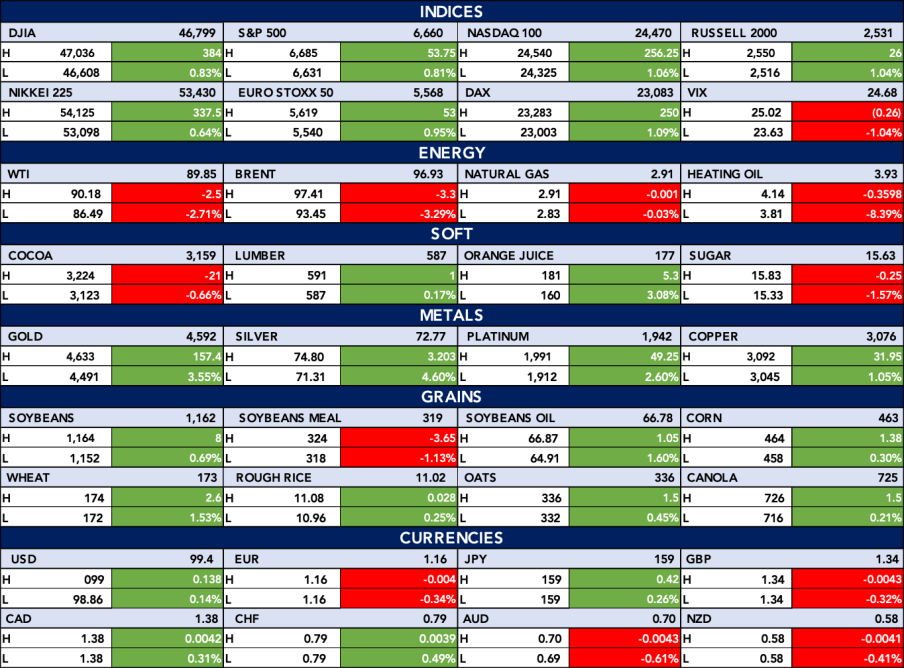
Global markets showed strength, with major indices like the S&P 500 and Nasdaq posting solid gains, while volatility eased as the VIX declined. Energy commodities weakened broadly, led by drops in crude oil and heating oil, while metals surged, with gold and silver recording notable gains. Agricultural commodities were mixed, as gains in grains like wheat and corn contrasted with declines in cocoa and sugar, while currency markets remained relatively stable with slight strength in the US dollar and mixed movements across major pairs.
Fixed Income (USA Bonds)
Events
Conclusion
Nigeria’s outlook remains cautiously positive, supported by a stronger banking sector and ongoing economic reforms, though energy supply issues may sustain near-term inflationary pressure. On the global stage, persistent geopolitical risks and evolving energy dynamics are likely to drive continued volatility. Investors should remain strategic focusing on fundamentally strong sectors while monitoring policy direction, energy markets, and cross-border capital movements for emerging opportunities.
Thanks for reading Ranora Consulting! Subscribe for free to receive new posts and support my work.