


The Week in One Paragraph
Nigeria’s 350-basis-point policy-rate reset produced an immediate market reaction, but not the broad easing implied by the headline. Investors submitted ₦4.09 trillion for the 364-day Treasury bill, while the 91-day and 182-day tenors were undersubscribed. That concentration matters: investors were rushing to secure one-year sovereign returns before further yield compression, rather than expressing confidence that liquidity, credit growth and business borrowing costs will improve immediately. Equities also advanced to new highs following Nigeria’s return to the FTSE Frontier universe, while the naira remained broadly stable. Globally, however, the direction was almost the reverse. The U.S. 10-year Treasury yield moved above 5.19%, Brent remained above US$100 and the dollar strengthened as markets priced another possible Federal Reserve hike. The week therefore produced a clear divergence: Nigeria is lowering its domestic rate structure just as the global discount rate is moving higher.
Top 5 Market Stories of the Week
1. The CBN reset the policy rate, but retained a tight liquidity framework
What happened: The Monetary Policy Committee reset the MPR from 26.5% to 23%, adjusted the standing-facilities corridor to +50/-300 basis points and retained the 45% cash reserve requirement for deposit money banks.
Why it mattered: The rate change lowers the formal policy anchor, but the unchanged CRR means banks still face a significant liquidity constraint. Government-security yields can adjust faster than commercial lending rates because the latter also reflect reserve requirements, funding costs, credit risk and bank capital allocation.
What comes next: Investors should watch overnight rates, OMO pricing and actual bank lending rates. These will reveal whether the decision becomes genuine credit easing or remains primarily a technical repricing of money markets.
2. The Treasury-bill auction revealed a concentrated easing trade
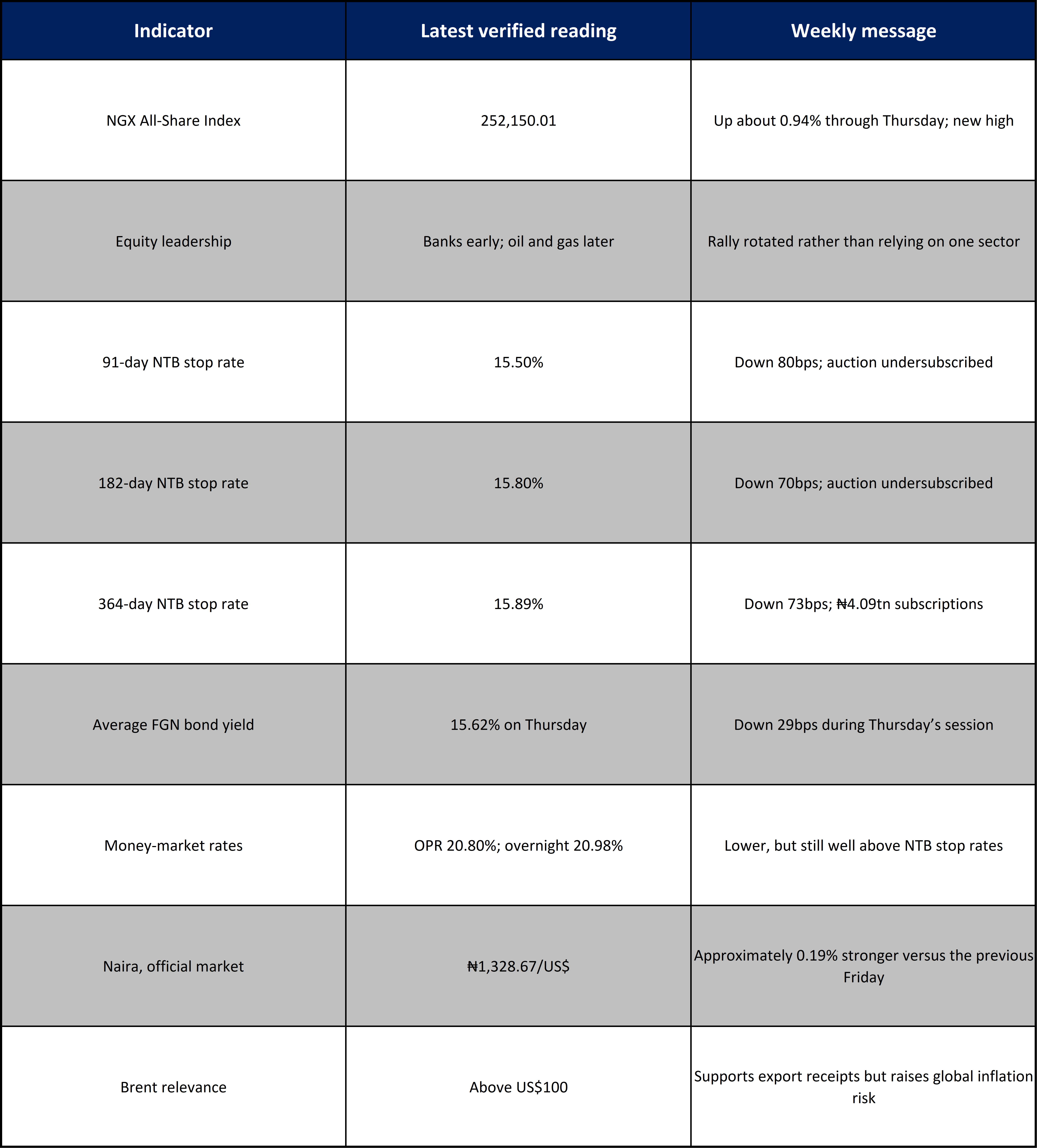
What happened: The ₦500 billion auction attracted ₦4.23 trillion in subscriptions. Of that amount, ₦4.09 trillion went to the 364-day bill, against only ₦300 billion offered. The tenor cleared at a 15.89% stop rate, 73 basis points below the previous auction. The 91-day and 182-day bills cleared at 15.50% and 15.80%, but both were undersubscribed.
Why it mattered: The overall 8.46-times bid-to-cover ratio overstates the breadth of demand. Roughly 97% of subscriptions targeted one tenor. Investors appear to expect further yield compression and want to lock in one-year carry while it remains available.
What comes next: The next test is whether demand spreads into longer FGN bonds and private credit. If it remains concentrated in sovereign paper, the government’s funding cost may fall without producing an equivalent improvement in financing conditions for businesses.
3. Nigerian equities reached new highs, but price leadership remains important
What happened: The NGX All-Share Index closed Thursday at 252,150.01 points, up approximately 0.94% from the previous Friday. The advance extended the market’s winning run and lifted the year-to-date gain to about 62%. Banking stocks led earlier in the week, while oil and gas gained 3.95% on Thursday as Seplat strengthened.
Why it mattered: Nigeria’s return to FTSE Frontier status on Monday improved international visibility, while lower domestic yields made equities relatively more attractive. However, an index record does not prove that foreign participation has broadened or that all valuations are compelling.
What comes next: Turnover in FTSE-eligible names, foreign-flow disclosures and market breadth will matter more than the headline index. Investors should distinguish liquidity-driven re-rating from earnings-supported appreciation.
4. The naira absorbed the policy change without immediate pressure
What happened: The naira closed at approximately ₦1,328.67/US$ in the official market on Thursday, slightly stronger than the previous Friday’s ₦1,331.20/US$. External reserves at US$55.25 billion.
Why it mattered: Currency stability gave the CBN space to reset its policy rate without triggering an immediate FX repricing. This matters because aggressive currency weakness would quickly complicate the easing case through imported inflation and reduced foreign appetite for naira assets.
What comes next: The more demanding test will come if domestic yields continue falling while U.S. yields and the dollar remain elevated. FX turnover, reserve changes and the pricing of OMO securities should be watched together.
5. Global bond yields restored the hurdle facing Nigerian assets
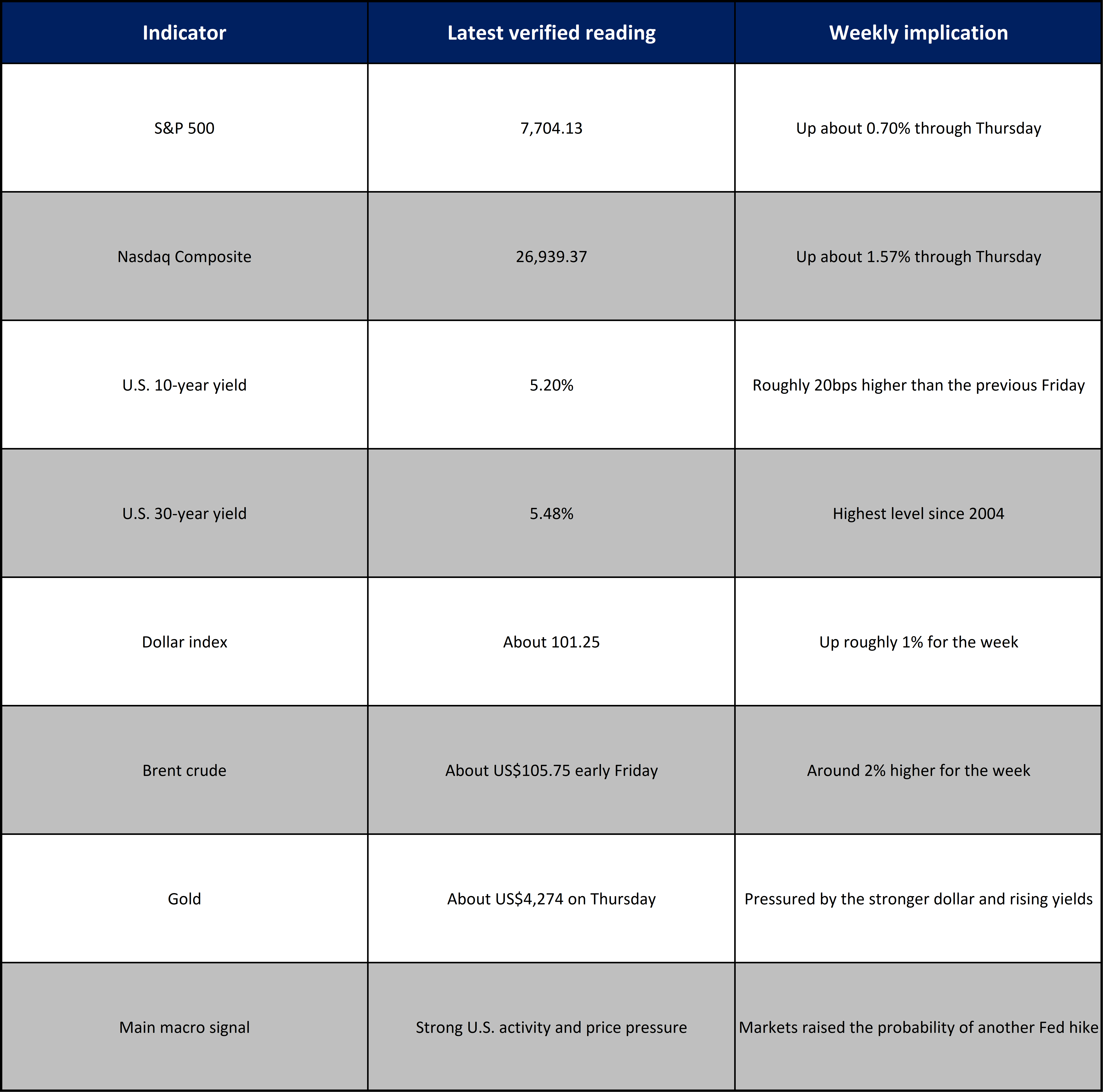
What happened: The U.S. 10-year Treasury yield rose to about 5.20% on Thursday, its highest level since 2007, while the 30-year yield reached approximately 5.48%. Brent traded near US$105.75 early Friday and the dollar index was up roughly 1% for the week.
Why it mattered: Higher U.S. yields increase the return global investors can earn without taking Nigerian sovereign, equity or currency risk. Elevated oil benefits Nigeria’s potential export receipts, but it also reinforces global inflation and tightening expectations.
What comes next: A sustained U.S. yield above 5% would raise the valuation hurdle for frontier-market equities and could limit how quickly Nigeria can reduce yields without weakening the naira carry proposition.
Nigeria Market Scorecard
Global Market Scorecard
The Main Lesson From This Week
Nigeria’s rate reset has created a segmented market, not a universal risk-on environment.
Sovereign borrowers benefited first. Treasury-bill and bond yields declined because banks and institutional investors had abundant liquidity and expected further compression. Equity investors also responded positively, particularly in liquid stocks positioned to benefit from FTSE visibility and lower competing yields.
Businesses and households have not yet received the same benefit. The 45% CRR remains in place, overnight money still costs roughly 21%, and banks must price credit risk on top of those funding constraints. A lower MPR can therefore coexist with expensive working capital and selective loan growth.
For portfolios, the implication is a barbell rather than a broad rotation. Existing naira duration may benefit if yields continue falling, while liquid equities with defensible earnings can attract capital as sovereign returns compress. The weak part of the strategy is indiscriminate exposure: compressed bill rates reduce the margin for error, and global yields above 5% make expensive or illiquid Nigerian assets harder to justify.
Ranora View:
The auction confirmed that investors believe the direction of Nigerian yields is lower. It did not confirm that credit conditions have become easy.
Existing holders of medium-duration naira securities are better positioned than investors now chasing sharply lower primary-market stop rates. New buyers should compare discount rates with true yields, secondary-market alternatives and the risk that global tightening limits further domestic compression.
Within equities, lower sovereign yields support valuation re-rating, but the preferred exposure remains liquid companies with pricing power, credible cash flow and limited refinancing pressure. Banks may benefit from stronger asset-market activity, although the unchanged CRR complicates any assumption of immediate lending-volume expansion.
The key portfolio risk is policy divergence. Nigeria is easing its domestic rate structure while U.S. yields, the dollar and oil-related inflation risks are rising. That divergence can persist while reserves and FX liquidity remain supportive, but it cannot be ignored.
What to Expect Next Week:
Post-auction yield discovery: Watch whether secondary bill and bond yields continue falling after the concentrated 364-day demand.
NGX breadth and turnover: Determine whether the post-FTSE rally broadens beyond a small group of liquid names.
FX resilience: Monitor official-market turnover and the naira’s response to a stronger dollar.
CBN liquidity operations: OMO issuance could absorb excess cash and change the apparent easing signal.
U.S. GDP and PCE: The BEA will release final second-quarter GDP and August personal income and outlays on 30 September, potentially resetting Fed expectations.
Question of the day:
Does the rush into the 364-day Treasury bill signal the beginning of a durable shift into Nigerian duration, or are investors moving too quickly ahead of evidence that inflation and FX stability can support further yield compression?
Stay smart. Stay informed. Subscribe to Ranora Market Outlook for free and support independent market analysis.