


Opening View:
Airtel Africa supplied the clearest earnings lesson of the week: a stronger naira can improve reported dollar growth without creating an equivalent acceleration in the underlying business. In Friday’s half-year release, the company reported Nigerian mobile-services revenue growth of 44.6% in dollars, against 26.6% in constant currency. Both are strong results. They should not become the same forecast. Once the comparison period catches up, a stable exchange rate preserves the higher dollar revenue base but does not repeat that currency-driven acceleration.
That distinction matters beyond telecoms. Investors should separate improvements that lift today’s earnings from drivers capable of compounding them. Nigeria’s completed Treasury-bill auction presented a related execution problem: lower stop rates came with limited allotments, so the advertised opportunity was not equally available to every bidder. Abroad, the Federal Reserve held rates while subsequent US inflation data left the case for cheap dollar funding unconvincing. Technology shares also came under renewed pressure.
The portfolio implication is selective rather than defensive by default. Give credit to expanding customer demand and credible margins, compare income opportunities on obtainable net terms, and avoid turning a favourable currency move or policy pause into a permanent valuation assumption.
The Big Picture:
The week’s main lesson is that a better reported number is not automatically a better entry price. Airtel’s customer growth is operating evidence; currency translation is a separate contributor. A lower bill-auction rate is a clearing price for accepted bids, not a promise of supply. A Fed hold leaves financing costs in place.
For businesses, budget operating demand, exchange rates and energy costs separately. For investors, model an unchanged exchange rate before deciding how much growth deserves to be capitalised. That is a more useful test than extrapolating the latest headline percentage.
Nigeria Market Intelligence:
Airtel provides evidence of demand as well as translation. The operating case is substantive: Airtel reports Nigerian data customers up 11.8% and monthly smartphone usage of 16.7GB, versus 12.7GB a year earlier. But its Nigerian mobile-services underlying EBITDA margin slipped from 58.8% in the first quarter to 57.5% in the second, with fuel costs weighing on the business.
Our interpretation: customer adoption supports the growth thesis; exchange rates and energy costs determine how much reaches dollar earnings. Watch whether usage and revenue per customer sustain growth if the currency comparison becomes less favourable. This is an earnings test, not an Airtel entry recommendation.
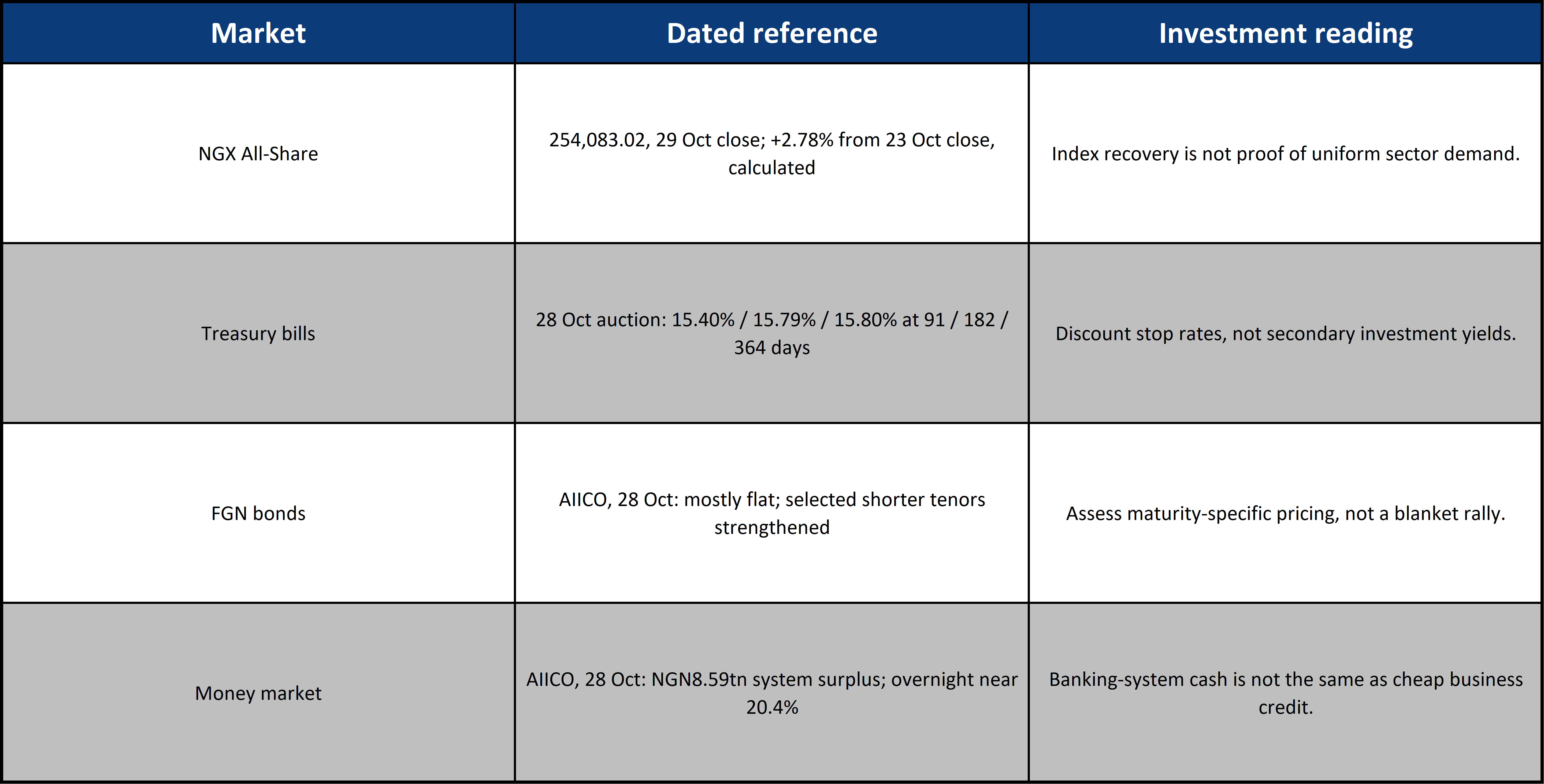
Lower bill rates came with scarce allocations. The 28 October auction allotted NGN71.16 billion against NGN800 billion offered, about 8.9% of the offer by our calculation. The 91-, 182- and 364-day discount stop rates were 15.40%, 15.79% and 15.80%.
This changes Wednesday’s pending-auction assessment: the outcome is now available, and access matters alongside yield. Unsuccessful bidders may seek secondary bills, but that does not establish an equity inflow or a fresh liquidity injection. Treasurers should compare executable prices, true yields, fees and maturity dates before committing cash elsewhere.
FirstHoldCo turnover needs a transaction explanation. FirstHoldCo and RCIM say approximately 5.2 billion existing shares have been crossed to investors under their disposal programme. These are secondary transfers, not new capital raised by FirstHoldCo. The statement also indicates that further crossings remain subject to approvals and execution.
Large transfer volumes should not be mistaken for continuously available trading depth. Watch subsequent ownership disclosures and ordinary-session liquidity; the announcement alone neither establishes a bargain nor explains every share-price move.
Nigeria Market Scorecard:
References below cover different observation dates, not a completed Friday-to-Friday return. Friday closing reports could not be reconciled; the equity benchmark uses Thursday’s corroborated close.
Global Market Intelligence:
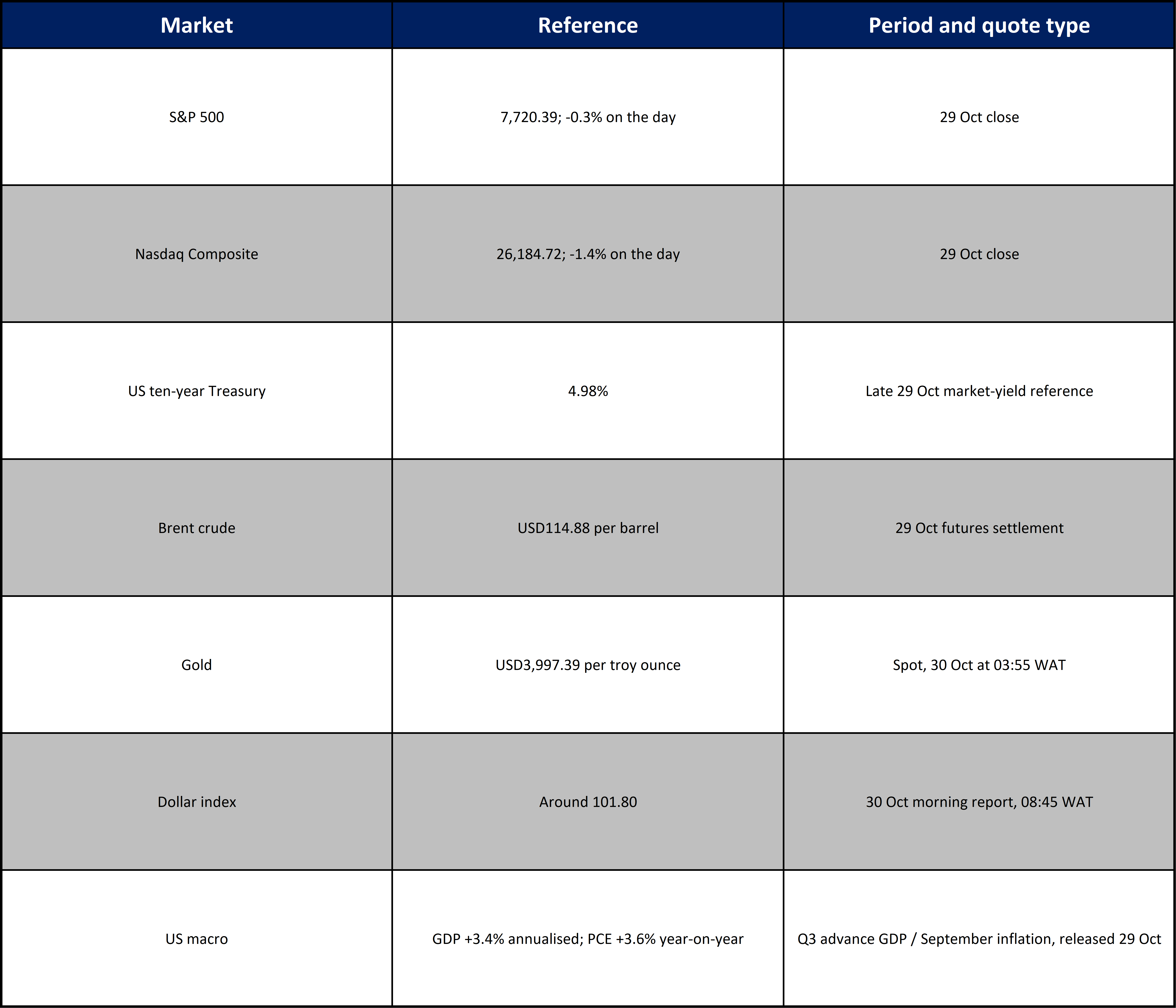
The Fed pause did not settle the inflation question. The Fed held its target range at 3.75%-4.00% on 28 October. Thursday’s releases then showed US third-quarter real GDP growth of 3.4% annualised and September PCE inflation of 3.6% year-on-year; the measure excluding food and energy was 3.1%.
Our reading: robust activity and persistent inflation do not support assuming imminent funding relief. Nigerian dollar borrowers should test refinancing at prevailing terms. Sovereign Eurobond investors must separate Nigeria’s credit spread from movements in US Treasury yields.
A Treasury rally is not a Nigerian credit upgrade. On Thursday, the Nasdaq Composite fell 1.4%, while the Russell 2000 rose 1.0%. Technology selling continued into Friday’s unfinished session.
This divergence argues against treating a technology-heavy index as the whole economy. For Nigerian portfolios, tighter global risk budgets are a possible transmission channel, not evidence that foreign investors have already withdrawn locally. Watch actual flows and trading depth before asserting contagion.
Oil still has opposing effects on Nigeria. Brent futures settled at USD114.88 a barrel on Thursday. Higher oil can support export receipts, conditional on production and collections, while raising fuel and logistics costs for domestic businesses. Airtel’s fuel-cost pressure makes that corporate channel concrete.
Oil exposure is therefore not a substitute for examining margins. Gold also weakened in the early Friday, a reminder that inflation pressure can coexist with losses in a non-yielding asset. Watch energy costs and interest rates together.
Global Market Scorecard:
US Friday trading is incomplete. These are dated closes or snapshots, not current executable quotes or final weekly returns.
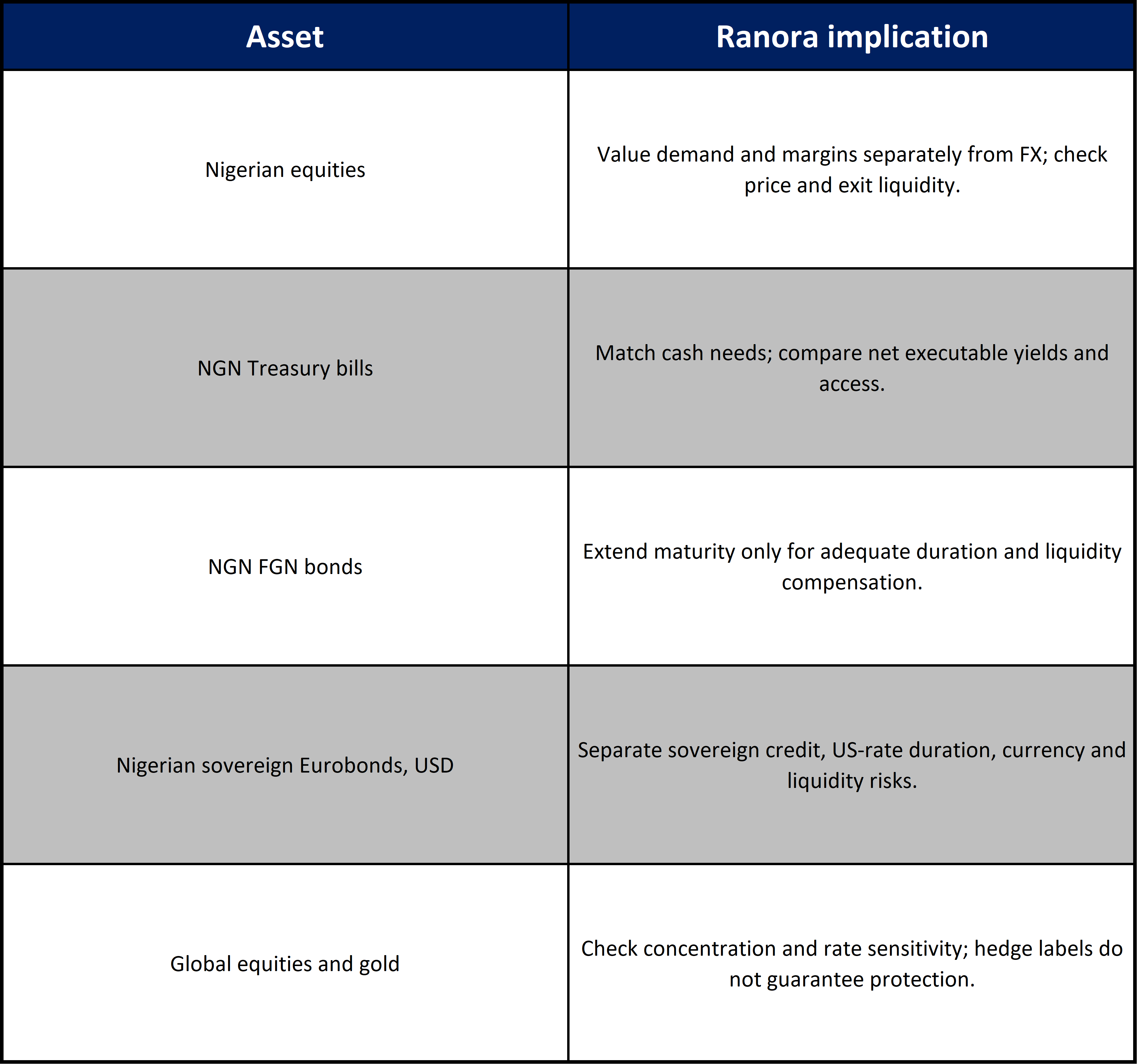
Asset Class Implications
Each asset needs a distinct pricing and risk test.
Investment Ideas Review:
NG-EQ-UNILEVER-MIX-20261026 | Unilever Nigeria Plc ordinary shares | NGX UNILEVER | NGN | Pending
Monday’s sole idea remains deferred. Foods growth still does not establish category-wide recovery. Nine-month net operating cash was NGN10.26 billion versus NGN32.83 billion a year earlier, with higher tax payments and working-capital absorption. No verified new evidence warrants upgrading the thesis.
Executable prices, spreads, fees and investor-specific tax economics remain unverified. The 30 October dividend qualification date does not guarantee entitlement for a late buyer. Reassess when valuation and cash conversion improve; weaker category sales or continuing cash absorption would undermine the case. No execution or realised return is implied.
Ranora View:
Give Airtel credit for customer adoption without extrapolating the currency contribution. A stable naira can preserve a better dollar earnings base without repeating the growth uplift once the comparison period catches up. Sustained monetisation and margins are the next test.
Our preference is selective equity underwriting and income investments matched to obligations. Scarce bill allotments are not sufficient reason to accept longer duration or weaker exit liquidity.
What to Watch Next:
Telecom forecasts: customer monetisation, currency assumptions and fuel costs.
Secondary bills and CBN operations: available net yields after restricted allotments.
FirstHoldCo: transfer completion, ownership disclosures and ordinary trading depth.
US labour data: September job openings on 3 November; October payrolls on 6 November.
Question of the day:
Which improvement deserves the larger valuation reward: stronger underlying demand or a more favourable currency environment?
Stay smart. Stay informed. Subscribe to Ranora Market Outlook for free and support independent market analysis.