


Opening View:
Nigeria ended the third quarter with a stronger operating signal than its equity market performance suggests. The Stanbic IBTC Bank Nigeria PMI rose to 56.4 in September from 54.3 in August, its highest reading in more than four and a half years. New orders and output expanded at their fastest rates since February 2022, while companies accumulated inventories at the quickest pace since late 2021.
This is more than a sentiment improvement. Businesses are committing working capital to materials and stock because they expect demand to hold. That should benefit transaction banking, trade finance, logistics and companies with sufficient balance-sheet strength to fund expansion.
The market is applying a harder test. The NGX All-Share Index declined approximately 0.52% over the shortened week, despite the strong activity signal. Financial stocks were among the principal drags during the midweek sell-off. Investors are asking whether higher volumes will translate into margins, free cash flow and dividends, particularly because the PMI also showed input-cost inflation rising to a three-month high.
Globally, weak US payroll growth reduced the probability of another immediate Federal Reserve rate increase. Yet long-term Treasury yields remained above 5%, suggesting that fiscal supply, inflation and term-premium concerns still matter. The week’s lesson is clear: improving growth is welcome, but capital remains expensive.
The Week in One Paragraph
Nigeria’s economy and its financial markets sent different signals. Private-sector demand accelerated, businesses increased inventories and the naira remained broadly stable, but equities retreated and the CBN continued absorbing surplus liquidity. Overseas, US employment growth slowed sharply, supporting risk assets on Friday, but the response from long-term bonds was less convincing. Oil and gold fell over the week, while the dollar remained stronger. For investors, the important question is no longer simply whether economic activity is recovering. It is which companies can finance growth, protect margins and convert higher sales into cash.
Top 5 Market Stories of the Week
1. Nigeria’s private sector moved from recovery to expansion
What happened: The September PMI increased to 56.4. New-order and output growth reached their strongest rates since February 2022, while inventories accumulated at the fastest pace since late 2021. Employment increased for a sixteenth month, although hiring remained modest.
Why it mattered: Inventory accumulation is an early capital-allocation signal. Companies are using cash or credit to position for future sales. That can increase demand for working-capital facilities, payments, trade finance and logistics services.
What comes next: The investment case now depends on conversion. Rising fuel, food and raw-material costs could turn higher revenues into weak margins if companies cannot reprice quickly or manage inventory efficiently.
2. The NGX did not immediately price in the stronger economy
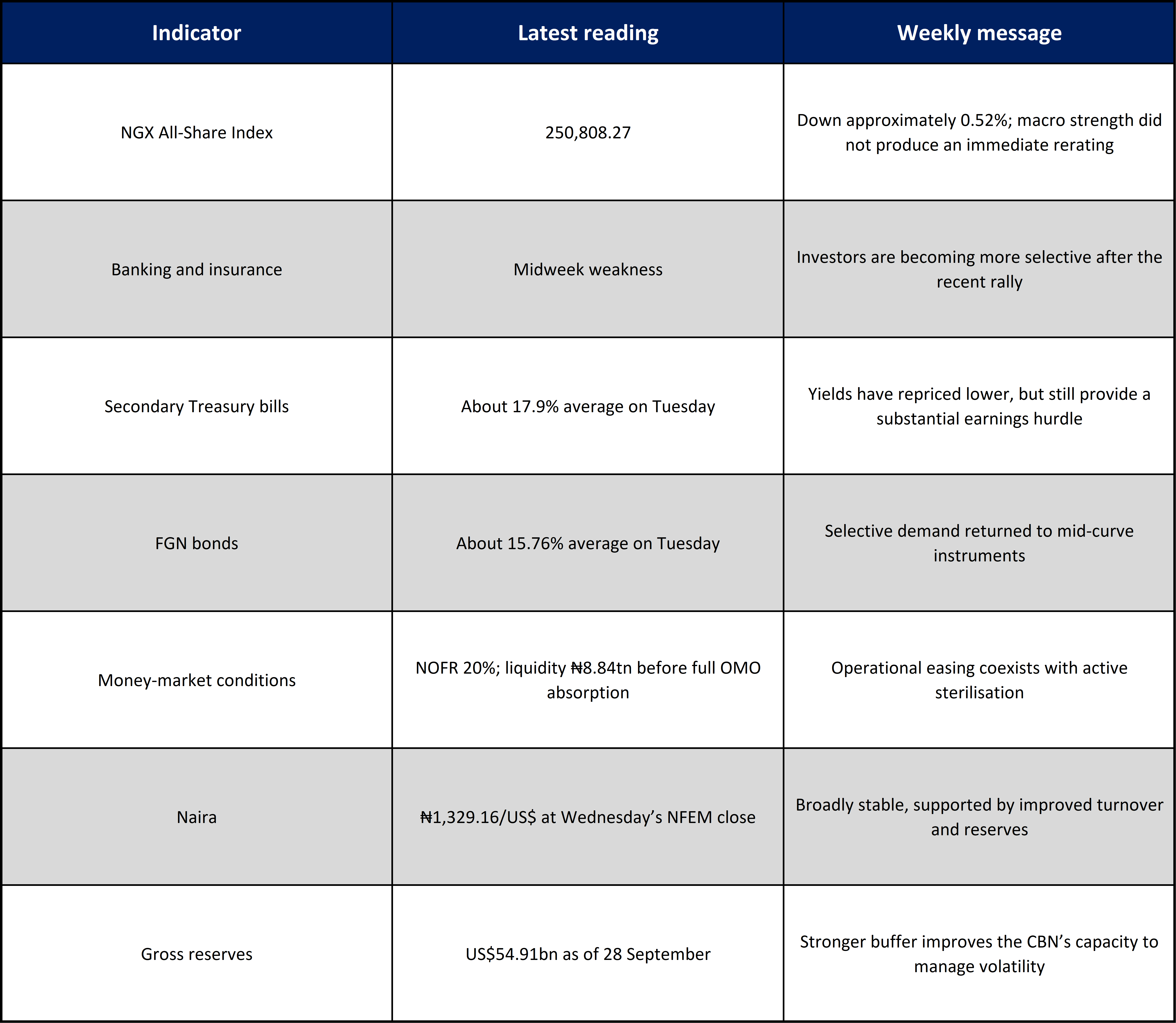
What happened: The All-Share Index closed Friday at 250,808.27, approximately 0.52% below the previous Friday’s 252,113.41. The market initially reached a higher close on Monday before profit-taking in banks and other large companies reversed the move.
Why it mattered: The decline does not invalidate the growth signal. It shows that investors are distinguishing between economic activity and shareholder returns. After a roughly 61% year-to-date index gain, earnings quality, valuation and liquidity matter more than broad macro optimism.
What comes next: Watch companies with strong inventory turnover, pricing power and limited refinancing needs. Banking exposure should increasingly be judged by loan quality, fee income and the ability to finance productive working capital without a disproportionate rise in impairment charges.
3. The CBN kept liquidity abundant but controlled
What happened: System liquidity reached ₦8.84 trillion on Tuesday, while the CBN allotted ₦4.69 trillion of OMO bills against ₦2.5 trillion offered. NOFR remained at the 20% floor, the average secondary Treasury-bill yield was about 17.9%, and the average FGN bond yield stood at 15.76%.
Why it mattered: The recent policy-rate reduction has lowered parts of the domestic yield curve, but the CBN is still preventing excess cash from becoming disorderly credit or FX demand. Monetary easing is therefore being transmitted selectively.
What comes next: Investors should compare Treasury bills, OMO instruments and bonds on true yield, liquidity and reinvestment risk. Businesses should not assume the lower policy rate will translate immediately into proportionately cheaper bank credit.
4. Weak US jobs reduced Fed-hike risk, but did not settle the bond question
What happened: US nonfarm payrolls increased by only 29,000 in September. Unemployment edged up to 4.2%, wage growth slowed to 0.1% month on month, and July and August payrolls were revised down by a combined 60,000.
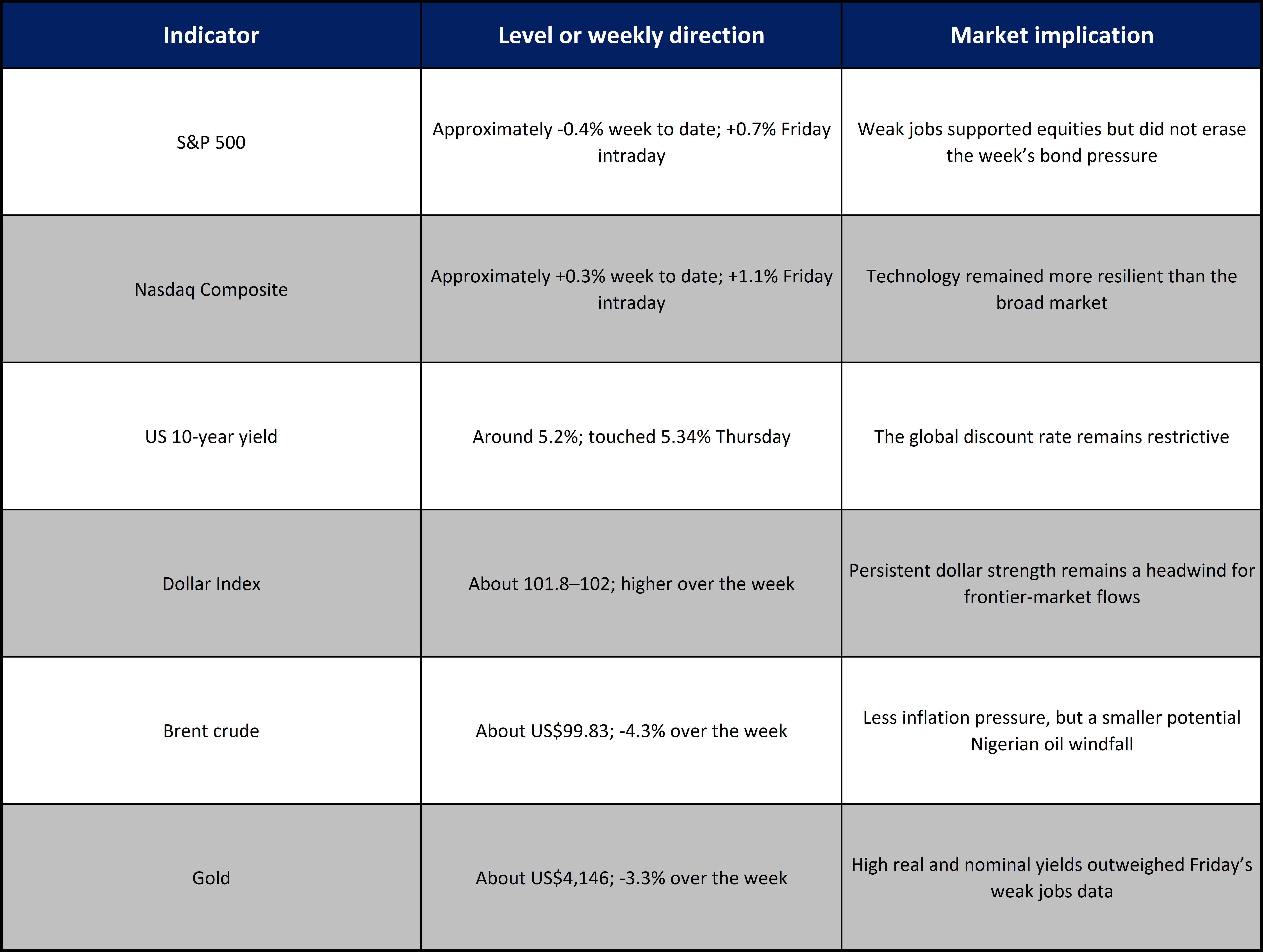
Why it mattered: Markets sharply reduced expectations of another Fed increase in October. However, the US 10-year yield, after falling toward 5.18%, moved back toward 5.2% during the session. That suggests weak employment alone may not overcome fiscal, supply and inflation concerns at the long end.
What comes next: A sustained fall in global discount rates will require softer inflation as well as softer employment. Until then, high US yields can continue competing with frontier-market assets for global capital.
5. Oil fell, but Nigeria’s fiscal relief remains conditional
What happened: Brent traded near US$99.83 per barrel on Friday, approximately 4.3% below the previous week’s close. Recovering flows through the Strait of Hormuz and discussion of emergency stock releases eased immediate supply anxiety.
Why it mattered: Lower oil reduces the global inflation impulse and may ease pressure on imported fuel costs. For Nigeria, however, it also moderates the potential revenue and FX benefit from elevated crude prices. The net effect depends on export volumes, realised prices and domestic fuel economics.
What comes next: Investors should monitor physical export flows rather than geopolitical headlines alone. A sustained move below US$100 would reduce the oil windfall narrative, while renewed disruption could quickly reverse the decline.
Nigeria Market Scorecard
Global Market Scorecard
Ranora View:
Nigeria’s September PMI is the week’s most important domestic signal because it shows companies acting before investors do. Faster inventory accumulation means businesses are deploying cash, taking supplier risk and preparing for sales. That could support bank credit, trade finance, logistics and selected industrial earnings over the next two quarters.
But inventory is not automatically profit. If demand disappoints, financing costs remain high or input prices rise faster than selling prices, today’s stock build becomes tomorrow’s cash-flow constraint.
We therefore prefer companies that combine demand exposure with pricing power, short cash-conversion cycles and limited refinancing needs. Banks that can finance productive working capital without sacrificing asset quality may benefit, while highly leveraged companies or businesses with slow-moving stock deserve a higher risk discount.
In fixed income, short naira carry remains useful, while duration should be added selectively. Globally, weak payrolls have reduced near-term Fed-hike risk, but the stubborn US long end warns against declaring the global rate shock over.
What to Watch Next:
Whether Nigeria’s higher PMI translates into stronger October company sales, credit growth and payment activity.
September input-cost trends and whether companies can protect gross margins.
The CBN’s next OMO operation and the effect of settlement on system liquidity and overnight rates.
Nigeria’s next Treasury-bill auction, particularly whether demand remains concentrated at the long end.
US inflation on 14 October and whether it confirms or contradicts the softer employment signal.
Question of the day:
Do you see Nigeria’s inventory build as evidence of durable demand, or as a working-capital risk if input costs and borrowing rates remain high?
Stay smart. Stay informed. Subscribe to Ranora Market Outlook for free and support independent market analysis.