


Opening View:
Nigeria’s most useful market signal this week was the price the government accepted for its borrowing. The CBN held its policy rate at 23%, but the next day’s Treasury-bill auction cleared at higher discount rates across all three tenors. Face-value allotment was broadly unchanged from the previous auction despite a smaller pool of subscriptions.
The apparent improvement in auction coverage therefore needs care. Bids covered more of the offer because the offer was smaller. That is different from an expanding pool of willing lenders, and it weakens the argument that a steady policy rate has made financing easier.
For businesses, the transmission runs through the return available on sovereign paper. A higher government funding benchmark can raise the compensation demanded from private borrowers and the earnings growth required to justify equity valuations. It does not establish that every bank loan has already repriced.
Globally, stronger US growth and persistent inflation complicate hopes that an equity recovery will bring cheaper dollar finance. Firmer oil also has opposing effects on Nigerian export receipts and business costs. The investment question is whether operating returns can cover the cost of funding them.
The Big Picture:
The week’s main lesson is that funding availability and funding price can move in different directions.
At Wednesday’s auction, subscriptions fell to NGN882.77bn from approximately NGN1.12tn at the previous sale. The offer fell to NGN600bn from NGN800bn, lifting bid-to-cover to 1.47 times from 1.40 times. Face-value allotment remained about NGN713bn. This is not a cash-proceeds comparison: bills are issued at a discount. The government accepted higher clearing rates without attracting a larger volume of bids.
Monday’s working-capital question now has a higher sovereign funding benchmark. For businesses, the test is the actual renewal quote and cash generated before repayment. The auction does not prove a general bank-liquidity shortage or that money left equities to buy bills.
Nigeria Market Intelligence:
The completed auction revealed a higher funding price. The 364-day bill’s auction discount rate rose to 16.60% from 15.89%. Shorter tenors also repriced higher. These are discount rates, not investors’ annual true yields or after-cost returns.
Corporate debt competes with the sovereign alternative, making frequent refinancing more sensitive to market pricing. Watch whether secondary-market offers sustain the repricing and subsequent auctions attract more demand at comparable issuance sizes.
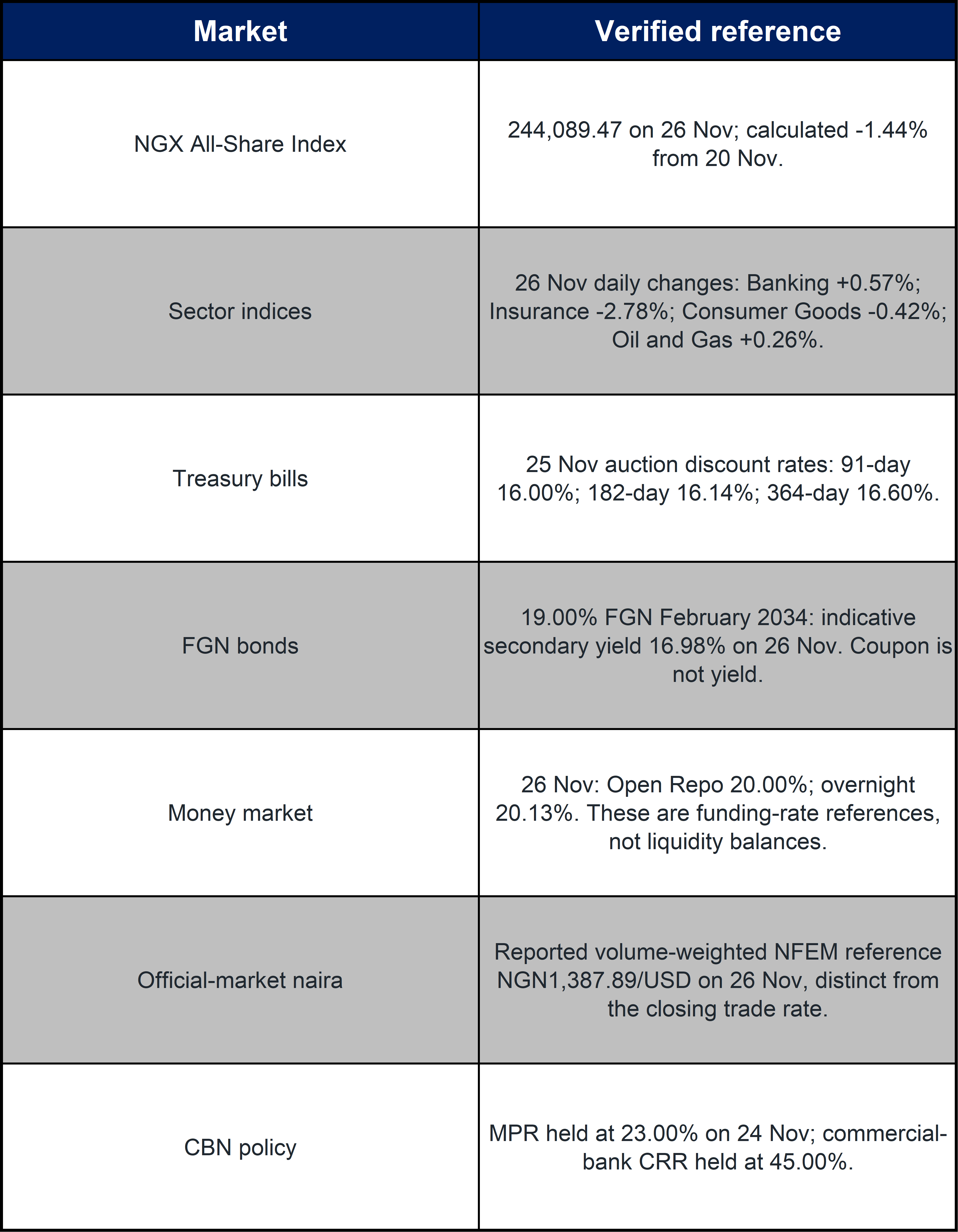
An equity bounce still needs broader participation. Thursday’s small NGX recovery left the All-Share Index 1.44% below the previous Friday’s close, calculated through Thursday only. Banking and oil-and-gas indices rose on the day while insurance and consumer goods fell.
The announced Dangote Refinery listing on 1 December will test trading depth. A larger listed market does not guarantee more liquidity: watch actual admission, turnover and fresh buying across existing shares. Available data do not establish that investors sold other stocks to fund the listing.
Retail dollar access is not the same as corporate FX relief. Reports of a temporary increase in banks’ weekly physical-dollar sales limit to eligible BDCs, to USD1m per operator, point to a targeted distribution measure. The reported NFEM reference strengthened on Thursday.
Importers still need obtainable bank rates and reliable supplier-payment settlement. More retail dollar notes do not guarantee easier overseas payments. Watch customer quotes and availability; Thursday’s currency move alone does not prove the policy caused it.
Nigeria Market Scorecard:
The figures below use their stated dates and measures, not a completed Friday closing scorecard.
Global Market Intelligence:
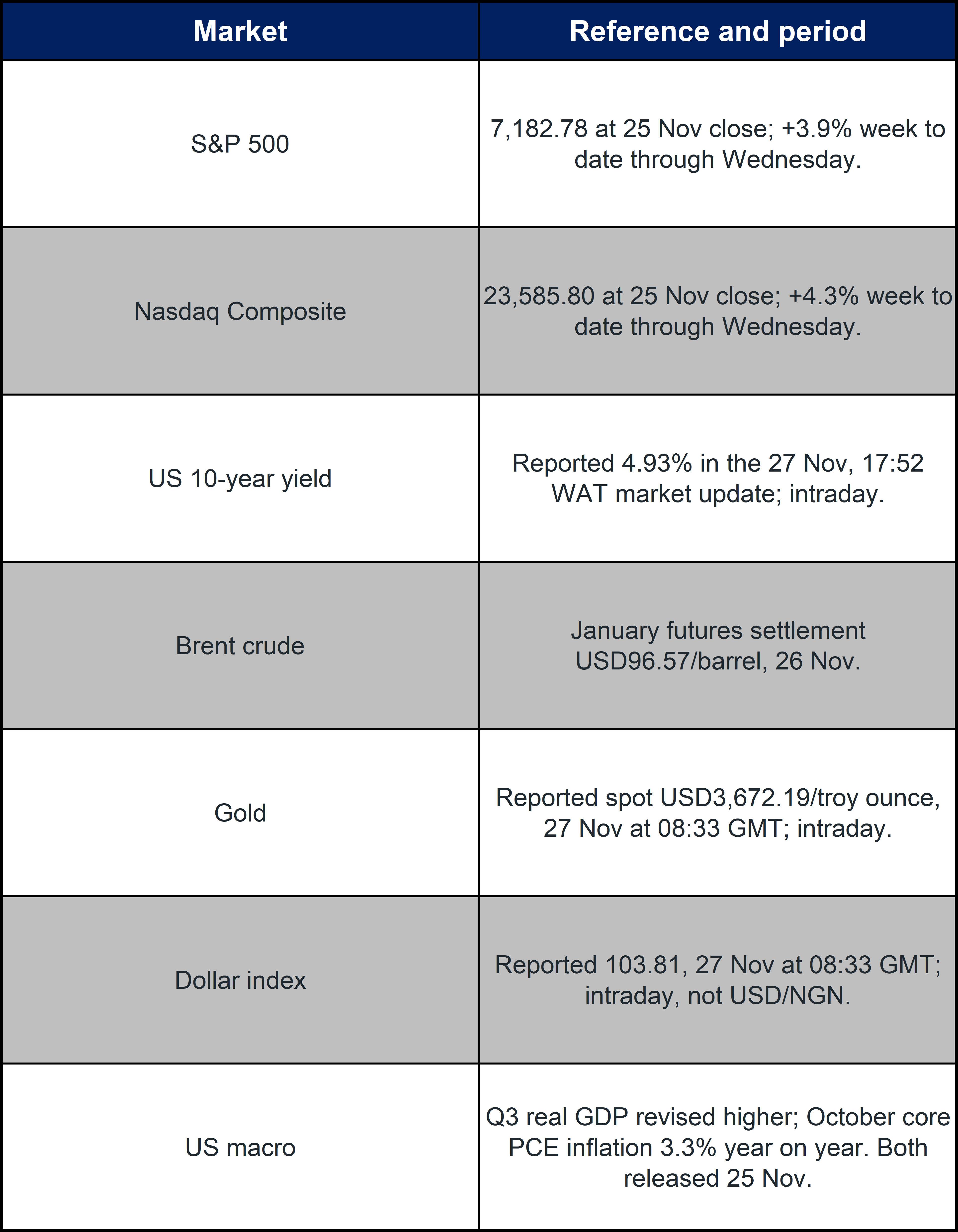
US growth leaves the inflation constraint intact. The second estimate put US third-quarter real GDP growth at a 4.3% annualised quarterly pace, up from 3.4%. October core PCE inflation was 3.3% year on year and 0.3% month on month.
This provides little basis for assuming imminent cheap-dollar funding. Nigerian USD borrowers face the US benchmark plus their credit premium and costs; a lower spread may not offset a higher benchmark. The next employment report will test demand persistence.
A stock recovery does not establish easier financing. US equities recovered ground this week despite sharp swings. At 17:52 WAT on Friday, the S&P 500 was up 1.5% on the day and the Nasdaq Composite 2.0%; the same market update put the US 10-year yield at 4.93%.
Improved sentiment could support Nigerian risk appetite, but verified evidence of fresh foreign buying is absent here. Watch funding spreads and actual participation after the US holiday period.
Higher oil supports receipts but complicates margins. January Brent futures settled at USD96.57 a barrel on Thursday amid renewed supply-disruption concerns, ahead of Sunday’s OPEC+ meetings.
Higher realised export prices can support Nigerian dollar receipts if production and collections hold up. Transport-intensive firms face the opposite exposure through fuel, freight and inventory costs. Contracts and domestic pass-through determine the net effect. Watch OPEC+ decisions and delivered energy costs.
Global Market Scorecard:
Completed-session references and reported intraday snapshots are deliberately separated..
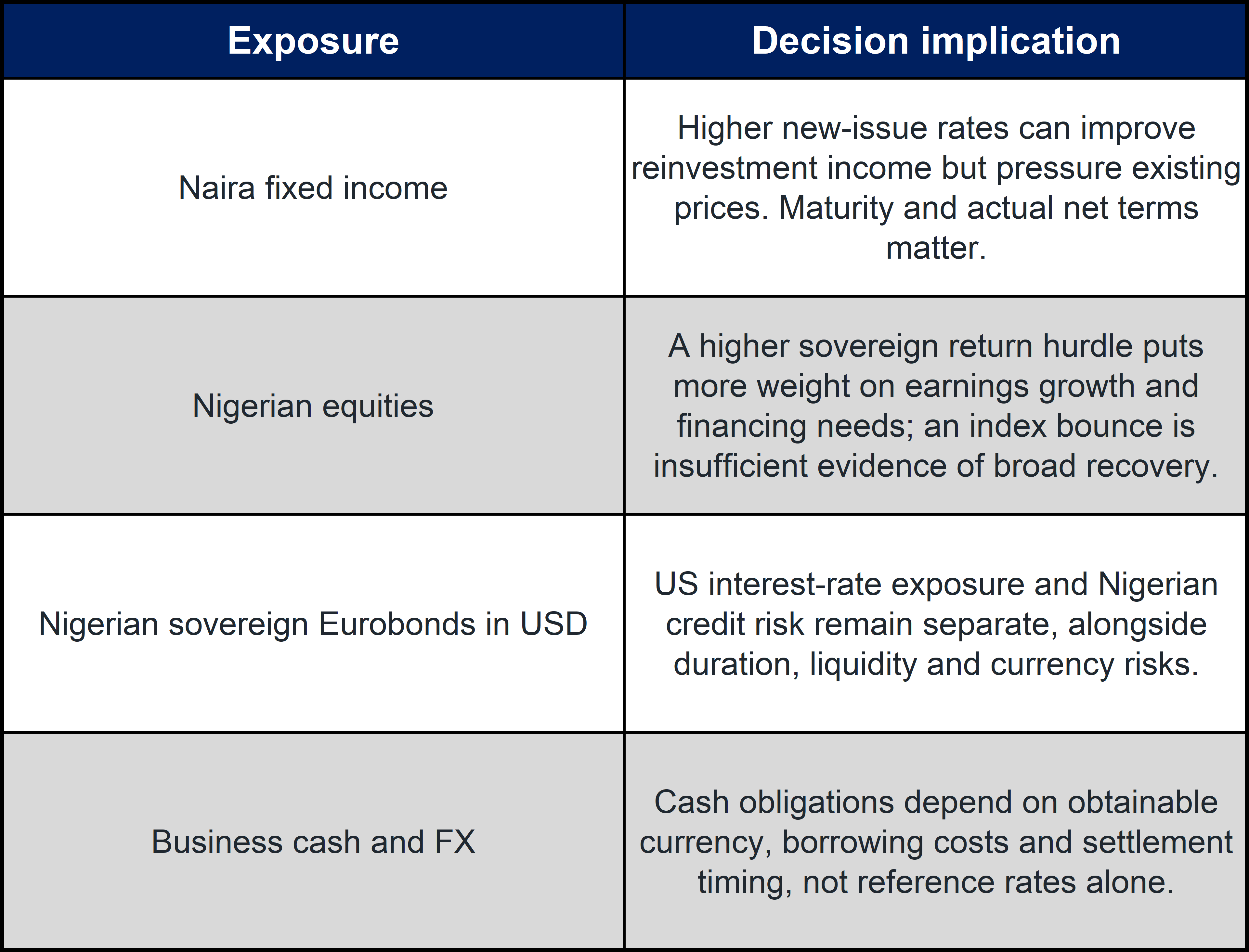
Asset Class Implications
Portfolio transmission, not instrument recommendations.
Investment Ideas Review:
NG-NTB-20270708-CURVE-20261123 | Nigerian Treasury bill maturing 8 July 2027 | NGN | Pending
Entry remains deferred. Thursday’s indicative secondary reference showed an annual yield of 18.56% for the July bill against 18.55% for the 4 November 2027 comparator. That one-basis-point displayed difference is not a verified net advantage. Higher rates at the new auction change the alternatives but do not establish the obtainable price of this exact July security.
The outstanding checks remain same-size, same-settlement dealer offers, exact security identification, access, fees, applicable tax and early-exit liquidity. Any currency conversion costs also matter. The prospective horizon remains to July maturity after a qualifying entry, with sovereign, inflation, reinvestment, naira and liquidity risks. Monday’s sole idea is retained under its original identifier; no transaction or realised return is implied.
Ranora View:
We read this week’s auction as evidence that the government accepted a higher price for bill funding despite an unchanged policy rate. The equity implication is a higher hurdle for earnings growth, not proof that every company is worth less. Businesses that repeatedly refinance their operating cycle are more exposed to this distinction than firms able to fund it internally.
The view would improve with stronger subscriptions at comparable supply, lower obtainable funding costs and wider equity participation. A rally in US stocks or a better auction-coverage ratio cannot substitute for those tests. For dollar liabilities, the benchmark rate, credit premium and conversion cost still need separate assessment.
What to Watch Next:
OPEC+ on 29 November: the production decisions and their implications for Nigerian receipts and delivered fuel costs.
Dangote Refinery on 1 December: completion of the announced listing and evidence of trading depth beyond headline market size.
US employment on 4 December: whether hiring and wages reinforce the pressure from persistent inflation.
Nigerian funding follow-through: executable secondary bill quotes, the next published auction terms and actual corporate renewal pricing.
FX distribution: whether reported BDC cash access translates into better customer availability, while corporate payment conditions are assessed separately.
Question of the day:
What would change your capital-allocation decisions most: lower borrowing costs, more reliable FX access, or stronger evidence of earnings growth?
Stay smart. Stay informed. Subscribe to Ranora Market Outlook for free and support independent market analysis.