


Opening View:
This week’s review of Nigerian bank accounts raises a more useful question than whether lenders are getting bigger: how much of that expansion is reaching customers as usable credit? A reported comparison of eight lenders shows deposits growing much faster than customer loans. Individual filings reveal different lending trajectories, making a broad credit-boom narrative premature.
For businesses, the distinction is practical. An expanding banking system does not guarantee a larger overdraft, a longer repayment period or a lower borrowing rate. A company increasing inventory can still face a financing gap between paying suppliers and collecting sales. For shareholders, deposit growth creates an opportunity, but the return depends on deployment, funding costs and eventual credit losses.
This week’s markets reinforced the need to separate those questions. Nigeria’s one-year Treasury-bill stop rate edged higher, while industrial shares outpaced banks through Thursday. Abroad, Friday’s slower headline producer-price increase did not eliminate underlying US inflation pressure. Nvidia’s leadership change added a company-specific shock to global equity portfolios, and Brent’s rebound complicated energy-cost planning.
Ranora’s reading is that financial capacity is improving unevenly, while the conditions for profitable borrowing remain demanding. That matters for bank valuations, corporate expansion plans and any portfolio thesis that assumes easier money will automatically lift earnings.
The Big Picture:
The week’s main lesson: funding capacity and credit transmission are different economic events.
A bank can attract deposits without finding enough loans that compensate for funding costs, capital requirements and expected losses. Sovereign securities provide a competing use of funds, but the evidence does not establish that government borrowing alone explains subdued lending.
Manufacturers and distributors need financing that lasts through their cash-conversion cycle. A lower policy-rate expectation has limited value if a credit line remains unapproved or its fees and repayment terms are unchanged. Internally funded businesses face a different expansion constraint from those dependent on refinancing.
Faster lending is not automatically better for shareholders either. Growth that later produces arrears can destroy the apparent earnings benefit. Profitable new credit and a broader improvement in borrower access are the tests that matter.
Nigeria Market Intelligence:
Lending growth is institution specific. BusinessDay’s review of eight lenders reported customer loans up 2.4% and deposits up 13.4% between September 2025 and September 2026. This is a sample of reported banking-group balances, not a measure of all new lending inside Nigeria.
The primary accounts underline the variation. Between December 2025 and September 2026, GTCO’s net customer loans fell 4.1% while customer deposits rose 9.4%. Stanbic IBTC’s net customer loans rose 9.9%; its statement attributes the increase to new origination. These percentages are Ranora calculations from the filings.
Repayments, impairments and currency translation can also change reported balances. The next test is broader origination with sustainable pricing and credit quality, not simply a larger sector asset total.
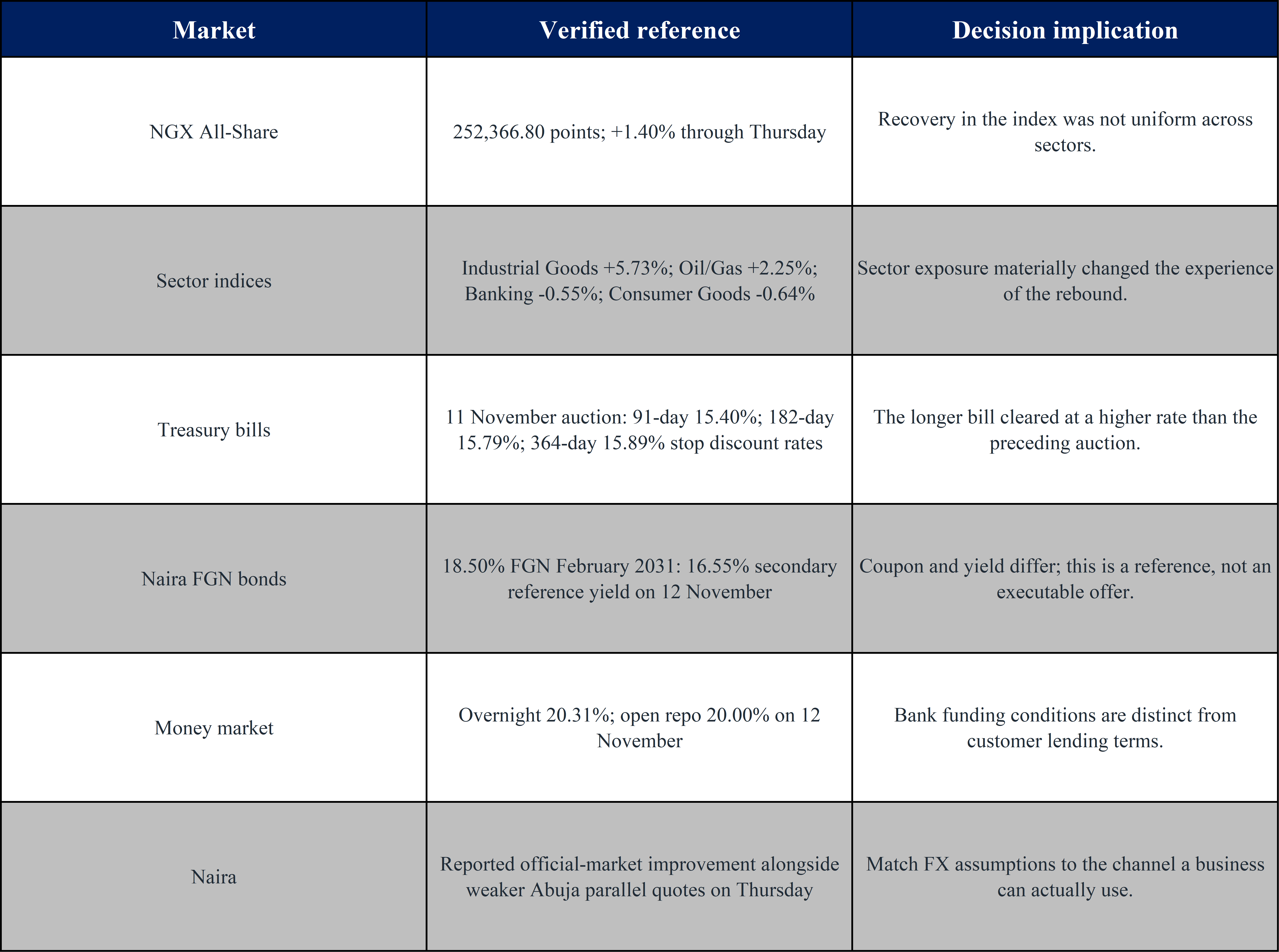
Treasury funding did not become cheaper automatically. The 11 November Treasury-bill auction lifted the 364-day stop discount rate to 15.89% from 15.80%. The 91-day and 182-day rates stayed at 15.40% and 15.79%. These are auction discount rates, not investor true yields or available dealing quotes.
The government accepted more funding than at the preceding auction despite lower subscriptions. The implication is that demand alone does not determine the clearing rate: the amount the issuer chooses to raise matters too. Next week’s bond auction will test whether that pricing tension extends further along the curve.
The equity recovery had different sector speeds. By Thursday, the NGX All-Share Index was 1.40% above the previous Friday’s close. Industrial Goods had gained 5.73%, while Banking and Consumer Goods were down 0.55% and 0.64%, respectively, over the same period.
That divergence is not proof that loan-book data caused bank-share weakness. It does show why a rising headline index cannot stand in for a uniform earnings recovery. The next useful signal is whether participation broadens alongside better operating results.
FX access matters more than a single headline rate. Thursday reporting showed a firmer naira at the official NFEM close but weaker parallel-market quotations from Abuja dealers. Those are different markets, and local dealer quotes are indicative.
For an importer, the relevant cost is the obtainable exchange rate plus fees and settlement timing. A favourable official-market move does not necessarily reduce the cash required to replace inventory through another channel.
Nigeria Market Scorecard:
Equity changes below are calculated from the 6 November close to the 12 November close, not completed week returns. Other rows are separately dated market references.
Global Market Intelligence:
Slower headline inflation is not broad price relief. Tuesday’s US CPI release showed prices rising 0.4% in October; the measure excluding food and energy rose 0.3%. Friday’s PPI release showed final-demand prices up 0.3% monthly and 6.5% annually. More revealingly, producer prices excluding food, energy and trade services rose 0.5% for a second consecutive month.
Ranora’s interpretation is that the case for assuming imminent dollar-funding relief remains weak. For Nigerian sovereign and corporate USD borrowers, financing costs depend on both US interest rates and their own credit spread. An improvement in Nigeria’s credit assessment would not by itself neutralise a rising Treasury yield. The next checkpoint is the Fed’s account of its October policy discussion.
Nvidia exposed a portfolio concentration problem. Nvidia announced Jensen Huang’s departure and Colette Kress’s appointment as interim chief executive on Thursday. Its shares finished the session about 4.3% lower.
Technology stocks were again pulling US indices lower in Friday morning trading as of 17:22 WAT. That market reaction does not establish that AI demand has collapsed. Portfolios holding different technology companies can still share a dependence on the same supplier and investment cycle. For Nigerian investors with offshore exposure, country diversification and business-risk diversification are not the same. Customer commitments and capital-spending guidance are the next operating tests.
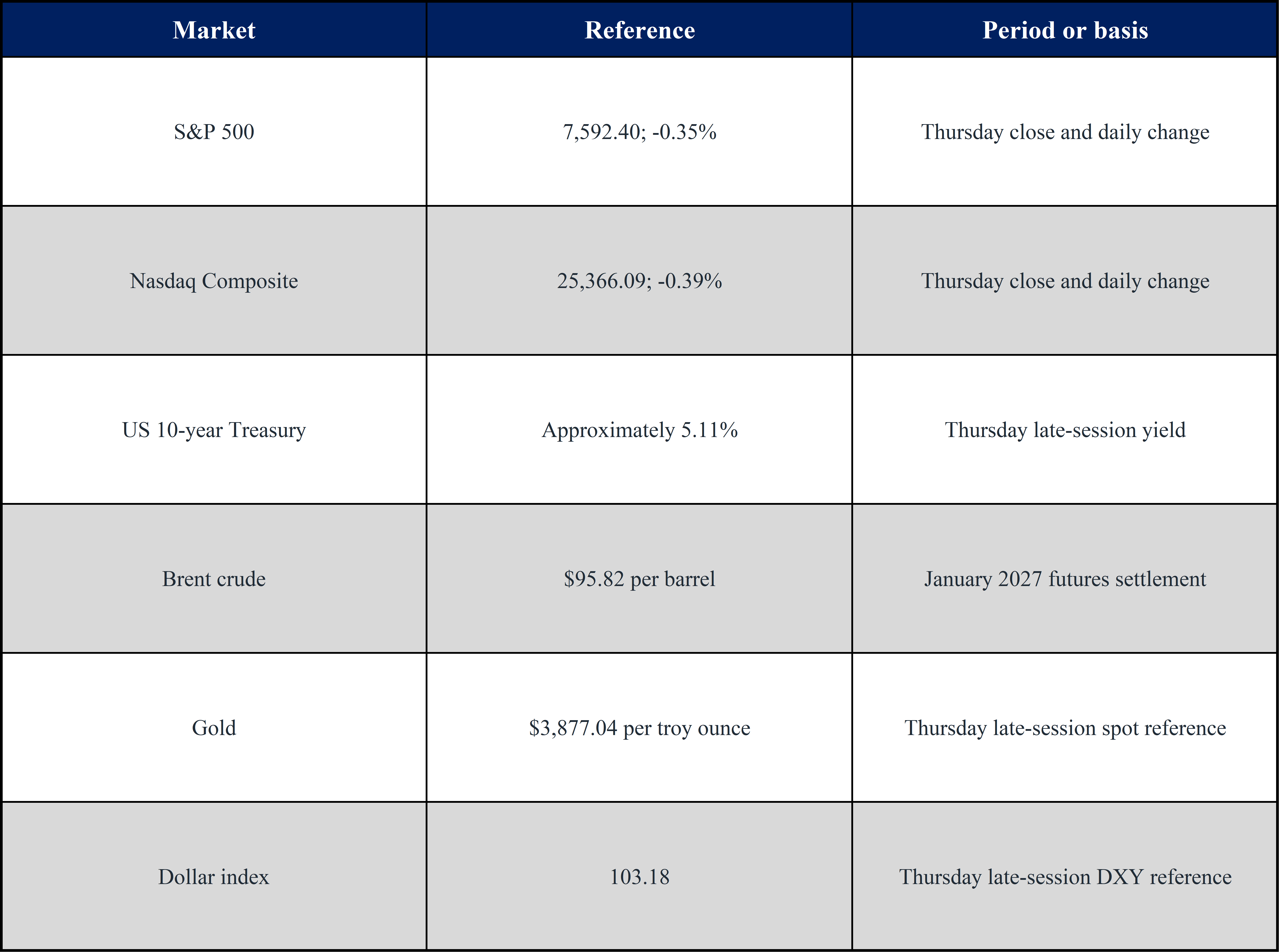
Oil relief remained reversible. January Brent settled at $95.82 a barrel on Thursday, up 3.3% that day, although still 2.54% below the preceding Friday’s settlement in the same contract.
For Nigeria, a higher oil price can support upstream receipts and external revenues while increasing fuel, transport and working-capital costs elsewhere. The timing and distribution of those effects differ. An exporter receiving more dollars and a distributor financing a larger diesel bill do not experience the same improvement. Next week’s test is whether delivered energy costs follow the benchmark, after FX and local pricing effects.
Global Market Scorecard:
These are Thursday 12 November observations. Equity figures are closes; Brent is a settlement; Treasury, dollar and spot-gold figures are late-session references, not Friday closing marks.
Asset Class Implications
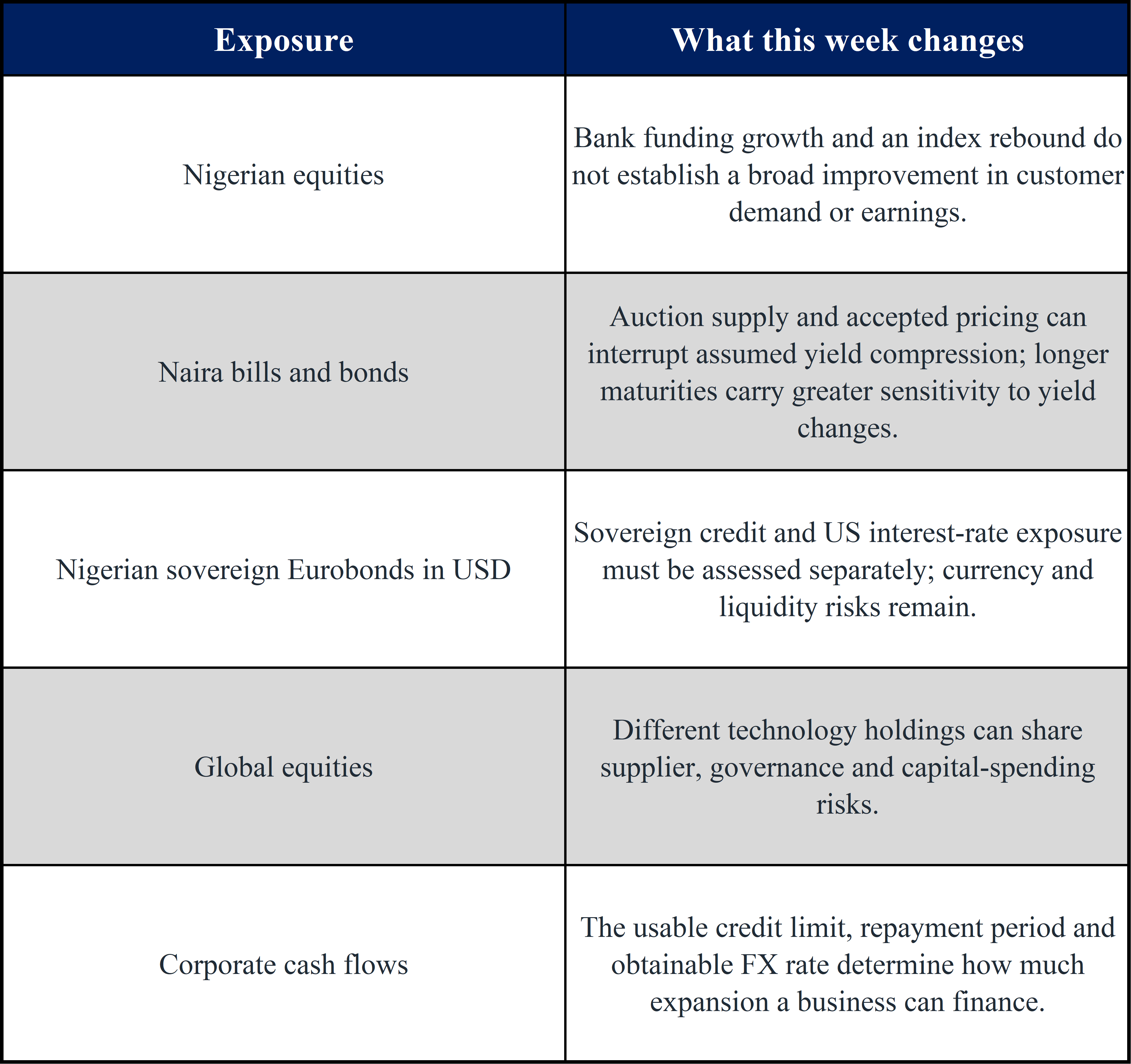
These are consequences for assessing risk and value, not trade instructions.
Investment Ideas Review:
Monday 9 November introduced no new qualifying investment opportunity and no new thesis identifier. That baseline remains unchanged at Friday’s review. Executable prices and complete net dealing costs have not been verified to support a fresh entry. Older candidates are not automatically renewed. No transaction or realised return is implied.
Ranora View:
The evidence supports an uneven credit recovery, not an assumption that bigger banks will finance every part of the economy at better terms. For bank earnings, the distinction is between gathering funds and deploying them profitably. For non-financial businesses, it is between growing orders and having the financing to fulfil them.
Borrowing dependence, loan quality and exposure to dollar funding can produce materially different outcomes within the same market. A broad recovery narrative is too coarse to capture those differences.
This view would change with evidence of broader new lending, improved attainable borrowing terms and stable repayment performance. Until then, capital availability should be assessed at the borrower and instrument level, rather than inferred from aggregate bank size or a higher equity index.
What to Watch Next:
Monday 16 November: the FGN bond auction. The DMO is offering N2 trillion, with settlement scheduled for 18 November. Watch clearing yields and actual allotments, not just subscriptions.
Nigeria’s October inflation report expected next week. Monthly food and non-food price changes will matter for household spending and inventory replacement costs; an annual decline alone would not establish falling prices.
Wednesday 18 November: Fed minutes. Look for the discussion of persistent inflation and policy restraint. The minutes describe October’s meeting and will not incorporate Friday’s PPI release.
Credit and FX transmission. Watch whether businesses obtain better lending limits, repayment terms and dollar settlement access. Those changes would give a recovery thesis more substance than growth in bank balance sheets alone.
Question of the day:
For your business or portfolio companies, is the binding constraint today the price of credit, access to credit, or confidence that demand will justify borrowing?
Stay smart. Stay informed. Subscribe to Ranora Market Outlook for free and support independent market analysis.