


The Week in One Paragraph
Nigeria ended the week with a better domestic inflation signal but a more difficult external policy environment. Headline inflation edged down to 15.39% in August, while monthly inflation slowed much more decisively to 0.71%. Investors also submitted ₦1.49tn of bids for ₦1tn of FGN bonds, and the NGX extended its recovery even as the ₦2.15tn Dangote Refinery offer began competing for capital. Those developments strengthen the argument for selective domestic monetary easing. The complication is that the Federal Reserve raised rates, the Bank of Japan followed, US Treasury yields returned to about 5%, and Brent remained above US$100 per barrel. The CBN therefore enters next week’s policy meeting with more domestic evidence for a cut but less external freedom to deliver one. The real market question is no longer whether Nigerian inflation is easing. It is whether the CBN can ease without weakening naira carry, unsettling foreign demand or reigniting imported inflation.
Top 5 Market Stories of the Week
Nigeria’s monthly inflation signal improved materially
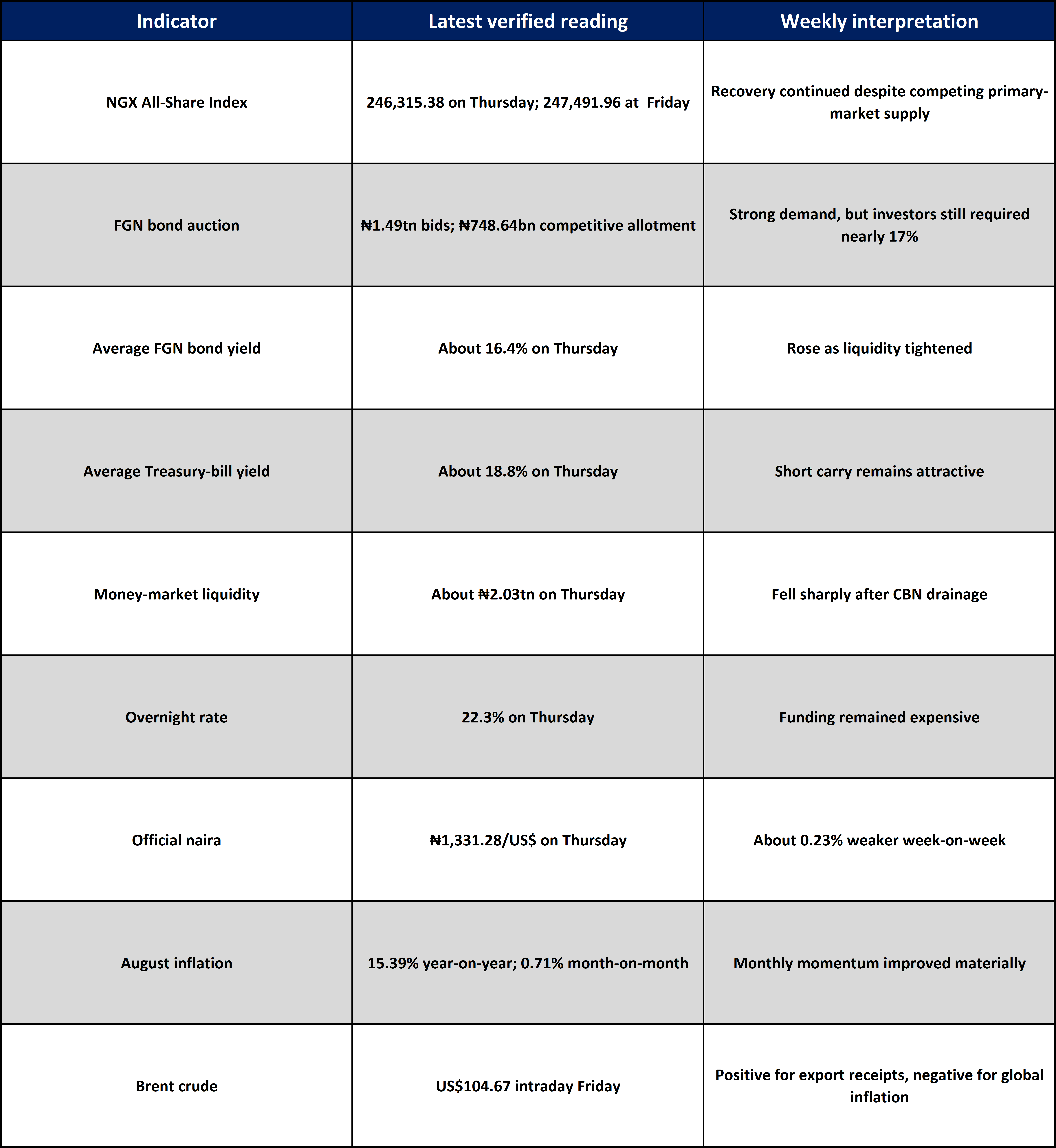
What happened: Headline inflation eased to 15.39% year-on-year in August from 15.43% in July. More importantly, monthly inflation slowed to 0.71% from 1.57%, while monthly food inflation fell to 1.02% from 5.56%. Annual food inflation remained elevated at 19.57%.
Why it mattered: The annual decline was small, but the monthly data suggest July’s price acceleration did not persist. That distinction matters for fixed income: another subdued monthly reading would make the disinflation trend more credible and strengthen the case for lower domestic yields.
It also matters for businesses. Slower monthly food and core price growth would reduce the pace of working-capital inflation, although it does not reverse the large increase in operating costs already accumulated.
What comes next: The CBN must decide whether this improvement is durable enough to justify a rate cut while oil prices, global yields and external financing conditions remain restrictive.
Strong bond demand lowered the government’s marginal borrowing rate
What happened: Investors submitted ₦1.49tn of competitive bids for the DMO’s ₦1tn September bond offer. Competitive allotment was ₦748.64bn. The new September 2036 bond cleared at 16.79%, while the reopened June 2038 bond cleared at 16.85%, 94 basis points below its August marginal rate.
Why it mattered: The result shows that institutional investors are willing to lock in longer-dated naira yields as inflation moderates. But the auction should not be read as evidence that money has become cheap: clearing rates remain close to 17%, and the DMO rejected a substantial share of bids rather than accept more expensive funding.
Secondary-market conditions also weakened later in the week as the CBN drained liquidity. By Thursday, average FGN bond yields had risen to about 16.4%, while average Treasury-bill and OMO yields were approximately 18.8% and 20.2%.
What to watch next: If the CBN cuts next week, the shape of the yield curve will matter more than the headline policy decision. A modest cut accompanied by continued OMO sterilisation may support selected bonds without producing broad monetary easing.
Nigerian equities absorbed the first week of the Dangote offer
What happened: The NGX All-Share Index gained 1.34% between the previous Friday and Thursday, closing Thursday at 246,315.38 after six consecutive positive sessions. At 14:30 WAT on Friday, it was another 0.48% higher at 247,491.96, putting the approximate week-to-date gain near 1.8%.
The advance coincided with the opening of the Dangote Petroleum Refinery offer: 4.1 billion shares at ₦525 each, representing a potential capital raise of approximately ₦2.15tn. The offer remains open until 13 October.
Why it mattered: The market did not immediately sell existing equities to fund the new issue. That is an encouraging early signal about domestic market capacity. It is not yet proof that the full offer can be absorbed without disruption, because no verified subscription total has been published.
The stronger test will come as investors actually fund applications and as allocations move closer. Turnover, market breadth and performance outside heavyweight stocks will show whether the rally reflects broad risk appetite or index concentration.
What comes next: Watch whether secondary-market liquidity weakens during the offer period and whether banks, pension funds and retail investors shift cash from listed equities or money-market instruments.
The naira remained stable, but the external rate gap widened
What happened: The naira closed Thursday at ₦1,331.28 per dollar in the official market, compared with ₦1,328.22 the previous Friday. That represents a modest weekly depreciation of about 0.23%. External reserves were reported near US$54.67bn as of 16 September.
Why it mattered: The naira’s limited movement despite a Fed hike and rising US yields suggests that Nigeria’s reserve position and domestic carry are still providing support. However, those same global developments increase the return international investors can earn in dollars. A large CBN rate cut could therefore reduce the relative attractiveness of naira assets unless it is supported by credible disinflation and continued FX supply.
What to watch next: The immediate signals will be FX turnover, the official-parallel spread and whether the naira holds its range after the CBN decision.
Global monetary tightening returned as an active portfolio risk
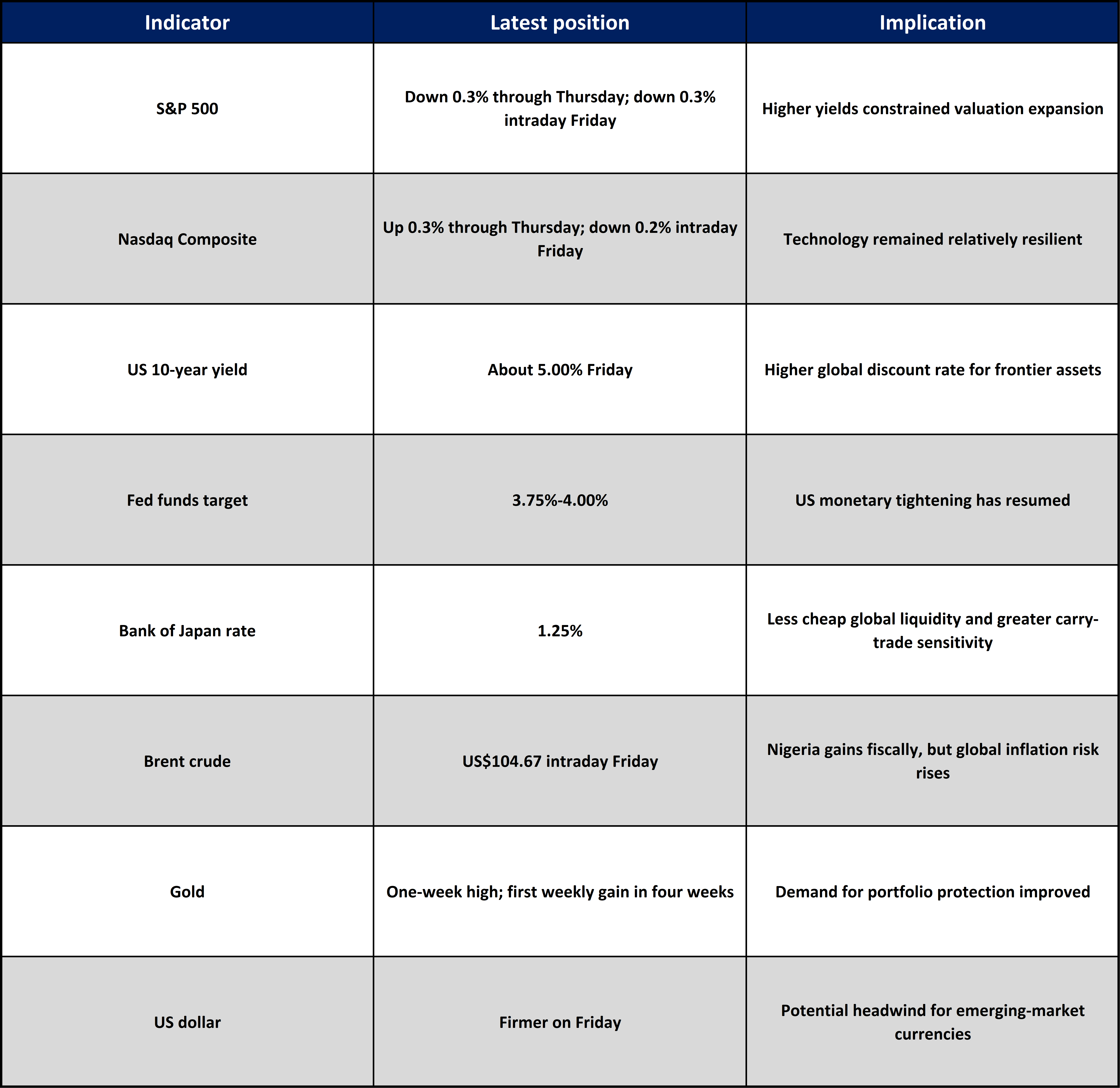
What happened: The Federal Reserve raised its target range by 25 basis points to 3.75%-4.00%. Its median projection placed the policy rate at 4.1% at the end of 2026, compared with 3.8% in June. The Bank of Japan then raised its policy rate to 1.25%, its highest level in 31 years. The Bank of England held at 3.75%, but three of nine policymakers voted for an increase.
The US 10-year Treasury yield returned to about 5% on Friday, while global equities struggled to establish a clear direction.
Why it mattered: A higher global risk-free rate raises the return hurdle for emerging and frontier-market assets. Nigerian bonds must offer enough yield to compensate for currency and liquidity risk, while Nigerian equities face a higher discount rate even if local earnings remain strong.
The tightening also reduces the likelihood that Nigeria can pursue a deep easing cycle without pressure on portfolio flows.
What to watch next: Investors should distinguish between a one-off global adjustment and a sustained hiking cycle. US inflation, energy prices and the Fed’s next guidance will determine which interpretation is correct.
Nigeria Market Scorecard
Global Market Scorecard
The Main Lesson From This Week
Nigeria has gained policy space, but it has not gained policy freedom.
Slower monthly inflation, lower bond-auction clearing rates and a stronger equity market all support a more constructive view of domestic assets. Yet the external environment means the CBN cannot assess inflation in isolation. A widening interest-rate advantage for dollar assets could weaken portfolio inflows, while oil above US$100 creates both export revenue and imported inflation.
That makes a modest, carefully communicated policy adjustment more plausible than an aggressive easing cycle. Investors should also avoid treating any CBN cut as an automatic signal to extend duration or buy equities broadly. The transmission mechanism will depend on whether the CBN continues to drain liquidity through OMO issuance and whether the naira remains stable.
Ranora View:
The most attractive position remains a barbell: retain short-duration naira carry while adding longer bonds gradually where yields adequately compensate for inflation and global-rate risk.
In equities, the week’s rally is encouraging, particularly because it occurred alongside a large public offer. However, the approximately 17% sovereign yield remains a demanding benchmark. Equity exposure should remain concentrated in liquid companies with pricing power, strong cash conversion, manageable refinancing requirements and earnings growth capable of clearing that hurdle.
A modest CBN cut would support sentiment, but the more important signals will be the naira’s response, subsequent OMO activity and the shape of the yield curve. Those will reveal whether policy has genuinely eased or merely changed at the headline level.
What to Expect Next Week:
The CBN policy decision: The size of any move will matter less than the guidance on inflation, FX stability and liquidity management.
Post-MPC yield-curve reaction: Watch whether long bond yields fall sustainably or whether investors resist extending duration.
Naira and FX turnover: Stability after the Fed and CBN decisions would strengthen the domestic disinflation case.
Dangote Refinery offer absorption: Look for verified subscription information, not informal indications of demand.
Oil and the US 10-year yield: Brent above US$100 and Treasury yields near 5% remain the main external constraints on Nigerian easing.
Question of the day:
Should the CBN use the improvement in monthly inflation to cut rates next week, or preserve naira carry until global yields and oil prices become less restrictive?
Stay smart. Stay informed. Subscribe to Ranora Market Outlook for free and support independent market analysis.