


Opening View:
This week brought a Nigerian oil-finance agreement whose importance extends beyond funding new production. NNPC and the CBN formalised a framework covering export receipts, domestic payments, contractor settlements and financing. The distinction matters: an oil sale, a financing agreement and cash available to meet an obligation are different things.
For suppliers, a shorter wait for payment could reduce borrowing needs before any new production arrives. For businesses buying dollars, more predictable export receipts could improve planning. Neither benefit has yet been demonstrated by the announcement, which does not quantify additional dollar inflows.
Markets supplied the wider context. Nigerian shares finished the week lower, while falling annual inflation coexisted with faster monthly price increases. Globally, Anthropic’s well-received debut did not prevent a broad US equity decline, and the Federal Reserve’s minutes left further tightening on the table.
Ranora’s reading is that confidence now needs operational evidence. Payment reliability, actual funding terms and the ability to finance growth matter more than the announcement of a framework. For investors and executives, the relevant question is how much uncertainty disappears between earning revenue and having cash available to use.
The Big Picture:
Signed Wednesday and announced Thursday, the pact formalises an existing relationship. Its near-term test is operational: payment targets and settlement performance would help suppliers price working capital and lenders judge repayment risk.
Future asset-backed borrowing needs a separate assessment. Repayment obligations could constrain revenue available for operations and remittances. Better liquidity today does not necessarily mean greater financial flexibility tomorrow.
Working groups and timelines are therefore starting points, not outcomes. The announcement does not disclose numerical targets or realised cash benefits sufficient to revise those risk assumptions. The main lesson is to separate access to finance from access to usable cash.
Nigeria Market Intelligence:
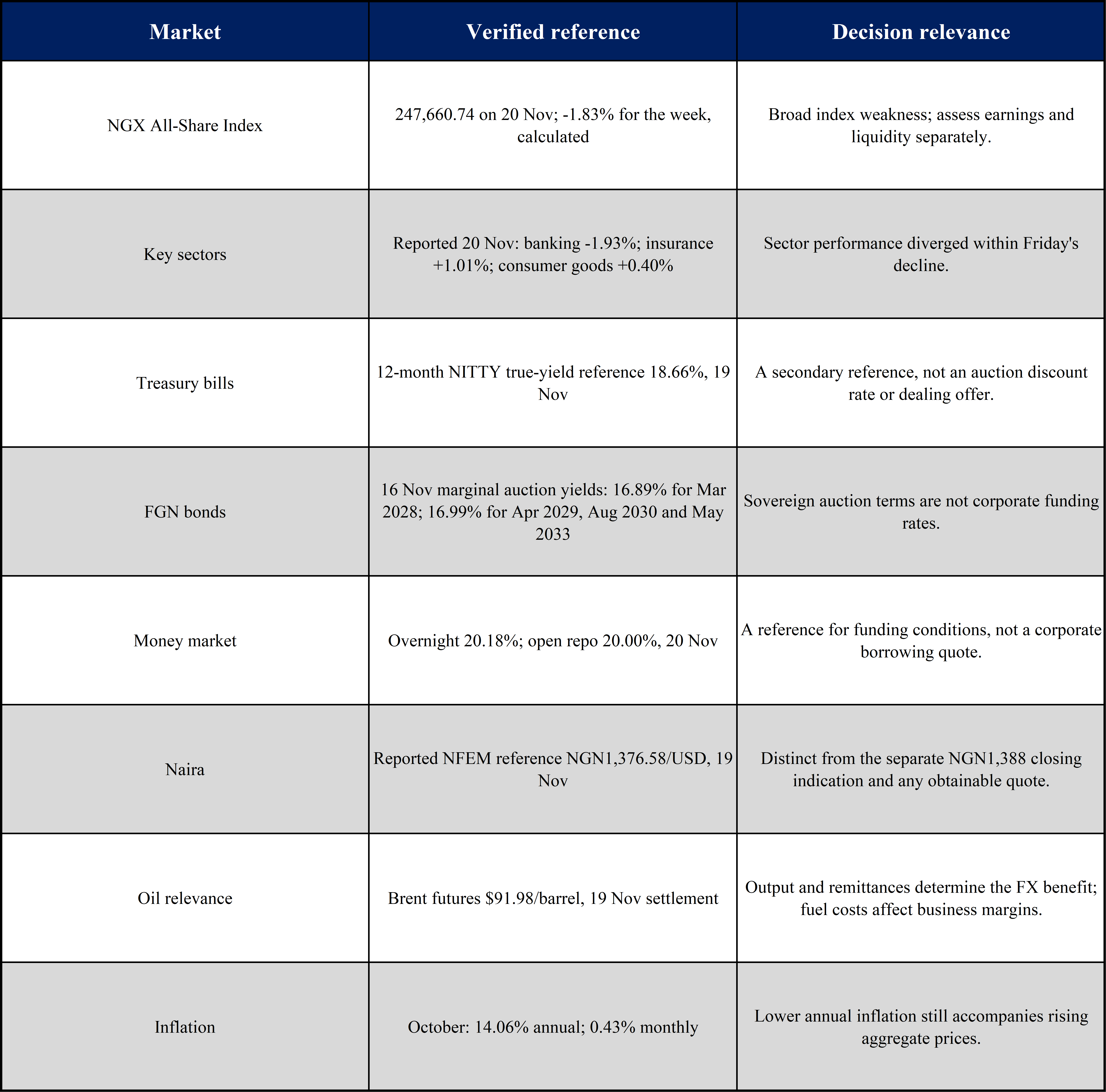
Disinflation has not become a general price decline. October headline inflation eased to 14.06% year on year from 14.63%, but monthly inflation increased to 0.43% from 0.06%. Businesses should distinguish slower annual inflation from lower replacement costs. For consumer companies, improving margins still depend on procurement, financing and sales volumes, not the annual headline alone. Next week’s MPC will test how the CBN balances this disinflation against currency and funding conditions.
Bond demand remained selective. At Monday's auction, the May 2033 line received 47.8% of competitive allotments despite representing 15% of the amount offered, by our calculation. This completes the story tracked earlier in the week: investors reshaped the government's planned maturity mix. It does not establish cheaper credit for businesses. The next test is whether secondary pricing and actual borrower terms reflect the same demand.
Equities gave back ground as FX pressure persisted. The NGX All-Share Index closed at 247,660.74, down a calculated 1.83% from the previous Friday. Reported Friday sector moves were uneven: banking fell while insurance and consumer goods rose. The naira also weakened at the reported official-market reference through Thursday. For import-dependent companies, currency costs can offset part of the benefit from domestic disinflation. Index weakness alone does not establish foreign capital flight or an earnings downgrade across all sectors.
Nigeria Market Scorecard:
Dates and measures differ across rows; Friday sector moves are not weekly returns.
Global Market Intelligence:
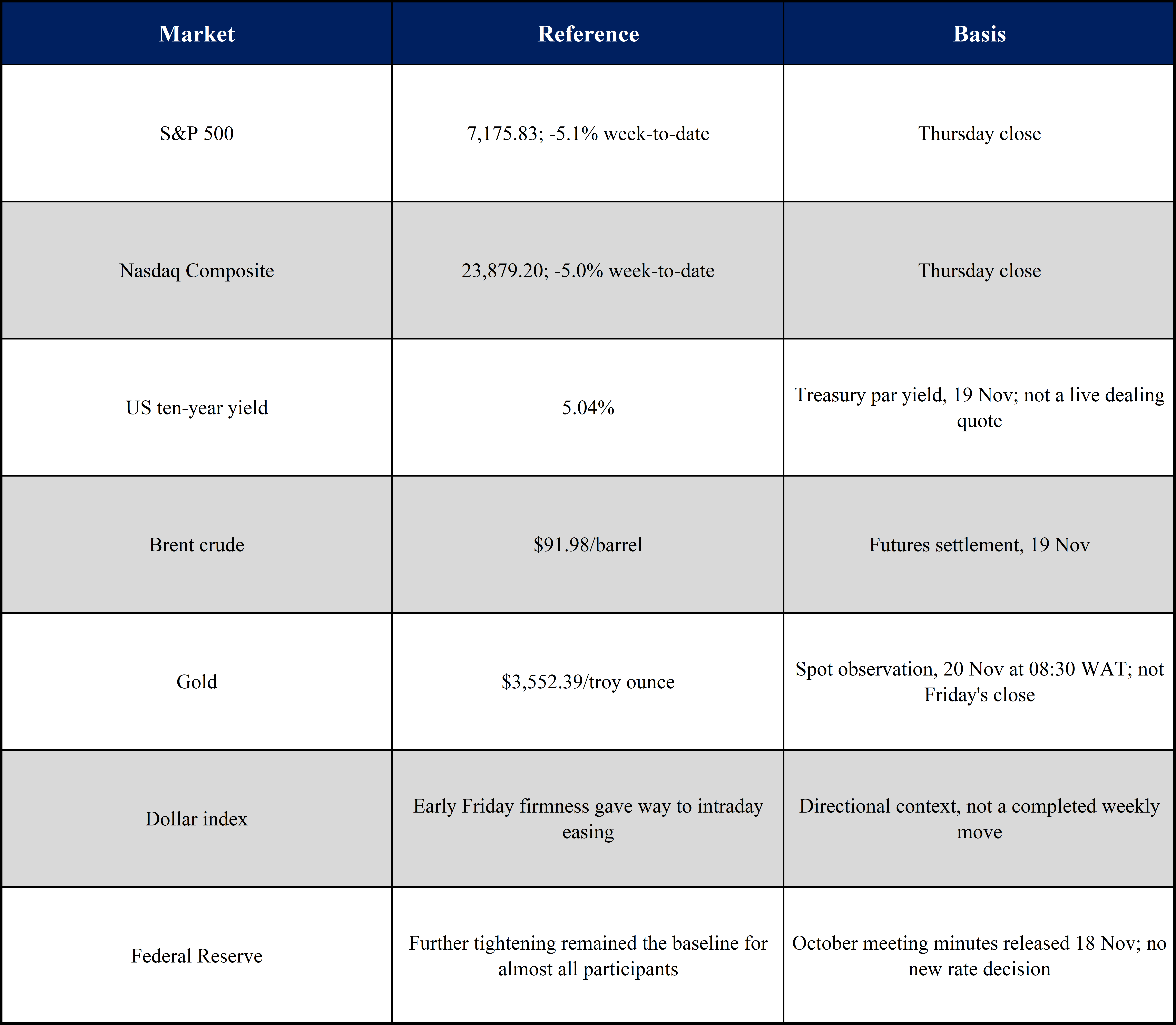
A successful listing did not repair broad risk appetite. Through Thursday, the S&P 500 was down 5.1% for the week and the Nasdaq Composite 5.0%. Anthropic’s positive debut coincided with widespread losses elsewhere. Our inference: funding one prominent issuer says little about general access to capital. For Nigerian founders, dilution and the time remaining before more funding is needed still depend on their own financing options. Watch whether equity participation improves beyond a few heavily traded names.
Treasury relief is not necessarily cheaper emerging-market finance. Wednesday's Fed minutes showed almost all participants considered further rate increases likely appropriate under their baseline outlooks. Yet the US ten-year par yield fell from the previous Friday through Thursday, with market yields falling further intraday on Friday. Government-bond buying during an equity selloff does not remove inflation risk. Nigerian dollar borrowers can face higher credit premiums even when Treasury yields fall. The test is the all-in funding cost, not the benchmark alone.
Oil and gold delivered different warnings. Brent futures settled at $91.98 a barrel on Thursday; spot gold weakened on Friday morning. Oil affects both Nigerian export receipts and business energy costs, with the net effect depending on production, remittances and domestic pass-through. Gold’s weakness illustrates that a diversifying asset can lose value when cash is needed. Watch delivered fuel prices and funding conditions rather than assume either commodity provides automatic protection.
Global Market Scorecard:
US equities are week-to-date through 19 November, not final Friday returns. Commodity and currency observations retain their own reference times.
Asset Class Implications
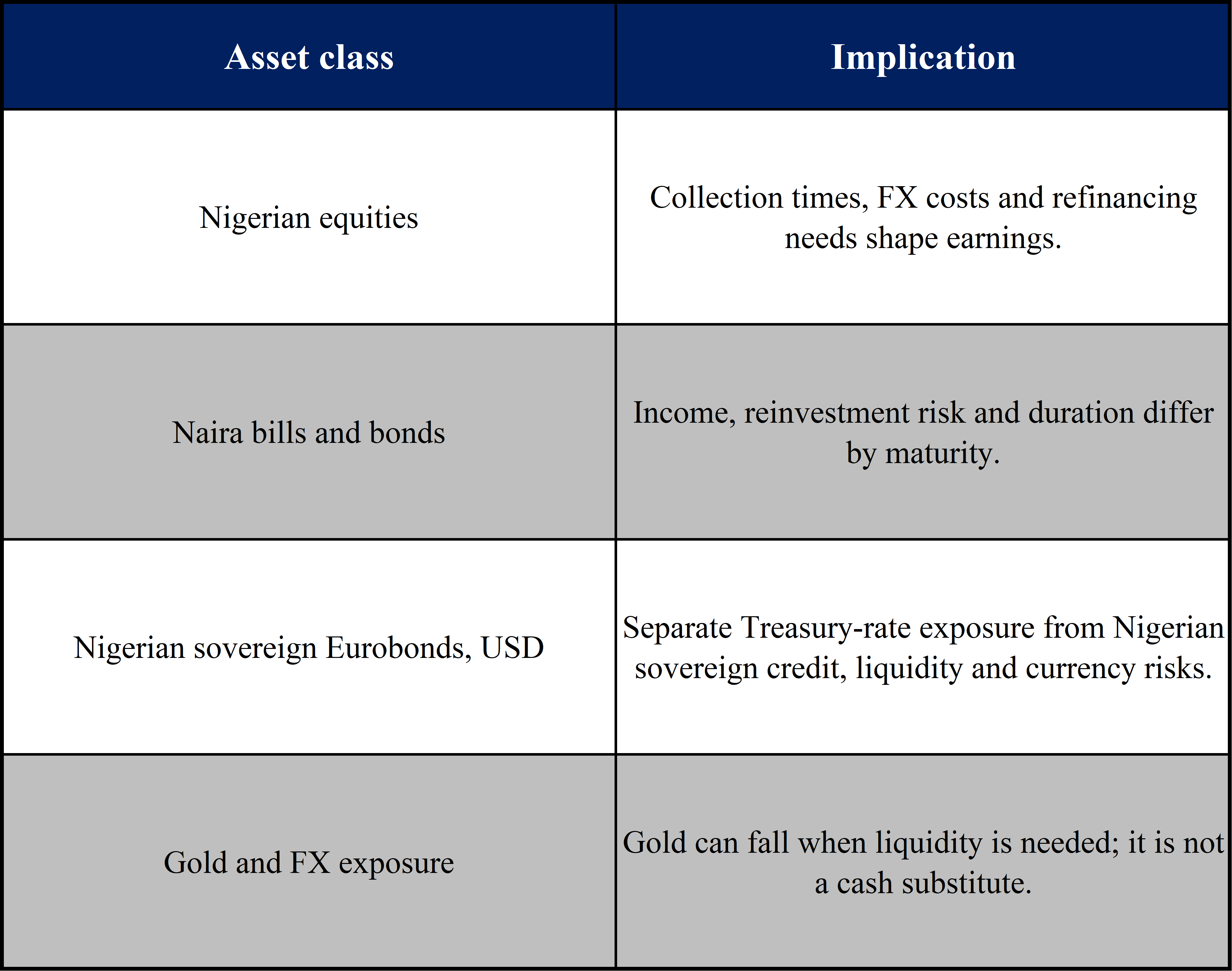
Portfolio transmission, not instrument recommendations.
Investment Ideas Review:
Monday introduced no qualifying opportunity or new thesis ID. That baseline is unchanged; earlier candidates have not been reactivated. Executable prices and complete net dealing economics remain unverified. Policy announcements and lower market prices do not close those gaps. No purchase or realised return is implied.
Ranora View:
Better payment execution could improve business conditions before new production arrives. But the NNPC-CBN announcement does not establish stronger supplier cash flows, additional FX supply or lower funding costs.
Confidence should rise when settlement performance and usable receipts improve. Until then, business plans still need realistic collection and refinancing assumptions. Investors should distinguish operational progress from financing announcements. Globally, a lower Treasury yield or successful IPO is likewise not proof of easier funding. Evaluate the cash consequences before changing the risk assessment.
What to Watch Next:
CBN MPC, 23-24 November: the balance between disinflation, FX conditions and funding costs, including measures beyond the policy rate.
NNPC-CBN implementation: payment targets, settlement evidence and financing terms.
Domestic markets: equity participation, secondary bond pricing and the naira after the MPC.
Global funding: whether wider credit spreads offset Treasury-yield relief for Nigerian dollar borrowers.
Question of the day:
For your business or portfolio, which would change decisions more: lower financing rates or greater certainty about when cash will arrive?
Stay smart. Stay informed. Subscribe to Ranora Market Outlook for free and support independent market analysis.