


Opening View:
Nigeria’s new stablecoin rules make the financing of digital payments part of this week’s investment story. Stablecoins are digital tokens designed to track a reference currency. Under the CBN framework, winning customers and handling more transactions must sit alongside local licensing, funded capital and protected customer backing. For investors in payment companies, the question becomes how much profit remains after financing the regulated business.
The wider market offered little room for complacency. The NGX All-Share Index fell 2.13% over the week, with industrial, banking and energy shares among the weaker sectors. In the United States, Friday’s technology rebound still left equities lower for the week. October’s addition of 165,000 payroll jobs also challenged the idea that an equity selloff would necessarily bring easier monetary policy.
Our reading is that expansion plans face separate demand and financing tests. A business can attract customers while its cost of serving them rises, or improve operations while investors reduce the price they will pay for future earnings. For Nigerian founders and executives, that distinction affects fundraising terms and the cash needed to sustain growth. For portfolios, it makes the economics behind an expansion more important than the expansion headline.
The Big Picture:
The main lesson is that regulatory access has a financing cost. The CBN requires capital to remain separate from customer reserves and operating liquidity. It also requires issuers to maintain their own liquid resources for operating or wind-down needs. Customer backing therefore cannot simply finance the company’s expansion budget.
That changes the investment calculation. A larger customer base may spread compliance costs across more transactions, but growth is valuable only if net earnings justify the capital committed. Sponsors must distinguish money available to run the business from money supporting regulated obligations.
Our inference is that well-funded operators may find compliance easier to sustain, while smaller businesses may seek partnerships. That is a possibility, not evidence that consolidation has begun. For corporate users, the immediate issue is continuity: which provider can maintain authorised access and reliable redemption without disrupting supplier payments? Neither a familiar token brand nor a new rulebook answers that question on its own..
Nigeria Market Intelligence:
Stablecoin access now carries explicit funding requirements. Minimum paid-up capital is NGN10 billion for naira-referenced issuers and NGN15 billion for foreign-currency-referenced issuers. Full reserve backing carries an additional minimum 2% buffer. Offshore sponsorship does not remove Nigerian incorporation and licensing requirements.
Existing operators have a conditional 180-day application window. Continued operations are restricted to existing scale and subject to registration, reporting and other interim requirements. The next commercial test is funded applications and workable service terms, not announcements of interest. These stablecoins must not be represented as NDIC-insured bank deposits.
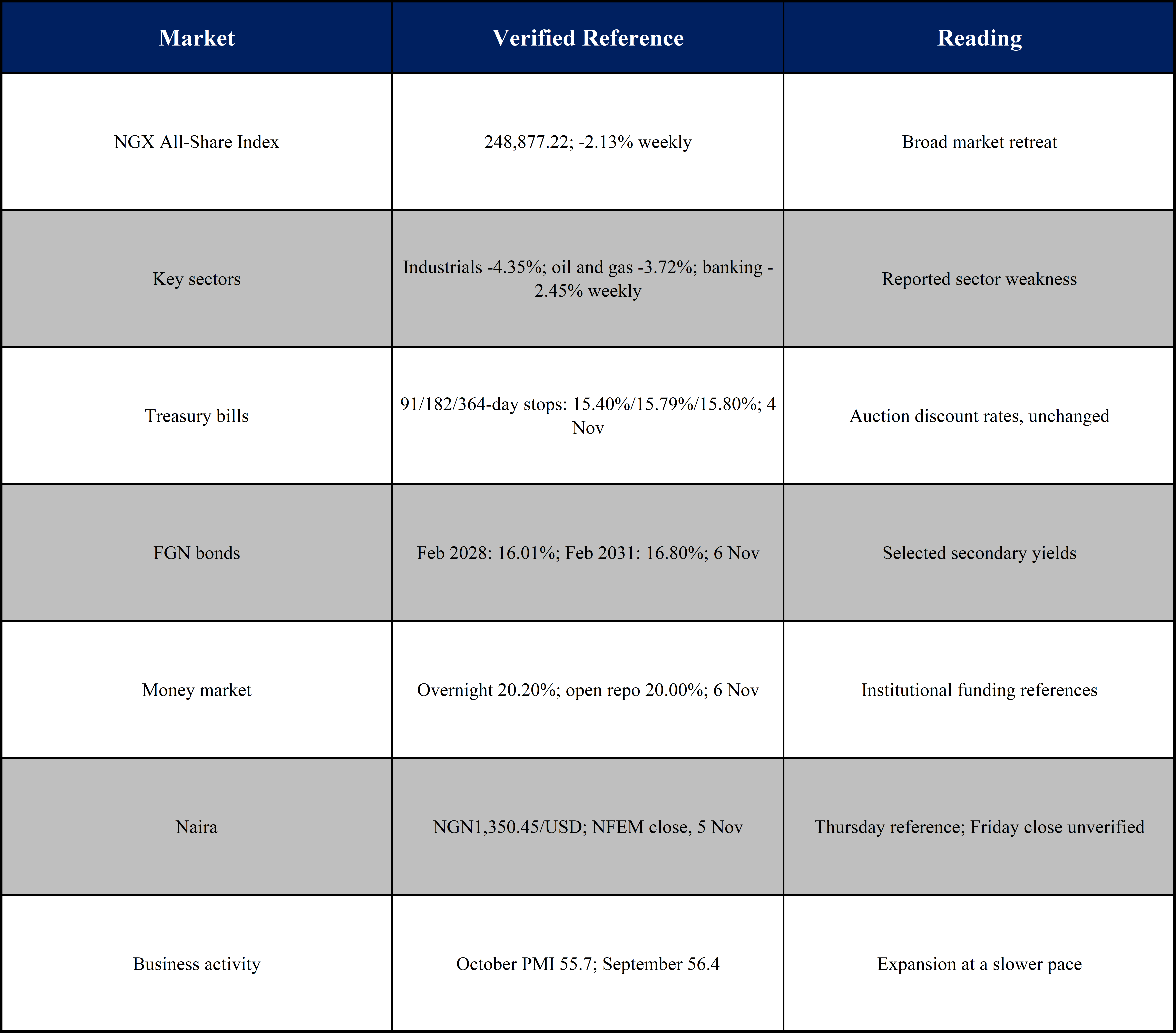
The equity retreat raises the cost of relying on market optimism. The ASI finished at 248,877.22. Reported weekly breadth was negative, with 57 decliners against 30 gainers. This was broader weakness than a disappointing move in one heavyweight.
For companies considering an equity raise, a lower valuation can mean more dilution for the same funding. For shareholders, the next useful evidence is whether selling is accompanied by weaker operating results or remains a repricing of expectations. The week’s decline alone does not distinguish those explanations.
Business expansion has not removed the funding hurdle. The October Stanbic IBTC PMI, released this week, was 55.7, down from 56.4 but still signalling expansion. Wednesday’s Treasury-bill auction left discount stop rates unchanged; Friday’s overnight money-market reference was 20.20%.
These are different markets, but the business implication is straightforward: more orders do not guarantee attractive profits when inventory and receivables need financing. Strong demand for government paper is not proof that a company can refinance cheaply. The next test is actual loan terms and the margin earned on incremental sales.
Nigeria Market Scorecard:
Equity changes cover the week ended 6 November. Other observations carry their own dates and are market references, not executable offers..
Global Market Intelligence:
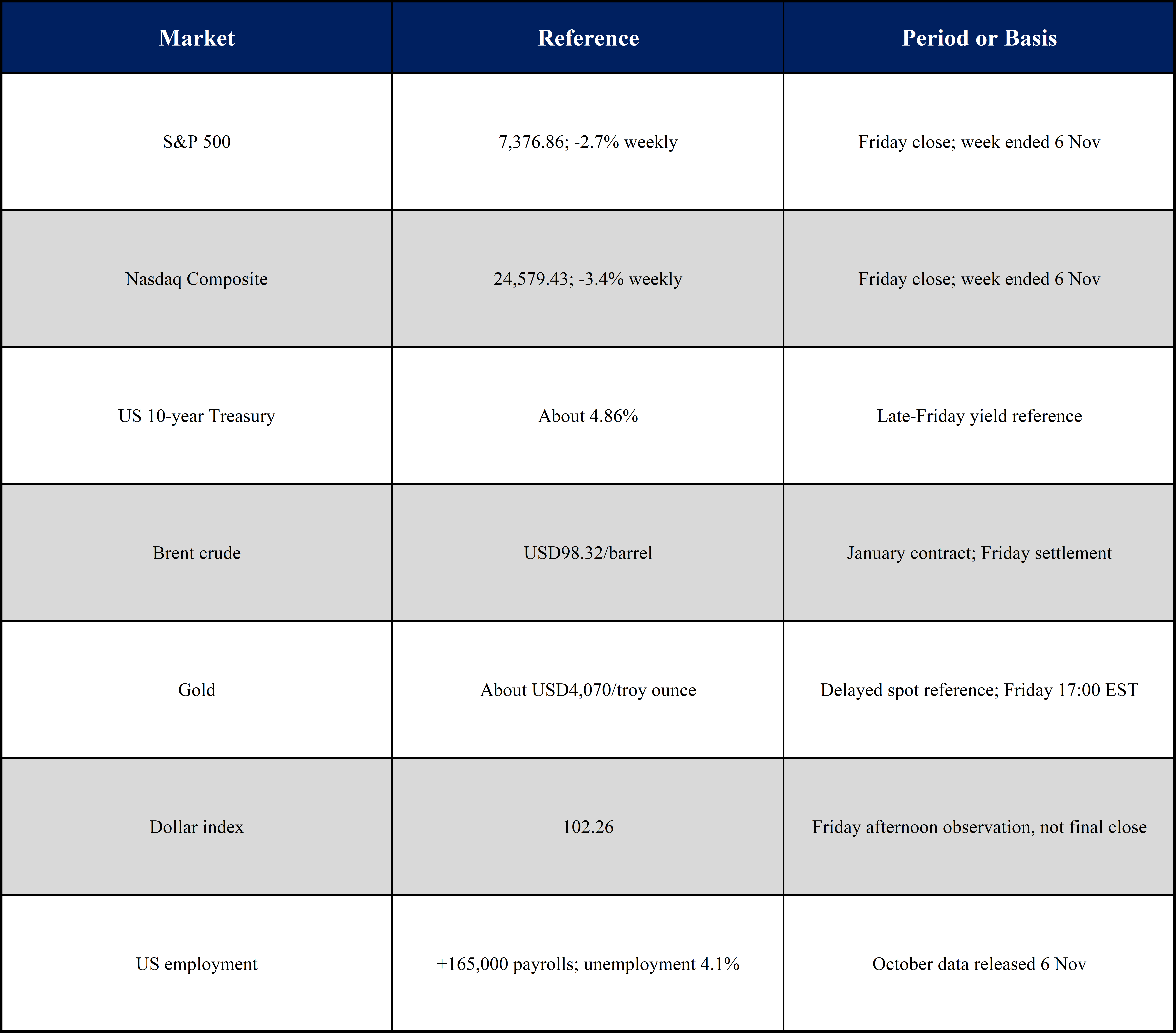
The AI trade acquired a policy complication. The US election result intensified concerns about tighter rules for data-centre development. Friday’s recovery did not erase weekly losses of 2.7% in the S&P 500 and 3.4% in the Nasdaq Composite.
The valuation issue is the timing of returns on expensive infrastructure. Delays can push revenue further out while financing costs continue. Nigerian technology and infrastructure ventures could encounter tougher funding scrutiny, although this week’s US selling does not establish Nigerian capital outflows. Watch actual legislative proposals and project decisions, rather than treating political intentions as enacted restrictions.
Strong employment complicates hopes for cheaper dollars. US payrolls rose by 165,000 in October, unemployment was 4.1%, and average hourly earnings increased 0.4% month on month. The dollar strengthened and Treasury yields rose after the release.
For Nigerian borrowers, improved country sentiment can still coexist with expensive dollar funding. Sovereign Eurobond prices reflect both Nigeria’s credit compensation and US interest rates; a move in one does not prove improvement in the other. Next week’s US inflation releases will test how much policy flexibility the jobs data leave.
Lower oil has different Nigerian beneficiaries. January-delivery Brent settled at USD98.32 a barrel on Friday after a sharp weekly retreat. Prospects for de-escalation in the Iran conflict influenced pricing.
Sustained lower prices would reduce support for oil-export receipts and upstream revenues. Energy-intensive businesses could benefit, but only as product prices, freight, contracts and FX transmit the decline into delivered costs. This is not an immediate, economy-wide cash-flow windfall. Watch actual fuel invoices and export volumes alongside Brent.
Global Market Scorecard:
Closing equity levels and oil settlement are shown alongside explicitly labelled currency, yield and spot references. They are not a synchronised trading basket.
Asset Class Implications
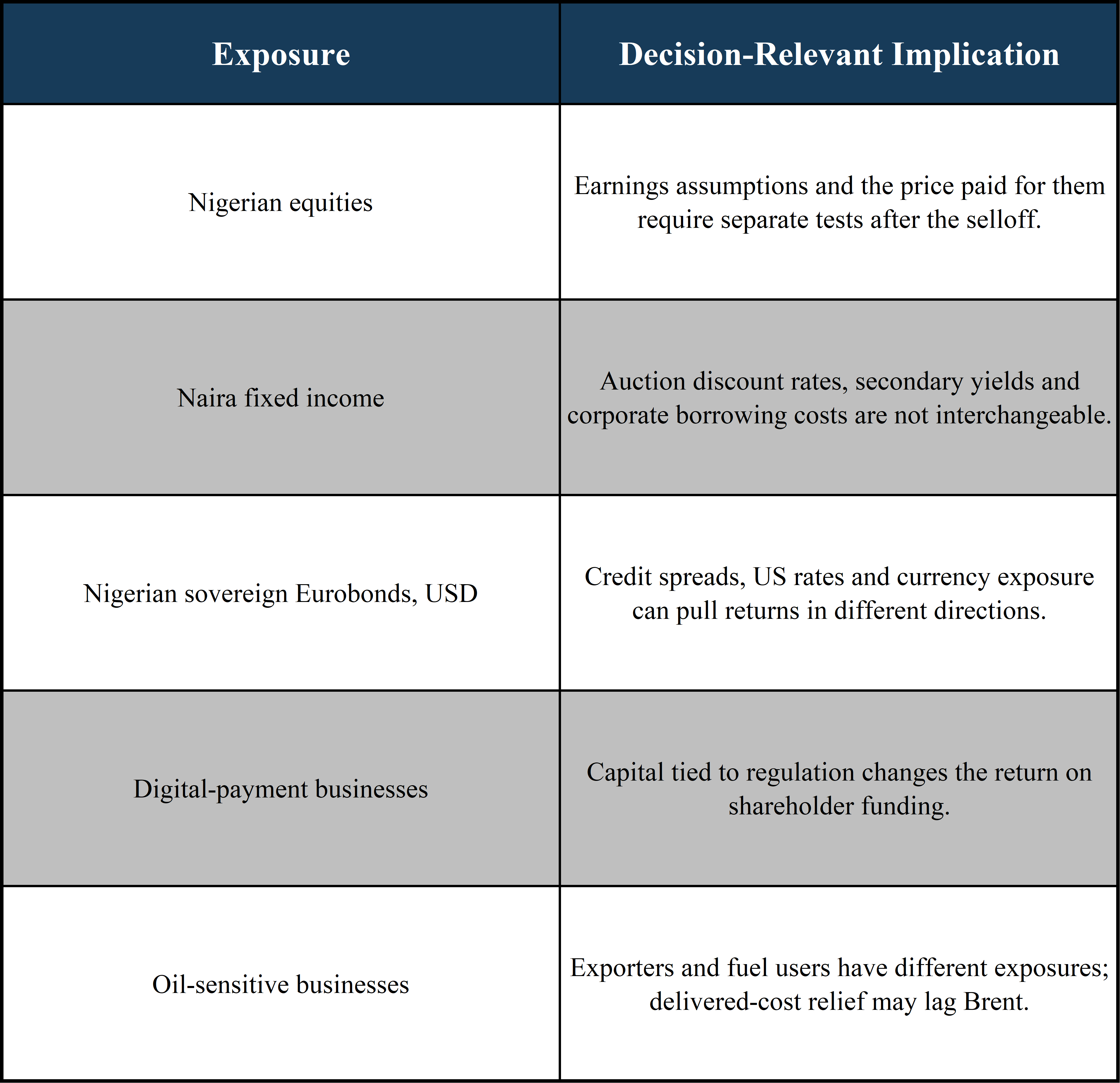
These are consequences for assessing risk and value, not trade instructions.
Investment Ideas Review:
MTN Nigeria Communications Plc ordinary shares | NGX MTNN | NGN
Thesis ID: NG-EQ-MTNN-NETWORK-20261102 | Status: Pending
This reconciles the sole idea introduced in Monday’s retained baseline. Entry remains deferred. Management’s 2 November call qualified the fibre thesis: offloading mobile traffic needs greater scale before the benefit becomes material, while radio and backhaul continue to absorb substantial capital spending. That timing qualification, noted on Wednesday, still matters.
Friday’s reported NGN837 closing price is an end-of-day reference, not an executable offer. A lower price does not resolve the unverified fibre payback or establish undervaluation. We still need a defensible valuation against normalised earnings, connection economics and obtainable pricing after fees, applicable taxes and spreads. New-buyer dividend eligibility and executable depth also require confirmation.
The prospective horizon remains 12-24 months after a qualifying entry. A quantified return case could strengthen the thesis; slower adoption, heavier investment needs or adverse energy and FX costs could weaken it. No purchase or realised return is implied, and no new idea replaces this identifier.
Ranora View:
The CBN framework makes funding capacity part of competitive positioning in digital payments. Our house view is that transaction growth deserves less weight in isolation: investors need to understand the earnings available after compliance costs and the capital required to sustain the service. Implementation costs could favour scale, but neither consolidation nor listed-bank earnings gains can yet be priced as established outcomes.
Across the wider market, the same funding discipline matters for different reasons. Nigeria’s equity decline does not by itself overturn the business-expansion signal. Strong US employment does not guarantee equity gains or cheaper dollar finance. The useful distinction is between an opportunity to grow and the cash, financing terms and shareholder returns that make growth worthwhile.
What to Watch Next:
US inflation: October CPI is scheduled for Tuesday 10 November and PPI for Friday 13 November, both at 14:30 WAT. The question is whether price pressure reinforces the restrictive-policy case.
Stablecoin implementation: Watch funded applications, interim permissions and provider notices. An application is not a licence, and a transition window is not unrestricted permission to expand.
Nigerian market participation: Look for broader equity buying alongside actual funding and FX terms. A benchmark rebound alone would not establish easier access to capital.
Oil transmission: Track shipping developments, export volumes and delivered fuel costs to identify which Nigerian cash flows actually change.
Question of the day:
When assessing a Nigerian growth business today, which deserves more weight in its valuation: customer demand or the capital required to serve it reliably?
Stay smart. Stay informed. Subscribe to Ranora Market Outlook for free and support independent market analysis.