


Opening View:
Friday’s most useful Nigerian earnings signal was the gap between financial relief and operating recovery. Transcorp Power reported improved collections and partial settlement of legacy market debts, yet revenue for the nine months to September fell 13.7%. Its pre-tax margin improved while absolute pre-tax profit declined. Repairing old receivables can ease financing pressure without restoring the electricity a generator can sell.
Guinness offered a more constructive company-specific signal through growing operating earnings and another dividend. But Thursday’s OMO auction supplied a counterweight: accepted rates were higher than at the previous auction on near-comparable, not identical, tenors.
Globally, AI-related selling accompanied a Treasury rally. Lower benchmark yields therefore did not amount to an uncomplicated return of risk appetite. Our conclusion: value cash recovery, recurring earnings and refinancing exposure separately. A healthier financial position is worth something; it does not justify paying today for an operating rebound that remains unproven.
The Big Picture:
Our earlier power-sector coverage asked whether settlement announcements would reach companies. The new disclosure makes the investment test more specific: even where collections improve, gas supply and transmission constraints can restrict revenue. The next valuation hurdle is reliable output and payment for current deliveries, not simply recognition of old debts. This is evidence from one issuer, not a verdict on the whole sector.
Nigeria Market Intelligence:
Power: distinguish cash from accounting relief. Transcorp Power’s nine-month revenue was N266.1bn and pre-tax profit N83.1bn. Its cash note shows N10.31bn before an overdraft, but N7.14bn after it. A credit-loss provision reversal is not a cash receipt. Investors should watch dispatch, gas availability and current-invoice collections before lifting recurring earnings assumptions.
Guinness: stronger operations, with a financing tailwind. Nine-month operating profit increased 23.4%, against 53.1% growth in profit after tax to N40.69bn; finance expenses fell to N5.83bn from N15.30bn. Investors should not extrapolate bottom-line growth indefinitely: part of the improvement comes from a smaller financing burden. Watch operating margins and dividend funding. The additional N7 dividend has a 30 October qualification date and 13 November payment date, subject to the announcement’s conditions and applicable withholding tax.
Rates: the auction matters more than an easing narrative. Monday’s FGN bond auction cleared the February 2034 bond at 16.99% and September 2036 at 17.29%. Thursday’s OMO stop rates were reported at 17.63% for 138 days and 17.14% for 180 days. These are different instruments and rate conventions, not directly comparable net returns. Cash managers should compare annualised net economics and access, not assume a straight-line fall in yields. Watch the next bill auction and secondary pricing.
Global Market Intelligence:
AI is facing a financing test. Thursday’s Nasdaq Composite decline of 2.60% made the cost and timing of AI investment harder to ignore. Revenue growth alone does not resolve funding needs or returns on capital. Next week’s Alphabet, Microsoft and Amazon reports should be assessed for cash generation, spending commitments and financing requirements.
A Treasury rally is not a Nigerian credit upgrade. US benchmark yields fell during the technology selloff. Nigerian Eurobonds combine US interest-rate exposure with sovereign credit and liquidity risk; a lower Treasury yield can be offset by a wider credit spread. We have not verified a matched Nigerian spread move and do not claim one occurred. Watch credit compensation alongside the Fed, rather than treating lower US yields as a buy signal.
Oil helps receipts only if barrels are delivered. Brent futures were quoted at $114.86 a barrel in Friday’s US pre-market report. Higher prices can improve Nigerian export receipts, conditional on production and sales, while increasing fuel and freight burdens for businesses. Producers and energy-intensive consumers should not be treated as one trade. Watch delivered energy costs and operating margins, not just crude headlines.
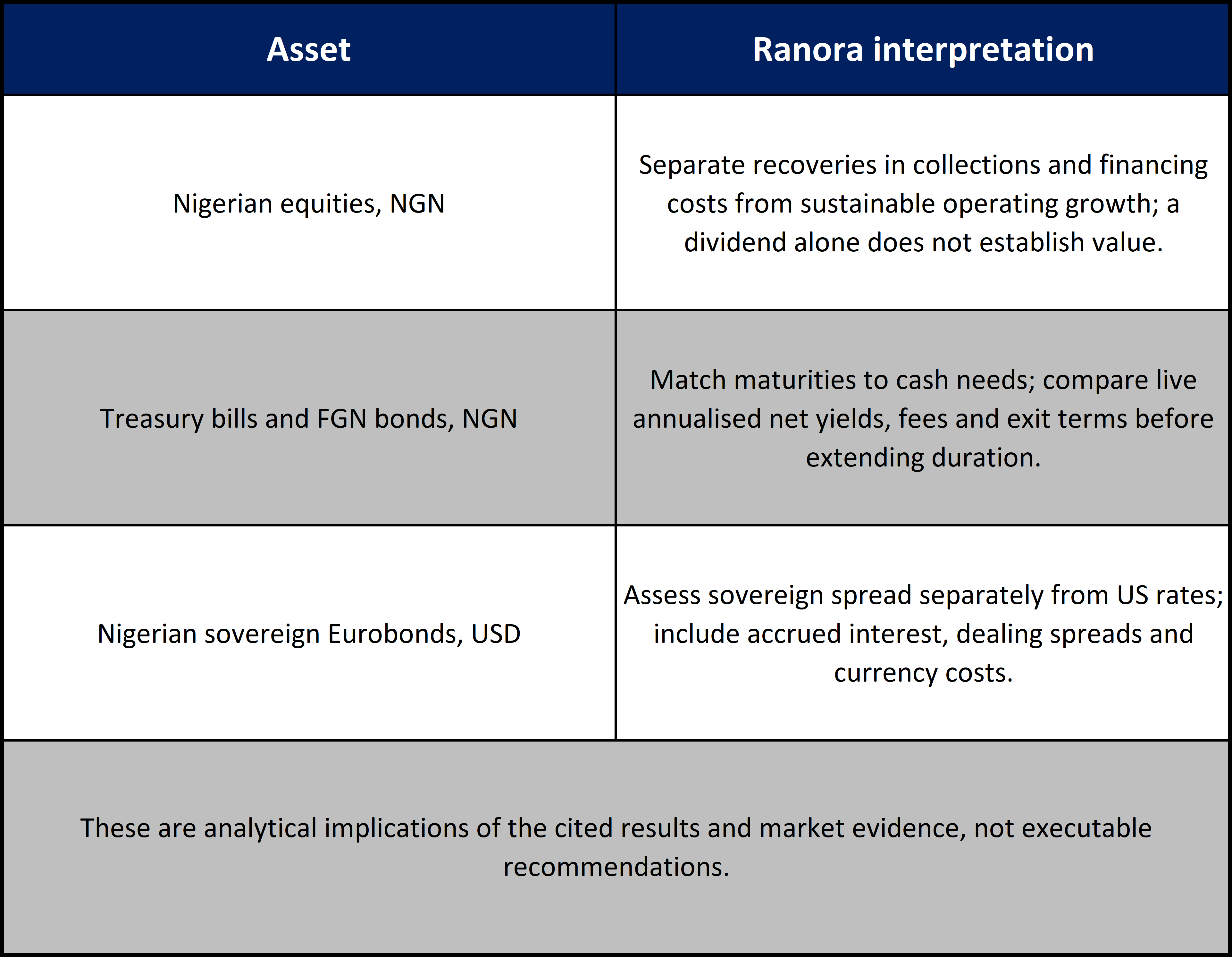
Asset Class Implications
Investment Ideas Review:
NG-EQ-TRANSCOHOT-CASH-20261019 | Transcorp Hotels ordinary shares, NGN | Pending. Entry remains deferred. Better collections at Transcorp Power do not establish repayment of amounts owed to Hotels. Require issuer-specific collections, valuation, corporate-action and trading-depth checks.
NG-FGN-2034-INCOME-20261019 | 19.00% FGN FEB 2034, NGN | Pending. The auction catalyst is complete at a 16.99% marginal rate, but entry still requires an executable net yield and comparison with shorter maturities. The 19% coupon is not the current yield.
Ranora View:
We would not pay an operating-recovery premium simply because legacy receivables are being settled. For power equities, require evidence that cash relief supports reliable deliveries and current collections. For consumer companies, test whether operating earnings sustain the improvement after financing benefits normalise. Keep naira income decisions tied to net entry terms and liability dates, and treat Nigerian dollar credit as a separate underwriting decision from US duration. The view becomes more constructive with sustained output, collections and cash generation; it weakens if operating constraints or refinancing costs absorb the relief. This is Ranora’s interpretation of the evidence above, not a new trade recommendation.
What to Watch Next:
Treasury bills, 28 October: the scheduled auction will test accepted rates after Thursday’s OMO pricing. Subject to the final circular.
Fed, 27–28 October: the policy message may reinforce or challenge the bond-market repricing.
AI earnings: watch whether cash generation and financing plans justify spending commitments at Alphabet, Microsoft and Amazon. Reuters, 23 October.
Guinness, 30 October: dividend qualification, with settlement eligibility and tax checked before any income-driven entry. Issuer notice, 21 October.
Question of the day:
Which deserves the larger valuation premium today: a company recovering old cash, or one demonstrating repeatable growth in cash from current operations?
Stay smart. Stay informed. Subscribe to Ranora Market Outlook for free and support independent market analysis.